
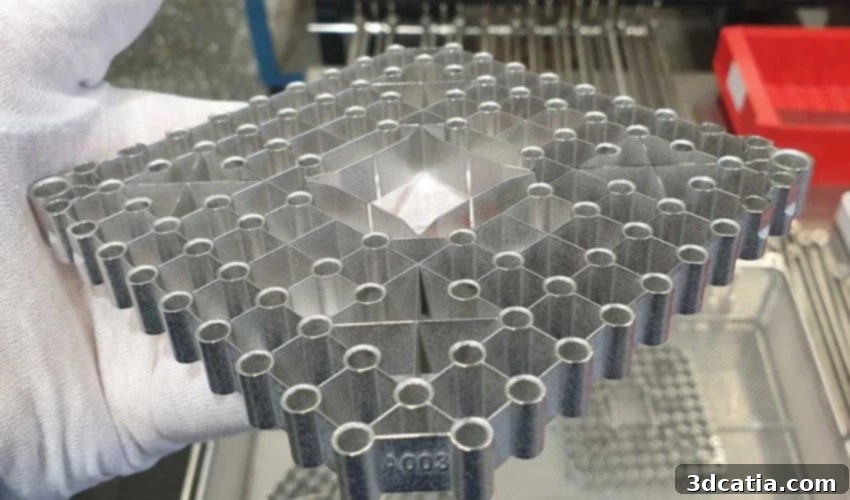
Revolutionizing Nuclear Power: Framatome Installs First 3D Printed Stainless Steel Fuel Component
In a landmark achievement for both the nuclear energy sector and additive manufacturing, Framatome, a leading French multinational nuclear company, has announced the successful installation of its first 3D printed stainless steel fuel component. This significant milestone marks a new era for advanced manufacturing within the highly regulated nuclear industry. Founded in 1958, Framatome began exploring the potential of 3D technologies in 2015, gradually integrating these innovative processes into its operational framework. The newly developed components, specifically upper tie plate grids, were meticulously designed and manufactured for a nuclear power plant in Sweden, operated by the renowned Swedish energy company Vattenfall. Their successful installation is part of an extensive, multi-year irradiation program, designed to rigorously test the performance and durability of these additive manufactured parts under real-world operating conditions within a nuclear reactor core.
The integration of additive manufacturing, commonly known as 3D printing, into critical industrial applications continues to expand rapidly. Just last week, we highlighted the transformative possibilities offered by additive manufacturing in the oil & gas industry. In that sector, these technologies are already proving invaluable for producing parts with complex geometries, which significantly improve the performance and efficiency of market solutions. Additive manufacturing offers a more cost-effective and efficient production method, enabling components to be created in a single, streamlined process. This eliminates the need for numerous time-consuming and expensive assembly steps that are typical of traditional manufacturing. Crucially, additive manufacturing also enhances the safety of production processes and safeguards personnel operating on-site – a paramount concern in industries dealing with hazardous materials or extreme conditions. These advanced technologies have been steadily gaining traction in the nuclear industry as well, particularly for safety-critical parts in power plants, where precision, material integrity, and reliability are non-negotiable. Demonstrating its ongoing commitment to innovation in this field, Framatome was previously involved in another pioneering project last year, collaborating with Oak Ridge National Laboratory. Together, they developed a 3D printed stainless steel fuel assembly channel fastener, which was successfully placed in a U.S. commercial Boiling Water Reactor (BWR) nuclear power plant, further solidifying the viability of additive manufacturing for nuclear applications.
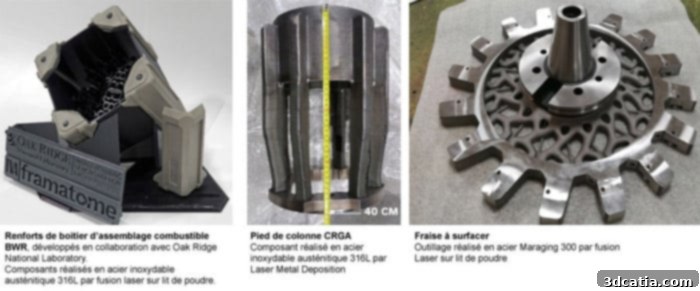
Different 3D printed parts from Framatome (photo credits: Framatome)
This latest announcement from Framatome represents yet another groundbreaking “first” for the company and the global nuclear industry, showcasing its successful installation of a 3D printed stainless steel part in a working Swedish nuclear power plant. The specific component, the upper tie plate grid, serves a vital non-structural weight-bearing function within the fuel assembly. Its primary role is to securely hold the fuel rods in place – these are the precision-engineered metal tubes containing cylindrical pellets of sintered uranium dioxide, which are the core source of energy. Beyond its structural support, the grid also acts as a critical barrier, designed to prevent any bulky debris from entering the sensitive fuel assembly, thereby ensuring the safe and efficient operation of the reactor. Lionel Gaiffe, Senior Executive Vice President of the Fuel Business Unit at Framatome, underscored the profound significance of this development, stating: “Advancements in the integrity of components manufactured using 3D-printing are revolutionary in the generation of safe, reliable low-carbon energy for long term operations. We appreciate Vattenfall for opening its doors and providing a steppingstone for future innovations and developments that will replace conventional manufacturing.” Gaiffe’s comments highlight not only the immediate technical achievement but also the broader implications for the future of nuclear energy, pointing towards enhanced safety, improved reliability, and a sustainable path for low-carbon energy generation.
The shift from traditional manufacturing processes to additive manufacturing for components like the upper tie plate grids signifies a monumental leap forward in efficiency and design freedom. Conventionally, the production of these complex grids involves multiple intricate steps, demanding a high level of operator supervision and labor-intensive processes. Typically, they are fabricated from metal plates that undergo a series of cutting, stamping, and forming operations, followed by precision welding, often via laser, to assemble the final structure. This multi-stage approach is not only time-consuming but also introduces potential points of failure and requires extensive quality control at each stage. By leveraging the power of additive manufacturing, Framatome’s teams can bypass many of these conventional steps entirely. This direct digital manufacturing approach allows for the creation of far more complex and optimized designs that are virtually impossible to achieve with traditional methods. Additive manufacturing enables the integration of multiple functionalities into a single part, reducing component count, weight, and assembly complexity, while simultaneously delivering superior performance characteristics. These advancements are critical for the nuclear industry, where every improvement in component design and manufacturing process contributes to enhanced safety, efficiency, and operational longevity. Ella Ekeroth of Vattenfall Nuclear Fuel AB further emphasized the collaborative and safety-focused approach:
“The safe operation of fuel assemblies is key to Vattenfall. Along with this basic principle, our contributions to the development of efficient and reliable manufacturing processes are in the best interest of the entire nuclear industry. The overall goal of these activities is to maintain and further enhance safety and enable economically viable long term operations.”
Ekeroth’s statement underscores the shared commitment to safety and innovation that drives such collaborations. The adoption of additive manufacturing not only streamlines production but also opens doors to creating components with improved material integrity, optimized thermal and hydraulic performance, and potentially extended service life within the harsh reactor environment. This innovative approach promises to yield significant long-term benefits for the nuclear industry, addressing challenges related to supply chain resilience, component obsolescence, and the continuous drive for operational excellence and economic viability.
As the nuclear industry awaits to learn more about the long-term impact and performance data of this pioneering 3D printed stainless steel component installed in a Swedish nuclear power plant, the implications for future developments are vast. This successful deployment is expected to accelerate the adoption of additive manufacturing for an even broader range of nuclear components, including other safety-critical parts. It represents a tangible step towards more agile and resilient manufacturing supply chains for nuclear power plants worldwide. The ability to produce highly complex, custom-designed parts on demand, with potentially reduced lead times and costs, could revolutionize maintenance, upgrades, and even the design of next-generation reactors. This innovation reinforces the nuclear industry’s commitment to continuous improvement, leveraging cutting-edge technologies to enhance the safety, reliability, and economic competitiveness of nuclear energy – a vital source of low-carbon electricity. For further details and the official announcement, you can find the press release directly from Framatome HERE.
What are your thoughts on this groundbreaking 3D printed stainless steel fuel component and its potential to transform the nuclear energy sector? We invite you to share your insights and opinions in a comment below. You can also engage with us and join the conversation on our LinkedIn, Facebook, and Twitter pages! Don’t miss out on the latest advancements and news in the world of 3D printing – remember to sign up for our free weekly Newsletter here, delivering the freshest updates directly to your inbox! Additionally, you can explore all our in-depth videos and exclusive content on our YouTube channel. We look forward to hearing from you!
*Cover Photo Credits: Framatome