
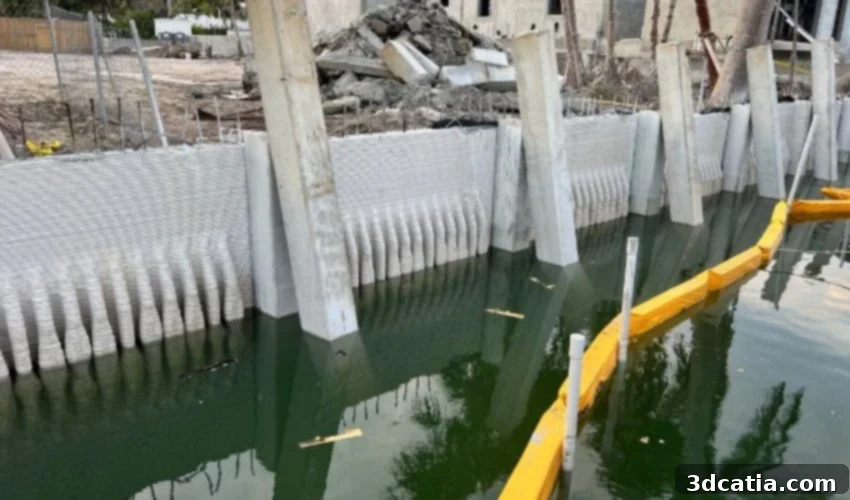
3D Printed Living Seawalls: Revolutionizing Coastal Protection and Restoring Marine Ecosystems
As the relentless march of climate change accelerates, global sea levels continue their alarming ascent, placing coastal communities worldwide in an increasingly precarious position. This existential threat is compounded by the widespread and distressing decline of coral reefs, vital underwater ecosystems that serve as natural barriers and biodiversity hotspots. Traditionally, efforts to combat these twin crises have been compartmentalized, addressing rising waters and ecological degradation as separate challenges. However, a visionary Miami-based tech company, Kind Designs, has emerged with a truly groundbreaking approach. By ingeniously leveraging 3D printing technology, Kind Designs has pioneered a solution that tackles both issues simultaneously, offering a paradigm shift in coastal sustainability. Through the development of innovative 3D printed ‘Living Seawalls,’ the company has positioned itself at the forefront of resilient infrastructure, presenting a solution with the profound potential to fundamentally redefine how we protect our precious coastlines and nurture our marine environments. To gain deeper insight into the company’s ambitious endeavors and future plans in this critical field, we had the privilege of speaking with the inspiring CEO and founder of Kind Designs, Anya Freeman.
3DN: Could you introduce yourself and Kind Designs?
Hello, my name is Anya Freeman, and I am the proud founder of Kind Designs. Our team is a passionate group of ocean enthusiasts based in Miami, united by a singular mission: to radically disrupt the conventional coastal construction industry. We aim to fortify coastal cities against the ravages of climate change by transforming what have historically been inert and often toxic concrete seawalls into vibrant, thriving artificial reefs. We achieve this transformative change through the strategic application of advanced 3D printing technology. Our vision is to create infrastructure that not only protects but also actively contributes to the health and biodiversity of our oceans.

Anya Freeman (center) and members of the Kind Designs team.
3DN: What inspired the concept of Living Seawalls, and how do they differ from traditional concrete seawalls in terms of environmental impact and effectiveness?
My journey to founding Kind Designs began in 2009 when I moved to Miami to attend law school. After graduating and establishing my career as an attorney, I lived in a house in Miami Beach with friends. It was during this time that I started noticing a radical and concerning increase in flooding and storm surges year after year. These weren’t isolated incidents; they were becoming a regular occurrence in my community, undeniably linked to the escalating problem of rising sea levels. It became commonplace for my friends and me to come home after a day’s work and have to wade through knee-deep water just to reach the front door of our own house. This direct, personal experience with the impacts of climate change was incredibly frustrating, particularly because the prevailing narrative surrounding this monumental problem felt overwhelmingly dominated by doom and gloom. What was even more disheartening was the apparent absence of any meaningful conversation about applying innovative technology to find tangible, actionable solutions.
Driven by this frustration and a deep-seated belief that technology held the key, I dove headfirst into extensive research for viable solutions. I quickly learned that the primary, and often only, line of defense against coastal flooding was the construction of seawalls. However, this traditional approach came with significant drawbacks: conventional seawalls are not only prohibitively expensive for many communities but, more critically, they are environmentally destructive, often obliterating marine life and habitats in their footprint. This realization fueled my determination to find a better way – a solution for Miami, and indeed for all vulnerable coastal cities, that could be both economically accessible for homeowners and communities, and simultaneously nurturing for marine ecosystems. And so, with this dual challenge in mind, Kind Designs was born.
Our company specializes in 3D printing ‘Living Seawalls.’ These innovative seawalls are engineered to be structurally identical to their traditional counterparts, ensuring the same robust protection against rising waters and storm surges. They boast the same PSI (pounds per square inch) ratings, incorporate equivalent reinforcement, and utilize identical installation methods. Where they fundamentally diverge, however, is in their revolutionary environmental functionality. Through a meticulous combination of advanced material composition and biomimicry design principles, our Living Seawalls do much more than just hold back the tide – they actively function as vibrant marine habitats. They feature strategically designed large caves and crevices, ingeniously mimicking the complex root systems of mangroves, providing essential shelter for diverse sea life from predators. Furthermore, their carefully engineered rugosity and textured surfaces create an ideal substrate for smaller organisms, such as corals, barnacles, and various invertebrates, to attach, colonize, and thrive, even enduring extreme weather events that would typically dislodge them from smoother, traditional surfaces. This dual functionality offers both vital protection for human communities and a significant ecological uplift for the marine environment.
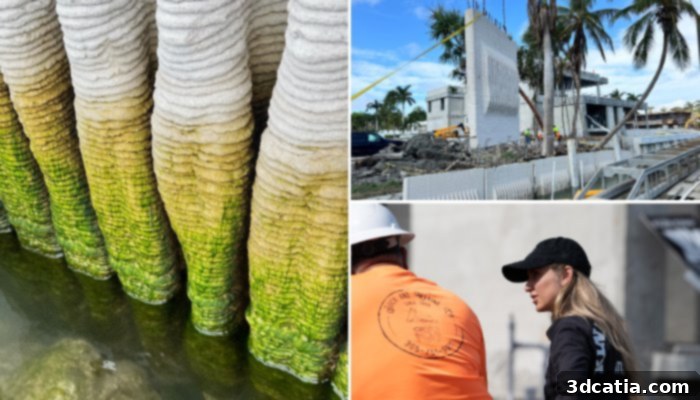
Kind Designs is the first to create this kind of 3D printed ‘Living Seawall’
3DN: Can you explain the process behind creating Living Seawalls, including the use of 3D printing technology?
The creation of our Living Seawalls is a testament to the power of advanced additive manufacturing. We have established an exclusive agreement with Cybe, a pioneering construction 3D printing company based in the Netherlands, specifically for seawall applications. Cybe’s robotic arms are renowned for being among the fastest on the market, capable of printing at an astonishing speed of 500mm per second. This unparalleled speed is crucial for efficient and scalable production, allowing us to rapidly fabricate large-scale infrastructure components. Beyond speed, Cybe’s technology also boasts an exceptionally small resolution size. Our Living Seawall layers are incredibly fine, measuring only a mere ½ inch in thickness. This superior resolution is a game-changer, unlocking an unprecedented degree of design freedom. We have capitalized on this capability to create the intricate, biologically inspired designs that mimic natural mangrove root systems, which would be impossible to achieve with conventional construction methods. For instance, we can print a robust 10 x 10-foot seawall panel in under an hour. Without the combination of such high-speed printing and fine resolution, achieving both excellent economic viability and the critical marine habitat function of our seawalls would simply not be possible. This precision and efficiency allow us to customize each section to best suit its unique environment, maximizing both structural integrity and ecological benefit.
3DN: In what ways do Living Seawalls contribute to marine ecosystems and biodiversity?
Our Living Seawalls are designed from the ground up to be ecological powerhouses, contributing significantly to marine ecosystems and biodiversity on multiple levels. At the macro level, the intricate designs within the walls explicitly mimic local marine habitats. For instance, in Florida, our designs replicate the complex, protective root systems of native mangroves, providing vital shelter and nursery grounds for a wide array of marine species. Beyond these larger structural features, the walls also incorporate a finely tuned micro design and surface texture that is specifically engineered to promote coral and small organism attachment and growth. This biomimetic approach ensures that the seawalls aren’t just barriers but become integral parts of the local ecosystem, fostering new life.
Crucially, the construction of these seawalls utilizes a proprietary mix material that is free from metals or chloride. This is a critical distinction, as it prevents the leaching of harmful chemicals into the ocean, a common problem with traditional concrete and other construction materials. Our materials have a proven track record, having been successfully employed in various artificial reef projects and even in reservoirs for drinking water, demonstrating their safety and efficacy in sensitive environmental applications. While our Living Seawawall installations are relatively new, the historical data on our material’s performance in other marine and environmental contexts spans many years, providing strong confidence in its long-term ecological benefits.
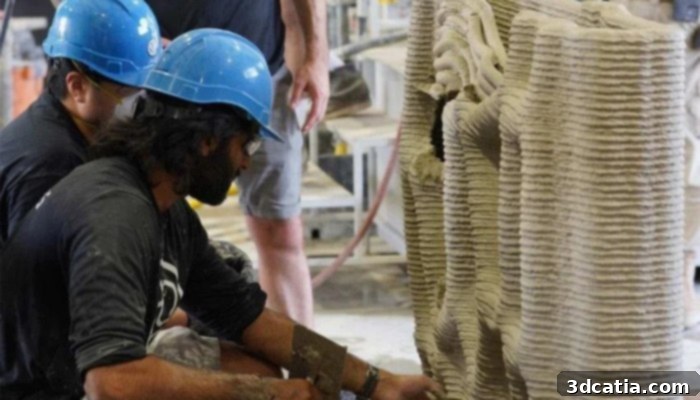
Examining the 3D printed Living Seawalls
Adding to their innovative ecological function, our Living Seawalls are also equipped with advanced sensing capabilities. We leverage the ideal real estate provided by the seawalls to collect data on 15 different water quality parameters. These are the same critical parameters that coastal counties currently collect manually, but our system provides live, continuous data. Furthermore, the intelligent design allows individual seawall sections to communicate with each other, effectively creating an entire distributed network of environmental information. This unprecedented network provides real-time insights into the health of our coastal waters, offering a level of data collection and environmental monitoring that was simply not possible with previous seawall technologies. This data is invaluable for informed decision-making in coastal management and further ecological research, showcasing the immense potential of integrating smart technology into resilient infrastructure.
3DN: How does Kind Designs approach the affordability and accessibility of Living Seawalls for coastal communities?
One of the core tenets of Kind Designs is our commitment to ensuring that sustainable, ecologically beneficial coastal protection is not a luxury, but an accessible option for all communities. This is why we emphatically state that there is no “green premium” associated with our Living Seawalls. It’s a common misconception that environmentally friendly solutions must inherently be more expensive, but we are actively working to dispel that notion. The reality is that traditional seawalls are already extraordinarily expensive, often cost-prohibitive for many homeowners. Many individuals purchased their homes years ago, long before the massive spike in property values in coastal cities, and are now facing the daunting financial burden of outdated and ineffective seawall infrastructure. For example, an average seawall installation in Miami can cost upwards of $300,000. The vast majority of homeowners simply do not have that kind of cash readily available. Therefore, it is absolutely essential for us not to create a product that adds to this financial strain, even if it offers superior environmental benefits.
We are proud to say that, for starters, we are already able to price-match the cost of existing, ecologically detrimental seawalls. This means that all the incredible environmental advantages, not to mention the significantly improved aesthetic appeal, come at no additional cost to the homeowner. This is a crucial step in making our solution widely adoptable. Beyond direct pricing, we are also actively engaging with local legislative bodies to establish a special permitting process specifically for Living Seawalls. The current permitting process for traditional seawalls can be incredibly complex, time-consuming, and expensive, adding significant hidden costs to a project. By streamlining this process for our eco-friendly designs, we anticipate providing huge cost savings on the overall project expense. Our goal is to make Living Seawalls not just an environmentally superior choice, but also the most economically sensible and accessible option for coastal residents and communities striving for resilience in the face of climate change.
3DN: Any last words for our readers?
We invite everyone interested in learning more about our innovative approach to coastal protection and marine ecosystem restoration to visit our website. You can find out more about our company, our technology, and our mission here.
We hope this insight into Kind Designs’ initiative has sparked your interest and encouraged you to consider the future of sustainable infrastructure. What are your thoughts on 3D printed Living Seawalls and their potential impact on our coastlines? We would love to hear from you! Let us know your opinions and questions in a comment below or join the conversation on our LinkedIn, Facebook, and Twitter pages! For the very latest news and developments in the exciting world of 3D printing delivered straight to your inbox, don’t forget to sign up for our free weekly newsletter here. You can also explore all our engaging videos and see this technology in action on our YouTube channel. Thank you for your interest in a more resilient and biodiverse future for our coastal regions.
*All Photo Credits: Kind Designs