
Revolutionizing Injection Molding: The Power of 3D Printed Molds and Additive Manufacturing
Injection molding stands as a cornerstone of modern manufacturing, a versatile process enabling the mass production of complex plastic parts with remarkable efficiency and consistency. From consumer electronics to automotive components, medical devices, and everyday household items, the vast majority of plastic products surrounding us are brought to life through injection molding. However, this traditional method comes with its own set of significant hurdles, primarily centered around the creation of the mold itself. Conventionally, these molds are precision-machined from robust metals like steel or aluminum, a process that is notoriously expensive, labor-intensive, and time-consuming. The initial investment in tooling can be prohibitive, often stretching lead times from weeks to months, making rapid prototyping and short-run production challenging and uneconomical.
This is precisely where the transformative capabilities of 3D printing, or additive manufacturing, emerge as a game-changer. Imagine bypassing the lengthy and costly traditional mold fabrication process altogether. Instead of meticulously machining a metal mold, manufacturers can now leverage 3D printing technologies to produce functional molds in a fraction of the time and at significantly reduced costs. This innovative approach not only slashes expenses and accelerates development cycles but also unlocks unprecedented design freedom. With additive manufacturing, it’s possible to create molds with intricate geometries, such as highly efficient internal cooling channels, which are either impossible or extremely difficult and expensive to achieve with conventional machining methods. This synergy between 3D printing and injection molding is redefining what’s possible in product development and production.
Embracing Additive Manufacturing for Rapid Tooling
The adoption of 3D printing for injection molding tooling, often referred to as “rapid tooling,” is rapidly gaining traction across various industries. This shift is driven by the undeniable advantages it offers over conventional methods, particularly for prototyping, low-volume production, and custom part fabrication. By utilizing various 3D printing techniques, companies can quickly iterate on mold designs, test new product concepts, and bring customized solutions to market faster than ever before. This agility is crucial in today’s fast-paced competitive landscape, where the ability to innovate quickly and respond to market demands can be a significant differentiator.
Several 3D printing technologies are proving incredibly effective for creating injection molds. Each offers distinct benefits depending on the specific requirements of the mold and the desired part characteristics:
- Fused Deposition Modeling (FDM): Often considered the most accessible 3D printing technology, FDM can produce quick, functional molds for concept validation and very short production runs. While offering lower resolution compared to other methods, its cost-effectiveness and speed make it ideal for initial testing.
- Laser Sintering (SLS): Selective Laser Sintering utilizes a laser to fuse powdered material, typically nylon, layer by layer. SLS molds are known for their mechanical strength, durability, and ability to produce complex internal structures without requiring support material, making them suitable for more demanding applications and longer production cycles.
- Stereolithography (SLA): SLA 3D printing employs a UV laser to cure liquid photopolymer resin, resulting in molds with exceptional surface finish and fine detail. These molds are excellent for parts requiring high aesthetic quality and tight tolerances. With specialized high-temperature resins, SLA molds can withstand the heat and pressure of injection molding for hundreds, sometimes thousands, of shots.
The choice of 3D printing technology depends on factors such as mold complexity, required lifespan, material compatibility, and budget. Regardless of the method, the overarching benefit remains: a dramatic reduction in the time and cost associated with producing injection molds, empowering manufacturers to innovate at an accelerated pace.
Unlocking New Possibilities: Benefits of 3D Printed Molds
The advantages of integrating 3D printed molds into the manufacturing workflow extend far beyond mere cost and time savings. They fundamentally alter the product development lifecycle and open doors to previously unattainable design and production strategies:
- Significant Cost Reduction: Eliminating expensive CNC machining and skilled labor for mold making drastically cuts tooling costs. For low-volume production or prototyping, a 3D printed mold can cost a fraction of its metal counterpart.
- Accelerated Lead Times: A traditional metal mold can take weeks or even months to produce. A 3D printed mold can be designed, printed, and ready for use in a matter of days, compressing product development schedules and enabling faster time-to-market.
- Enhanced Design Freedom & Complexity: 3D printing allows for the creation of intricate mold geometries that are impossible or cost-prohibitive with conventional manufacturing. This includes features like conformal cooling channels that closely follow the contours of the part, leading to more uniform cooling, reduced cycle times, and improved part quality by minimizing warpage and shrinkage.
- Rapid Iteration and Prototyping: Designers can quickly produce multiple mold iterations to test different designs, materials, or gate locations without significant financial commitment. This iterative approach speeds up design validation and optimization.
- Reduced Risk for New Product Launches: For new products with uncertain market demand, 3D printed molds allow manufacturers to produce initial batches without committing to expensive hard tooling, thereby mitigating financial risk.
- Customization and Small-Batch Production: The economic viability of 3D printed molds makes custom parts and low-volume production runs much more feasible, catering to niche markets or specialized applications.
- Material Versatility: Advances in 3D printable materials mean that molds can be made from resins or powders capable of withstanding various injection molding temperatures and pressures, compatible with a wide range of plastic injection materials.
These benefits collectively contribute to a more agile, cost-effective, and innovative manufacturing ecosystem, making 3D printed molds an indispensable tool for forward-thinking companies.
Formlabs: Driving Innovation in Additive Manufacturing for Tooling
At the forefront of this revolution is Formlabs, a leading company renowned globally for offering professional 3D printers that are the preferred choice for engineers, designers, manufacturers, and decision-makers worldwide. Headquartered in Massachusetts, Formlabs has consistently pushed the boundaries of additive manufacturing, developing a comprehensive ecosystem of hardware, software, and high-performance materials tailored for diverse industrial applications, including advanced tooling. Their commitment to innovation is evident in their wide range of SLA (Stereolithography) machines, which are celebrated for their precision, surface quality, and reliability, making them ideal for crafting highly detailed and accurate injection molds. Furthermore, Formlabs has expanded its portfolio with robust SLS (Selective Laser Sintering) solutions, exemplified by the Fuse 1, which provides industrial-grade part quality and material versatility, perfectly suited for more durable and complex mold applications.
Formlabs’ strength lies not only in its state-of-the-art hardware but also in its extensive suite of proprietary high-performance materials and intuitive software. These materials are engineered to meet the demanding requirements of injection molding, offering high heat deflection temperatures, strength, and chemical resistance, ensuring that 3D printed molds can withstand the rigors of the process for a significant number of shots. Their integrated approach ensures a seamless workflow from design to print to final part, empowering users to leverage the full potential of additive manufacturing for rapid tooling and beyond. Formlabs continues to play a pivotal role in democratizing access to industrial-grade 3D printing, making advanced manufacturing capabilities accessible to a broader range of businesses, from small design studios to large-scale production facilities.
Comprehensive Insights: A Look Back at Our Expert Webinar
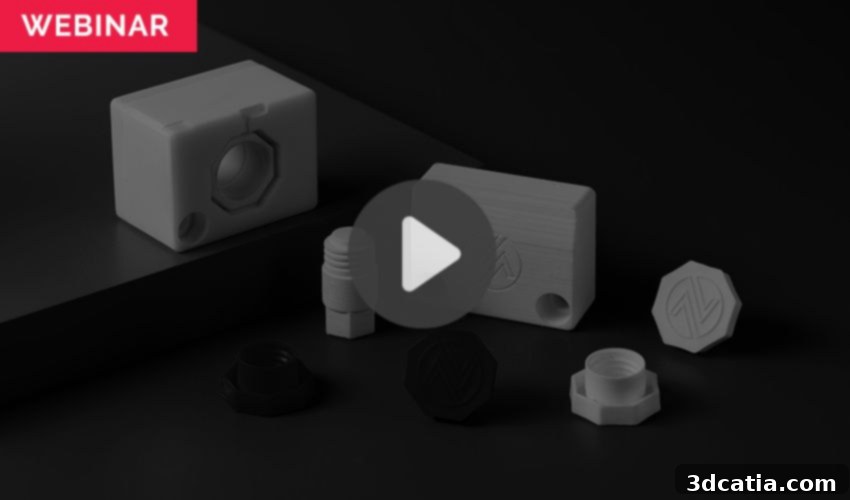
For those seeking to delve deeper into the transformative potential of 3D printing for injection molding, a highly insightful webinar, hosted by Formlabs Applications Engineer, Juliette Combe, and 3Dnatives, offered an invaluable resource. This session thoroughly explored how additive manufacturing enables in-demand mold fabrication, facilitating the generation of hundreds of parts, from initial concept to final production, in a matter of days rather than weeks or months. The webinar covered a wide array of crucial topics essential for anyone considering or implementing 3D printed tooling in their operations.
Key discussions included:
- Material Compatibility: Understanding which 3D printable resins and powders are best suited for various injection molding plastics and processes.
- Lifespan of 3D Printed Molds: Insights into the durability and typical shot counts achievable with different 3D printed mold materials and designs.
- Cost-Benefit Analysis: A detailed comparison of the financial implications between traditional metal molds and rapidly produced 3D printed molds, highlighting the immense savings possible.
- Practical Application Cases: Real-world examples illustrating how businesses are successfully leveraging 3D printed molds for short-run production, prototyping, and custom part creation across diverse industries.
- Step-by-Step Workflow: A clear demonstration of the various stages involved in designing, printing, post-processing, and utilizing a 3D printed mold, providing a practical roadmap for adoption.
This webinar served as a perfect opportunity for newcomers and experienced professionals alike to gain foundational knowledge and advanced insights into 3D printing for plastic molds. By watching the replay, viewers can accelerate their product development cycles, boost their innovation capabilities, and significantly reduce operational costs, making it an essential watch for anyone looking to stay competitive in modern manufacturing.
Meet the Experts Behind the Insights
Expert Speakers
 Juliette Combe is an accomplished Application Engineer at Formlabs, where she dedicates her expertise to pioneering research on cutting-edge 3D printing workflows specifically tailored for engineering and manufacturing applications. Her extensive scope of work encompasses vital collaborations with Formlabs customers, rigorous in-house testing to validate new processes and materials, and crucial knowledge transfer through the creation of highly informative technical content and engaging training programs. Prior to her impactful role at Formlabs, Juliette contributed her skills to the Open Innovation group at GE Power, where she further honed her understanding of industrial challenges and innovative solutions. She holds a master’s degree in Mechanical Engineering from the prestigious ETH Zurich and has conducted advanced research on nano-3D printing during her tenure at UC Berkeley. Her deep theoretical knowledge combined with practical application experience makes her an authoritative voice in the field of additive manufacturing for industrial tooling.
 Madeleine Prior serves as the English Content Specialist for 3Dnatives, widely recognized as the leading international online magazine dedicated to 3D Printing and Additive Manufacturing. As an integral member of the 3Dnatives editorial team, Madeleine is responsible for defining and curating the content that resonates with the platform’s vast English-speaking audience. Her role involves meticulously tracking the latest developments within the additive manufacturing sector and effectively communicating their implications to readers, ensuring they are always abreast of emerging trends, technological breakthroughs, and industry insights. Her expertise in distilling complex technical information into accessible and engaging content is invaluable, making her a key contributor to the dissemination of knowledge within the 3D printing community.
The Future of Manufacturing is Here: Embrace 3D Printed Tooling
The landscape of manufacturing is continually evolving, and the integration of 3D printing into injection molding represents one of its most exciting advancements. By offering solutions that are faster, more cost-effective, and geometrically complex, 3D printed molds are not just an alternative but a superior choice for a growing range of applications. Whether it’s for accelerating product development, facilitating small-batch customized production, or simply reducing the financial barriers to innovation, additive manufacturing provides a powerful toolkit. We encourage you to explore these possibilities and witness firsthand how this technology can transform your manufacturing processes. Watch the replay below to harness the full potential of 3D printed molds and drive your innovation forward!