

AI-Powered 3D Concrete Printing: Transforming Military Construction and Global Readiness
The landscape of global defense and humanitarian aid is on the cusp of a profound transformation, spearheaded by advancements in additive manufacturing. While 3D printing has brought myriad benefits to the general public, its impact within the defense sector is particularly significant and rapidly expanding. Projections indicate that the additive manufacturing market in the military is poised to reach an impressive $1.7 billion by 2027. This burgeoning growth is driven by the technology’s ability to offer unparalleled agility, resilience, and cost-efficiency in critical situations. From adapting swiftly to evolving geopolitical conflicts, such as the war in Ukraine where 3D printed components have proven vital, to constructing essential infrastructure, the versatility of 3D printing is redefining military operations. Among these innovations, concrete additive manufacturing stands out as a critical area of interest. Its immense potential lies in providing rapid deployment and robust construction solutions for a variety of needs, including the housing of troops, secure supply storage facilities, and crucial humanitarian aid stations, both domestically and in remote international locations. The U.S. military, in particular, has demonstrated a keen interest in leveraging this technology to enhance its operational capabilities and global responsiveness.
Traditional construction methods often present significant logistical hurdles and time constraints for military operations. Deploying personnel and equipment to remote or hostile environments, sourcing conventional building materials, and enduring lengthy construction timelines can severely impact mission effectiveness and increase operational costs. This is precisely where advanced solutions like 3D printed concrete, especially when augmented by artificial intelligence, offer a revolutionary alternative. The ability to quickly erect durable structures with minimal labor and reliance on complex supply chains can dramatically improve military readiness, facilitate disaster response, and enhance the safety of personnel involved in construction efforts. By reducing the time required for deployment and construction from months to mere days or weeks, military forces can establish vital infrastructure with unprecedented speed and efficiency, directly supporting strategic objectives and humanitarian missions worldwide.
Strategic Investment: The US Army Corps of Engineers and Missouri S&T Partnership
Recognizing the transformative potential of this technology, the U.S. Army Corps of Engineers (USACE) has made a significant investment to propel research in this field. A recent award of $1.4 million has been granted to a dedicated research team at the Missouri University of Science and Technology (Missouri S&T). This crucial funding underscores the military’s commitment to exploring cutting-edge solutions for its construction needs. The Missouri S&T team’s innovative approach centers on integrating artificial intelligence (AI) to optimize the 3D concrete printing process. Their primary objective is to develop AI algorithms capable of identifying and analyzing locally available materials suitable for incorporation into concrete mixtures. This AI-driven material selection process aims to overcome one of the most persistent challenges in traditional military construction: the logistical nightmare of transporting heavy and bulky construction materials to often inaccessible sites.
The core innovation behind the Missouri S&T team’s research lies in utilizing AI to automate the identification and assessment of the most beneficial and readily available resources within a specific geographical area. This intelligent sourcing mechanism represents a fundamental shift in construction planning, moving away from a reliance on pre-manufactured or distant materials. By allowing AI to pinpoint local aggregates, binders, and other components, the project seeks to eliminate the protracted logistical timelines associated with waiting for traditional construction material deliveries. When combined with the inherent speed and reduced labor intensity of 3D printing concrete structures, this AI-enhanced methodology promises to revolutionize construction timelines. Building projects that would typically demand months for completion could potentially be finished in a matter of days or weeks, significantly accelerating the deployment of essential facilities, whether for troop accommodations, tactical installations, or emergency response shelters.
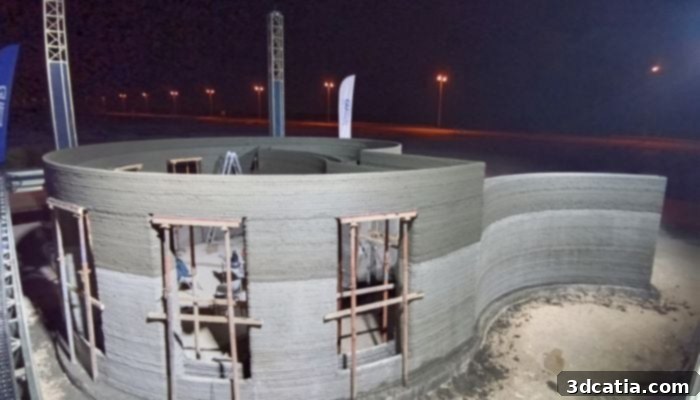
3D printed construction projects are gaining traction around the world due to their low cost and fast build times. This cafe in Oman was printed in just 22 hours. (photo credits: COBOD)
The Power of AI in Material Selection for Optimized Performance
Dr. Kamal Khayat, the distinguished leader of the Missouri S&T research team, eloquently articulated the vision behind this groundbreaking initiative. He emphasized, “By harnessing the power of AI, our research team aims to streamline the process of material selection, ensuring optimal performance and cost-effectiveness. The AI program will evaluate a wide range of locally available materials in various areas and identify the most appropriate combinations for 3D printing concrete. This will enhance the efficiency of the construction process, improve troop safety, pave the way for more sustainable practices and help expedite humanitarian assistance missions.” This statement encapsulates the multi-faceted benefits of their approach. AI’s capacity to analyze diverse material properties, environmental conditions, and structural requirements simultaneously allows for the creation of bespoke concrete mixtures tailored to specific project needs and geographic locations.
The integration of AI goes beyond simple material identification. It involves complex computational analysis to predict how different local ingredients will interact within the concrete mix, affecting its strength, durability, and extrudability. This predictive capability is crucial for ensuring that the 3D printed structures meet stringent military standards for safety and resilience. By optimizing the material composition, the research directly contributes to improved troop safety by constructing more robust and reliable shelters. Furthermore, the focus on locally sourced materials inherently promotes sustainable practices, reducing the carbon footprint associated with long-distance transportation and minimizing waste. Ultimately, this enhanced efficiency and sustainability have a direct impact on the speed and efficacy of humanitarian assistance missions, enabling faster and more resource-efficient responses to global crises.
Utilizing AI for Localized and Sustainable 3D Printed Concrete
A cornerstone of the Missouri S&T team’s research is the strategic goal of incorporating a significant proportion of local or indigenous materials into their 3D printed concrete formulations – specifically, 50% or more. This ambitious target aims to maximize the benefits of localized production. The distinction between “local” and “indigenous” materials is important. Local resources are generally defined as waste byproducts derived from nearby industrial or agricultural sectors, such as fly ash from power plants, slag from steel production, or ground glass from recycling facilities. These materials not only reduce construction costs but also contribute to a circular economy by diverting waste from landfills. Indigenous materials, on the other hand, refer to naturally occurring mineral deposits readily available in the immediate environment, such as specific types of sand, gravel, or clays. The AI system’s role is critical here, as it automatically identifies, categorizes, and designates the most useful and abundant materials within the local area, significantly accelerating a process that would otherwise be labor-intensive and time-consuming for human experts.
Beyond the composition of the concrete, Dr. Khayat and his team are also intensely focused on the rheological properties of the mixtures, particularly how easily various materials can be pumped and extruded through the 3D printing nozzle. This is a critical factor for the success of 3D concrete printing. A mixture that is too viscous will clog the printer, while one that is too fluid will not retain its shape, leading to structural failure. The AI model is being trained to analyze material properties not just for strength and durability, but also for their workability during the additive manufacturing process. This ensures that the concrete not only performs well once cured but also flows seamlessly during printing, allowing for continuous, high-speed construction. This dual focus on material sourcing and printability ensures that the AI-driven approach is comprehensive, addressing both the supply chain and the technical execution aspects of 3D concrete printing.
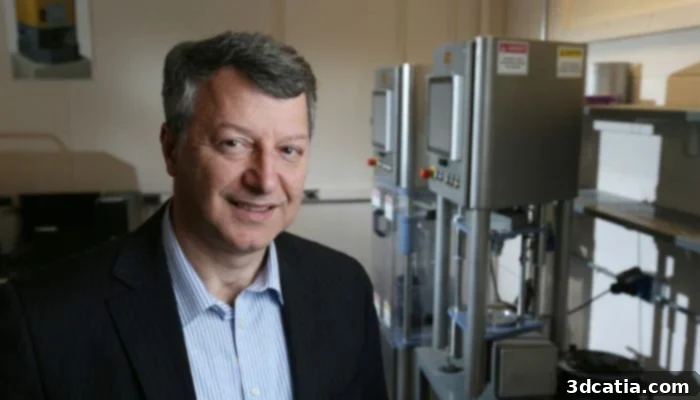
Dr. Kamal Khayat, head of the Missouri S&T research team, has been at the forefront of concrete engineering and research. He is the recipient of multiple awards including a lifetime achievement award from the International RILEM Conference on Rheology and Processing of Construction Materials. (photo credits: Sam O’Keefe/Missouri S&T)
Enhancing Structural Integrity: Reinforcement and Broader Impact
The innovation extends beyond just optimizing the concrete mix; the team is also actively exploring methods to enhance the structural integrity of 3D printed components. This includes testing a diverse assortment of fibers, such as natural options like bamboo and cellulose, or recycled materials like rubber, which can be incorporated to reinforce the 3D printed concrete. While concrete excels in compressive strength, its tensile strength can be improved with fiber reinforcement, making structures more resistant to cracking and environmental stresses. Following the same logic of localization and sustainability, these potential reinforcing materials can also be elements identified by AI as suitable for procurement from the local environment or as industrial waste- or byproducts. For instance, locally sourced agricultural waste could be processed into cellulose fibers, or discarded tires could be shredded into rubber aggregates, further contributing to a sustainable and self-sufficient construction ecosystem.
Dr. Khayat expressed profound satisfaction regarding the potential impact of this research, noting how it will “make [a] significant difference in the mobility of our troops.” The ability to rapidly construct durable infrastructure on demand directly enhances military operational flexibility and responsiveness, crucial for modern defense strategies. Moreover, he highlighted the broader implications of using local materials, emphasizing that it will provide substantial sustainability benefits and economic advantages to the local civilian sector. This approach fosters a symbiotic relationship between military innovation and community development, promoting local job creation, reducing environmental impact, and potentially stimulating local economies through demand for waste byproducts or indigenous resources. This interdisciplinary approach showcases the vast potential of this technology to transcend military applications, offering solutions that benefit multiple industries and global communities by driving more sustainable, efficient, and localized construction practices.
The pioneering work at Missouri S&T, supported by the U.S. Army Corps of Engineers, exemplifies the exciting future of construction, where the fusion of additive manufacturing and artificial intelligence promises not only to revolutionize military logistics and readiness but also to set new benchmarks for sustainability and efficiency in building worldwide. This research is paving the way for a future where essential infrastructure can be erected rapidly, cost-effectively, and with minimal environmental footprint, addressing critical needs from troop housing to disaster relief with unprecedented agility. To delve deeper into the specifics of the research being conducted at Missouri S&T, you can find more information HERE.
What are your thoughts on this innovative 3D printed construction research and its potential? We invite you to share your insights and comments below, or engage with us on our LinkedIn, Facebook, and Twitter pages! Don’t miss out on the latest 3D printing news and innovations – remember to sign up for our free weekly Newsletter here, delivered straight to your inbox! You can also explore all our compelling videos and content on our YouTube channel.
*Cover photo credits: Michael Pierce/Missouri S&T