
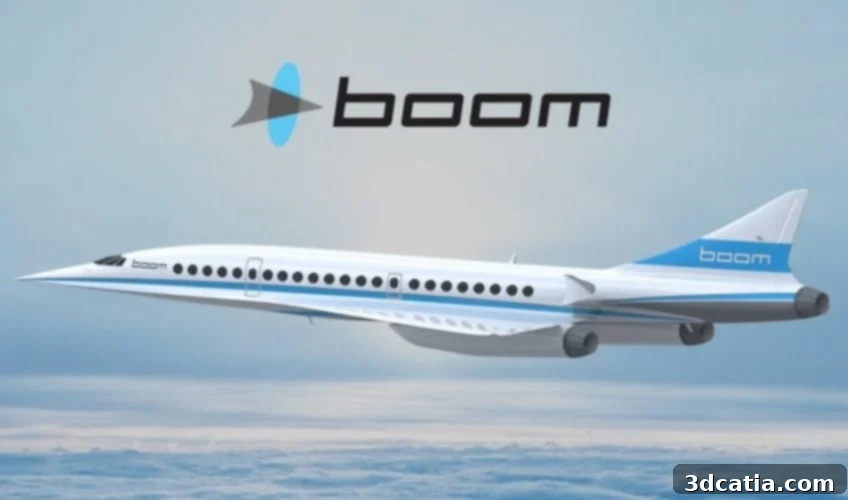
Boom Supersonic XB-1: Redefining High-Speed Travel with Advanced Additive Manufacturing and Sustainable Innovation
Just a few months ago, aviation enthusiasts and industry experts alike witnessed a monumental leap forward with the launch of Boom Supersonic’s XB-1 demonstrator aircraft. Hailed as a spiritual successor to the legendary Concorde, the XB-1 is much more than a high-speed jet; it represents a bold vision for the future of commercial aviation. This groundbreaking aircraft isn’t just fast; it’s a testament to how cutting-edge technology, particularly advanced 3D printing, can revolutionize aircraft design and manufacturing. Boom Supersonic recently unveiled an in-depth study detailing the intricate design and manufacturing processes, culminating in the sleek, high-performance jet ready to push the boundaries of flight.
A cornerstone of the XB-1’s innovative construction is the integration of advanced additive manufacturing. Specifically, 21 critical components within the XB-1 were fabricated using Velo3D’s state-of-the-art Sapphire 3D printer, which employs the Powder Bed Fusion technique. This strategic adoption of metal 3D printing has yielded profound benefits for Boom Supersonic. It dramatically minimized manufacturing lead times, significantly reduced the aircraft’s overall weight – a crucial factor for supersonic flight efficiency – and provided unparalleled design flexibility. These advantages are not merely incremental improvements; they are foundational to creating an aircraft that is faster, more efficient, and ultimately, more viable for a new era of supersonic commercial travel.
Boom Supersonic’s ambition extends far beyond speed. The company is not only responsible for the world’s first independently developed supersonic jet but also stands out as the first commercial aircraft manufacturer to embed sustainability into its aircraft design philosophy from inception. This commitment is deeply ingrained, aiming for 100% carbon neutrality across its entire operations. This encompasses every stage, from the initial design phase of their advanced aircraft and the energy-efficient operation of their production facilities to the responsible recycling of their jets at the end of their operational life. Boom Supersonic is dedicated to forging a new travel standard, envisioning a future where the exhilaration of high-speed flight is seamlessly combined with convenience and affordability, making supersonic travel an accessible and sustainable reality for a broader population.
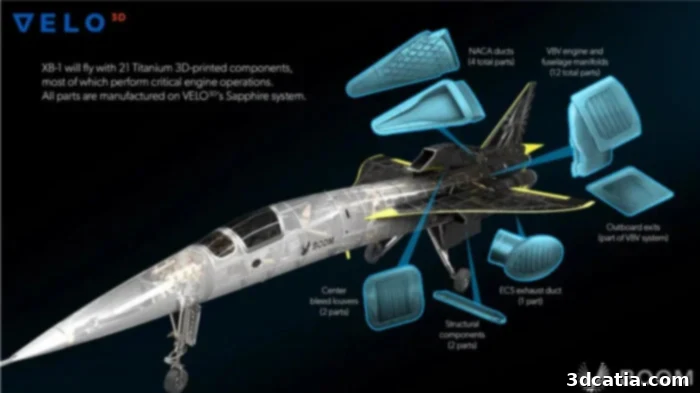
The XB-1 has 21 components 3D printed using Velo3D’s Sapphire 3D printer. (Photo Credit: Boom Supersonic)
The XB-1’s 3D printed components are predominantly intricate parts designed to channel high-velocity air, such as vanes and ducts. These components often operate under extreme thermal conditions, with air temperatures regularly exceeding 260ºC. The nature of supersonic flight demands extraordinary precision and efficiency in airflow management, making these parts geometrically complex and incredibly challenging to produce with conventional manufacturing techniques. Traditional machining or casting methods simply cannot achieve the fine details, complex internal geometries, and optimal aerodynamic profiles required for such high-performance applications. This is precisely where additive manufacturing shines.
Engineer Byron Young elaborated on the indispensable role of additive manufacturing for these specific components: “If fast moving air is touching it, we care about that surface from an efficiency and performance standpoint. So when designing these parts, you generally start with aerodynamic profiles and then trim, fillet, and thicken surfaces to create the solid part itself. The resulting parts are very complex—which meant they definitely needed to be fabricated through 3D printing.” This process, where designers can precisely sculpt the internal and external contours to optimize airflow, minimize drag, and maximize propulsion efficiency, is a game-changer. Additive manufacturing allows for the creation of organic, free-form shapes that reduce turbulence and enhance the overall aerodynamic performance of the aircraft, which is critical for achieving and sustaining supersonic speeds efficiently.
The choice of material for these 3D printed parts was crucial, and titanium was the unequivocal material of choice. Titanium is renowned in the aerospace sector for its exceptional strength-to-weight ratio, superior durability, and remarkable capacity to withstand extremely high temperatures – qualities that are non-negotiable for supersonic aircraft components. However, traditional manufacturing methods often struggle with titanium; it can be prone to cracking or developing internal stresses if cooled too rapidly or unevenly during conventional casting or machining processes. These challenges are elegantly circumvented by advanced additive manufacturing techniques like Powder Bed Fusion.
With systems like Velo3D’s Sapphire printer, manufacturers gain precise control over the material deposition and the entire build environment. This includes meticulous regulation of temperature, cooling rates, and laser parameters, which ensures the integrity of the titanium parts throughout the printing process, mitigating issues like cracking and distortion. After the intricate parts are cooled and carefully removed from the build plate, they undergo post-processing. A significant advantage of Velo3D’s Sapphire SupportFree 3D printing technology is the minimal need for support structures during printing. This innovative approach dramatically reduces the time and labor required for post-processing, often limiting it to around half an hour per component and requiring very little intricate handiwork. This efficiency is a massive boost for rapid prototyping and production in the aerospace industry, where every minute and every gram counts.
Furthermore, given that flight components, particularly those subjected to the extreme conditions of supersonic flight, endure constant cyclical loading during takeoff, landing, and various flight maneuvers, they must undergo additional treatments to ensure their longevity and safety. To prolong their fatigue lives and enhance their structural integrity, these parts are subjected to Hot Isostatic Pressing (HIP) and subsequent heat treatment. HIP involves subjecting the components to high temperatures and pressures, which eliminates internal porosity and voids, resulting in a denser, stronger material. Heat treatment further refines the material’s microstructure, improving its mechanical properties such as toughness and resistance to fatigue. These rigorous post-processing steps are essential to guarantee that every 3D printed component meets the stringent safety and performance standards demanded by supersonic aviation.
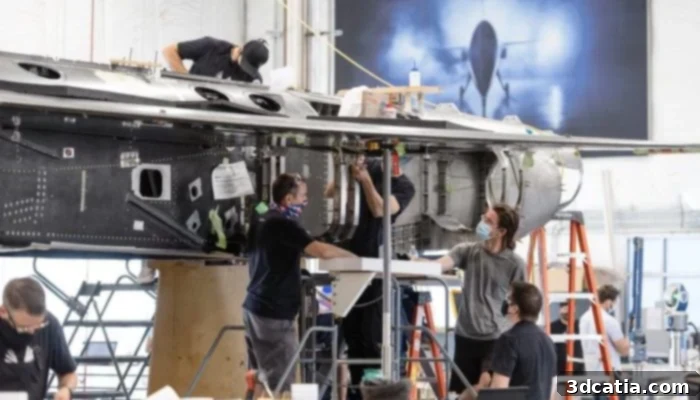
Engineers at Boom Supersonic putting together the XB-1.
Despite having made significant strides with the XB-1, which serves as a crucial stepping stone for their larger Overture commercial airliner, Boom Supersonic acknowledges that their ultimate goal of revolutionizing commercial flight is an ongoing journey. Blake Scholl, founder and CEO of Boom Supersonic, articulates this vision succinctly: “I’ll know we’ve succeeded when high-speed flight is considered normal.” This statement underscores the company’s commitment not just to developing faster aircraft, but to making supersonic travel an everyday reality, accessible and integrated into global travel patterns, moving beyond its niche, luxury status of the past.
The XB-1 demonstrator is paving the way for the future Overture commercial airliner, which promises to connect the world at unprecedented speeds, significantly reducing travel times across continents. By combining advanced aerodynamics, sustainable fuel options, and cutting-edge manufacturing techniques like those demonstrated in the XB-1, Boom Supersonic aims to make supersonic flight not only efficient and exhilarating but also environmentally responsible. This holistic approach is critical for the long-term viability and success of high-speed commercial air travel in the 21st century, addressing both the desire for speed and the imperative for sustainability.
What are your thoughts on the Boom Supersonic XB-1 and the future of high-speed sustainable flight? We invite you to share your insights in a comment below or join the conversation on our Facebook and Twitter pages! For the very latest updates in the world of 3D printing and advanced manufacturing, sign up for our free weekly Newsletter here, delivering all the essential news straight to your inbox!