

Gold Nanoparticles Revolutionize 3D Printing Quality Control by Revealing Hidden Defects
Additive manufacturing, more commonly known as 3D printing, has emerged as a transformative technology across numerous industries, enabling rapid prototyping, custom part creation, and the production of complex geometries previously unattainable. From aerospace components and medical implants to consumer goods, its applications are vast and ever-expanding. However, despite its myriad advantages, 3D printing is not without its challenges. One of the most significant hurdles lies in ensuring the consistent quality and structural integrity of printed parts, especially when defects are not visible to the naked eye. This is where groundbreaking research from Vanderbilt University is set to make a profound impact.
Researchers at Vanderbilt University in the United States have developed an ingenious technique to detect subtle anomalies that can occur within 3D printed components. Their innovation centers around the use of gold nanoparticles, leveraging their unique optical properties to signal the presence of defects. This method provides a fast, precise, and non-destructive way to identify imperfections, promising to significantly enhance the reliability and widespread adoption of 3D printing technology. This advancement addresses a critical need for robust quality control mechanisms in additive manufacturing, offering a bright future for the industry.
The Growing Need for Advanced 3D Printing Quality Assurance
While 3D printing streamlines the manufacturing process and unlocks unprecedented design freedom, it also introduces a unique set of quality control challenges. Unlike traditional manufacturing methods where defects might be more predictable or easily observed, flaws in 3D printed parts can be insidious. These can range from microscopic voids and inconsistencies in material density to incomplete layer fusion, leading to internal stresses or areas of increased fragility. A poorly deposited layer of material, for instance, might not be immediately apparent but can drastically compromise the final part’s strength and overall performance.
The consequences of undetected defects can be severe, particularly in critical applications such as aerospace, automotive, or medical devices. A faulty component in an aircraft engine or a medical implant could lead to catastrophic failure, posing significant safety risks and incurring immense financial costs. Current quality inspection methods often involve destructive testing, which means sacrificing parts for analysis, or rely on expensive and time-consuming techniques like X-ray computed tomography, which can be prohibitive for routine production. The ability to non-destructively and efficiently identify these hidden flaws is paramount for the continued growth and trustworthiness of additive manufacturing.
Vanderbilt’s Innovative Approach: Gold Nanoparticles to the Rescue
The team at Vanderbilt University has pioneered a truly novel solution to this persistent problem. Their method involves integrating minuscule gold nanoparticles directly into the 3D printing material itself. The core idea is to transform standard printing filaments into “smart materials” that can self-report their internal integrity. This revolutionary concept harnesses the inherent optical properties of gold at the nanoscale, turning potential vulnerabilities into detectable signals.
The process begins with gold chloride, a compound typically dark brown in color. The Vanderbilt team meticulously processes this material to convert it into gold nanoparticles. These particles are astonishingly small, approximately 100,000 times thinner than a human hair, yet their impact on defect detection is immense. Their diminutive size allows them to be uniformly dispersed throughout the printing material without significantly altering its macroscopic properties or printability.
From Gold Chloride to Smart Filament: The Manufacturing Process
Once the gold nanoparticles are prepared, they are meticulously mixed with a dissolved plastic polymer – the base material for the 3D printing filament. This creates a homogeneous mixture where the gold particles are evenly distributed throughout the polymer solution. Following this, the mixture is carefully dried, a process that removes the solvent and allows the polymer to harden around the embedded gold nanoparticles. The solidified material is then ground into a fine powder or pellet form, which can subsequently be extruded into a 3D printing filament. This specialized filament, now infused with countless gold nanoparticles, becomes the cornerstone of their defect detection system.
The uniformity of the gold nanoparticle dispersion throughout the filament is crucial. Any significant clumping or uneven distribution could lead to false positives or missed defects. The researchers have fine-tuned this integration process to ensure that the nanoparticles act as a reliable indicator of material consistency. This meticulous engineering of the smart filament is what enables the subsequent detection of structural anomalies during or after the printing process.
Rapid and Non-Destructive Defect Identification with Spectrophotometry
The actual defect detection mechanism relies on a highly specialized spectrophotometer. This instrument is capable of analyzing the optical properties of the gold nanoparticles embedded within the 3D printed part. Gold nanoparticles exhibit a phenomenon known as surface plasmon resonance, where they absorb and scatter light at specific wavelengths. When these nanoparticles are uniformly distributed throughout a flawless material, they produce a predictable optical signature.
However, if a defect like a void, a delamination, or an area of inconsistent material density occurs within the printed part, the local concentration or arrangement of the gold nanoparticles changes. This alteration in their environment directly impacts their optical absorbance properties. The spectrophotometer can detect these subtle changes in absorbance, thereby pinpointing the exact location and nature of the defect. This innovative approach allows researchers to identify flaws in a 3D printed part in mere seconds, offering an unprecedented level of speed and efficiency in quality control.
Cole Brubaker, an engineer graduate of Vanderbilt University who was instrumental in this research, clearly articulated the simplicity and power of their method: “We use the absorbance properties of embedded gold nanoparticles. We scan the room and we can see where the absorbance decreases inside, signaling a defect in the material. A defect can be found with a single non-destructive measurement. It’s very fast, it only takes a few seconds.” This direct and elegant solution overcomes many of the limitations of traditional inspection techniques.
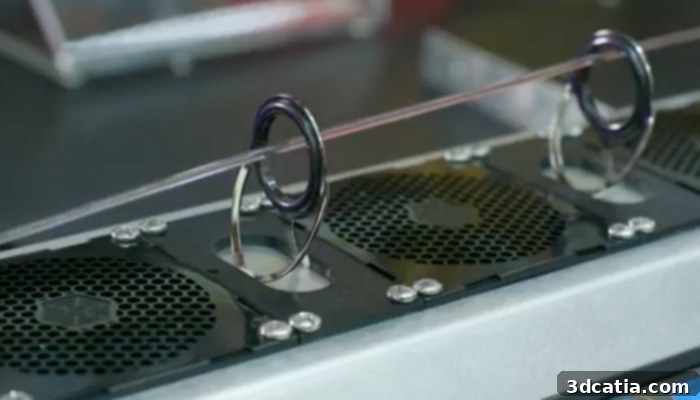
Nanoparticles are integrated into the 3D printing filament, making the material ‘smart’ and capable of revealing internal defects.
Transforming Quality Control and Future Implications
The implications of this breakthrough are profound. With this technology, 3D printed parts could essentially “self-evaluate,” dramatically reducing the time and cost associated with post-production verification processes. This shift from reactive defect detection to proactive, integrated quality monitoring represents a significant leap forward for additive manufacturing. Industries that rely heavily on the integrity of complex, custom-made parts, such as aerospace, medical device manufacturing, and high-performance automotive sectors, stand to benefit immensely. The ability to quickly and reliably certify parts will accelerate product development cycles, improve safety standards, and ultimately lead to more robust and trustworthy 3D printed products.
The development of such ‘smart materials’ also opens new avenues for in-situ monitoring during the printing process itself. Imagine a 3D printer that can detect a defect as it’s forming and potentially correct it, or at least halt the print to prevent further material waste. This vision moves additive manufacturing closer to fully automated and self-optimizing production lines. Beyond quality control, this research highlights the growing trend of integrating functional nanoparticles into materials to imbue them with enhanced capabilities, pushing the boundaries of material science and engineering.
The Road Ahead for Smart 3D Printing Materials
While the potential of this gold nanoparticle technique is undeniable, there are still several steps to navigate before this smart material enters the mainstream 3D printing filament market. Key considerations include the scalability of nanoparticle production and integration, optimizing the cost-effectiveness of using gold in filaments, and developing standardized spectrophotometer systems that can be easily adopted by manufacturers. Furthermore, regulatory approvals for materials used in specific applications, especially those involving human contact, will require thorough testing and validation.
Despite these challenges, the Vanderbilt University team’s innovation represents a significant milestone in additive manufacturing. It underscores the ongoing commitment of researchers to overcome the inherent limitations of new technologies and to continuously push the boundaries of what’s possible. As the demand for complex, high-performance 3D printed parts continues to grow, such advancements in quality assurance will be crucial for unlocking the technology’s full potential and ensuring its widespread, reliable application.
In the meantime, you can find more detailed information on this pioneering research and other cutting-edge projects on the official website of Vanderbilt University. For a visual overview, be sure to watch the video below, which further elaborates on the technique and its exciting possibilities:
What do you think about this innovative technique using gold nanoparticles to detect defects in 3D printed parts? Do you foresee this becoming a standard in additive manufacturing? Let us know your thoughts in a comment below or join the conversation on our Facebook and Twitter pages! And remember to sign up for our free weekly Newsletter, to get all the latest news and breakthroughs in 3D printing sent straight to your inbox!