
Revolutionary Breakthrough: NIST Pioneers 3D Printing of 17-4 PH Stainless Steel with Enhanced Properties
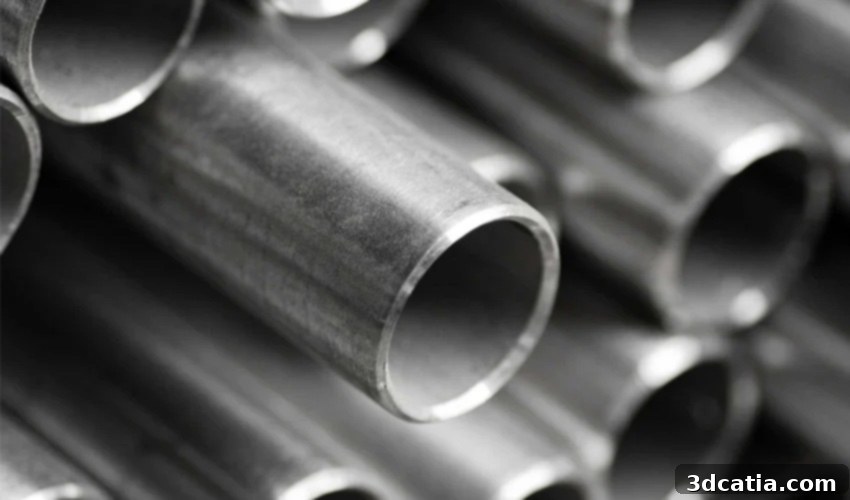
Steel, a fundamental material in modern industry, is globally recognized for its exceptional mechanical properties, particularly its impressive resistance to corrosion and remarkable strength. These attributes make it indispensable across a multitude of sectors, and its role is continually expanding, especially within the burgeoning 3D printing industry. Among the vast family of steels, stainless steel stands out as a unique alloy, often referred to as ‘inox,’ primarily composed of iron, chromium, and a small but critical amount of carbon. This specific composition grants it superior corrosion resistance compared to conventional steels. However, for applications demanding even greater performance, an advanced variant known as 17-4 precipitation hardening (PH) stainless steel emerges as a material of choice. This particular alloy is not only celebrated for its inherent corrosion resistance but also for its extraordinary hardness, making it ideal for highly demanding environments. For years, the challenge of leveraging additive manufacturing for such high-performance alloys has persisted. Now, a groundbreaking development has been reported: a dedicated team of researchers at the National Institute of Standards and Technology (NIST) has successfully achieved the 3D printing of 17-4 PH stainless steel, critically retaining both its essential corrosion resistance and its remarkable hardness – a feat previously considered extremely difficult to consistently achieve.
The Expanding Realm of Metal Additive Manufacturing and its Inherent Challenges
Metal additive manufacturing, often simply called metal 3D printing, has experienced phenomenal growth over the past few years. This innovative technology is rapidly expanding the frontiers of possibility across a diverse array of industries. From the rigorous demands of the aerospace sector, where lightweight and complex components are crucial for fuel efficiency and performance, to the precision requirements of medicine, enabling the creation of custom implants and surgical tools, and even the high-volume needs of the automotive industry for prototyping and functional parts, metal 3D printing is proving transformative. Its ability to produce intricate geometries, optimize material usage, and enable rapid prototyping has positioned it as a key technology for future manufacturing.
Despite its immense potential and growing adoption, metal 3D printing presents a unique set of challenges that are far from easy to master, particularly when working with advanced alloys like 17-4 PH stainless steel. One of the most significant hurdles lies in managing the extreme thermal gradients inherent to the additive manufacturing process. During fabrication, material heats up and cools down at extraordinarily rapid rates. This rapid thermal cycling, involving localized melting and solidification, can lead to significant variations in temperature within the material over very short periods. Fan Zhang, a distinguished physicist at NIST and a co-author of the pivotal study, eloquently describes this phenomenon: “When you think about additive manufacturing of metals, we are essentially welding millions of tiny, powdered particles into one piece with a high-powered source such as a laser, melting them into a liquid and cooling them into a solid. But the cooling rate is high, sometimes higher than one million degrees Celsius per second, and this extreme nonequilibrium condition creates a set of extraordinary measurement challenges.” These rapid and localized temperature fluctuations can induce internal stresses, lead to undesirable microstructural changes, and ultimately compromise the desired mechanical properties of the final part, such as its strength, ductility, or corrosion resistance. Ensuring consistency and predictability in these properties across an entire 3D printed component is paramount for critical applications.
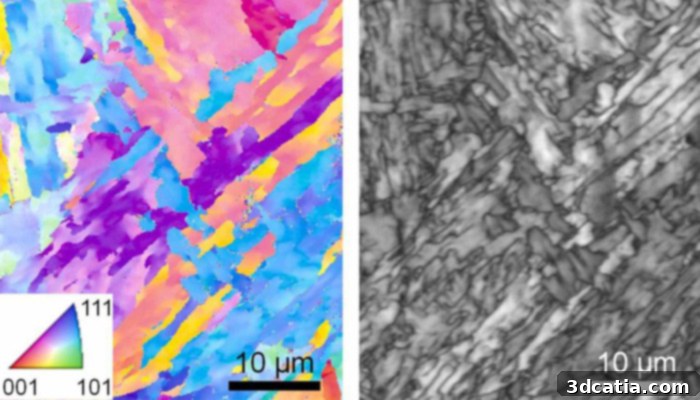
A microscopic image of a 3D printed 17-4 stainless steel. The colors on the left represent the different orientations of the crystals in the alloy (photo credit: Q. Guo/University of Wisconsin-Madison)
NIST’s Innovative Research: Unlocking the Secrets of 17-4 PH Steel Microstructure
The inherent temperature changes during metal additive manufacturing processes frequently lead to structural irregularities and defects. Consequently, consistently obtaining a metal part with precisely the desired properties, such as optimal hardness and corrosion resistance, has historically proven challenging for alloys like 17-4 PH stainless steel. Recognizing this critical hurdle, the NIST research team embarked on a mission to gain a deeper, more comprehensive understanding of the variations in the crystalline structure of the metal as it is formed. Their specific focus was on PH 17-4 steel, with the ultimate goal of reliably achieving its coveted properties – exceptional hardness and superior corrosion resistance.
To accomplish this ambitious objective, the researchers employed a highly advanced scientific instrument: a synchrotron. A synchrotron is a powerful electromagnetic device that accelerates elementary particles, such as electrons, to nearly the speed of light, producing extremely bright and coherent X-ray beams. These X-rays are far more intense and precise than those from conventional laboratory sources, making them ideal for probing the atomic and molecular structure of materials in real-time. The NIST team utilized this cutting-edge technology by projecting these high-energy X-rays onto the 17-4 PH steel precisely while it was being printed. This innovative approach allowed them to observe and follow the evolution of its crystal structure dynamically, as the material transitioned from a molten state to a solid. This in-situ, real-time observation capability was absolutely critical, as it provided unprecedented insights into the rapid solidification processes occurring at cooling rates exceeding one million degrees Celsius per second. By meticulously tracking these microstructural changes, they were able to unravel a multitude of influencing factors, including the precise role of the alloy’s composition and how it dictated the formation of specific crystal phases.
Key Findings: The Power of Composition Control and Martensitic Stability
The profound insights gained from their synchrotron-based observations led the NIST team to a pivotal conclusion. As Fan Zhang further elaborated, “Composition control is truly the key to 3D-printing alloys. By controlling the composition, we are able to control how it solidifies. We also showed that, over a wide range of cooling rates, say between 1,000 and 10 million degrees Celsius per second, our compositions consistently result in fully martensitic 17-4 PH steel.” This statement underscores the core of their breakthrough. Martensitic steel is renowned for its exceptional hardness and strength, properties derived from its unique crystal structure formed through rapid cooling. Traditionally, achieving a consistent martensitic structure in 17-4 PH steel, especially under the extreme thermal conditions of 3D printing, has been a significant hurdle. However, by carefully tailoring the precise chemical composition of the alloy, NIST researchers were able to manipulate the solidification pathway. This allowed them to guide the formation of the desired martensitic phase with remarkable consistency, even across a vast spectrum of cooling rates encountered in different additive manufacturing parameters.
The ability to reliably produce a fully martensitic structure is critical because it directly translates to the desired mechanical properties of 17-4 PH stainless steel: its high hardness and strength. Furthermore, maintaining the correct composition ensures that the material retains its excellent corrosion resistance. What makes this achievement even more significant is that by turning to 3D printing and precise composition control, the researchers were able to produce a very high-quality 17-4 PH steel while simultaneously bypassing some of the complex and often energy-intensive cooling and heat treatment steps typically required in traditional manufacturing methods for this alloy. These traditional post-processing steps are often necessary to induce the desired microstructure and properties, adding significant time, cost, and complexity to the production process. Therefore, this innovation suggests that the production of high-performance 17-4 PH stainless steel components could become considerably easier and more cost-effective by leveraging additive manufacturing. This breakthrough not only validates the potential of metal 3D printing for challenging materials but also provides a blueprint for developing and optimizing other high-performance alloys for additive manufacturing, promising a new era of material design and production efficiency. More detailed information about this groundbreaking research can be found by exploring the full study HERE.
Future Applications and the Impact on Advanced Manufacturing
The successful 3D printing of 17-4 PH stainless steel with preserved hardness and corrosion resistance opens up a vast array of potential applications across various industries. In the aerospace sector, components requiring high strength-to-weight ratios, such as brackets, structural elements, and engine parts, can now be fabricated with complex geometries previously impossible to achieve with traditional methods. This leads to lighter, more efficient aircraft and spacecraft. For the medical field, the ability to 3D print custom surgical instruments, dental implants, and prosthetic components from a biocompatible and corrosion-resistant material like 17-4 PH steel offers unprecedented customization, improving patient outcomes and device performance. The automotive industry can benefit from customized tooling, lightweight structural parts, and performance components that can withstand harsh operating conditions.
Beyond these established sectors, this breakthrough also promises significant advancements in other critical areas. For instance, in the marine industry, where corrosion resistance is paramount, parts for underwater vehicles, sensors, and structural components could be 3D printed with enhanced durability. The energy sector, including oil and gas, nuclear, and renewable energy, could utilize 3D printed 17-4 PH steel for specialized components exposed to corrosive environments and high mechanical stresses. Furthermore, the ability to achieve consistent material properties across a wide range of cooling rates signifies a robust and reliable manufacturing process, crucial for industrial adoption. This innovation not only enables the production of superior parts but also accelerates the design cycle, reduces material waste, and potentially lowers overall manufacturing costs by streamlining post-processing steps. The NIST research sets a powerful precedent, demonstrating how fundamental scientific understanding, combined with advanced characterization techniques like synchrotrons, can unlock the full potential of additive manufacturing for challenging materials, paving the way for a new generation of high-performance engineered components.
Conclusion
The work by the NIST team represents a monumental leap forward in the field of metal additive manufacturing. By successfully demonstrating the 3D printing of 17-4 PH stainless steel while meticulously preserving its critical hardness and corrosion resistance, they have overcome a significant barrier that limited the application of this high-performance alloy in additive manufacturing. Their detailed study, leveraging advanced synchrotron technology, illuminated the crucial role of composition control in dictating microstructure formation during rapid solidification. This precise understanding allows for the consistent production of fully martensitic structures, eliminating the need for complex traditional heat treatments and significantly simplifying the manufacturing process.
This breakthrough promises to revolutionize industries ranging from aerospace and medicine to automotive and marine, enabling the creation of stronger, lighter, and more durable components with unprecedented design freedom and cost efficiency. It underscores the immense potential of integrating material science with advanced manufacturing techniques to push the boundaries of what is possible. As the metal additive manufacturing landscape continues to evolve, NIST’s achievement serves as a beacon, guiding future research into other challenging alloys and accelerating the adoption of 3D printing for high-performance applications globally.
What are your thoughts on the potential impact of 3D printing this advanced steel? We invite you to share your insights in a comment below or join the conversation on our LinkedIn, Facebook, and Twitter pages! Don’t forget to sign up for our free weekly Newsletter here to receive the latest 3D printing news directly in your inbox. You can also explore all our informative videos on our YouTube channel.
*Cover Photo Credits: Futura Sciences