
Czinger 21C: 3D Printed Hypercar Smashes Records, Redefining Automotive Performance
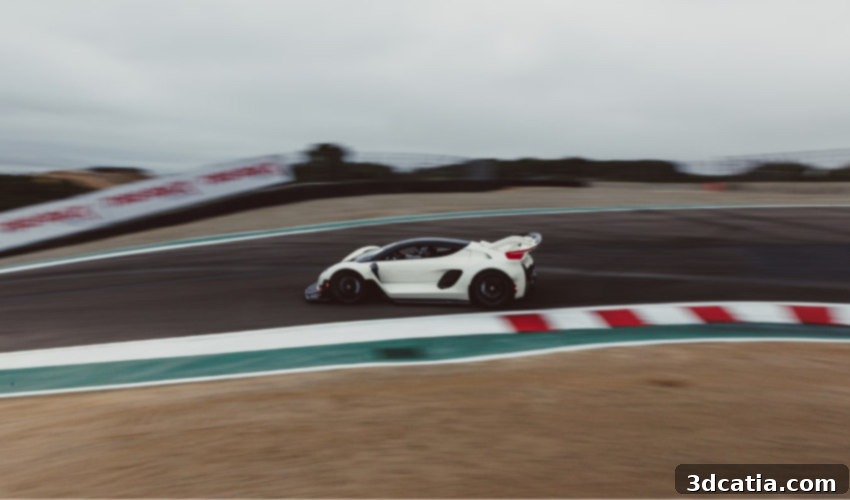
Czinger Vehicles, a groundbreaking automotive manufacturer based in Torrance, California, has recently made headlines by setting an astonishing five new lap records across some of California’s most iconic racetracks. Their innovative 3D printed hypercar, the Czinger 21C, achieved this remarkable feat during a meticulously planned campaign dubbed “Gold Rush.” Over just five consecutive days, the 21C established new benchmarks at Sonoma Raceway, Laguna Seca, Thunderhill Raceway, Willow Springs International Raceway, and the Thermal Club. This unprecedented record-breaking streak not only underscored the immense power and sophisticated hybrid system of the car’s twin-turbo V8 engine but also unequivocally demonstrated the profound aerodynamic and structural advantages derived from advanced 3D printing technologies in high-performance automotive engineering. Czinger is not merely building fast cars; they are fundamentally reshaping how hypercars are designed, engineered, and built, pushing the boundaries of what’s possible in the realm of speed and innovation.
Czinger’s Revolutionary Approach: The Power of Additive Manufacturing
At the core of Czinger’s philosophy is an unwavering commitment to utilizing additive manufacturing to craft vehicles that are superior in every measurable way. Unlike traditional automotive companies that rely on conventional fabrication methods, Czinger has built its entire reputation on leveraging the unparalleled capabilities of 3D printing to produce structural components. This results in parts that are inherently lighter, significantly stronger, and demonstrably more aerodynamic than those achievable through standard manufacturing processes. The chassis of the Czinger 21C, along with a multitude of its intricate internal components, is meticulously constructed using a proprietary 3D printing process. This advanced methodology grants designers an extraordinary level of freedom, allowing them to create complex, organic, and high-strength geometries precisely where they are needed for optimal performance. This innovative approach has been instrumental in drastically reducing the car’s overall weight while simultaneously enhancing its structural rigidity, a critical factor for achieving peak performance and handling on the racetrack.
The proprietary additive manufacturing system employed by Czinger is a game-changer. It allows for the production of components with optimized lattice structures and integrated functionalities that are simply impossible to achieve with traditional casting, stamping, or machining. By precisely controlling material placement at a microscopic level, Czinger can engineer parts that are exceptionally strong in critical load-bearing areas while shedding unnecessary mass elsewhere. This meticulous optimization translates directly into tangible performance benefits, contributing to the 21C’s agile handling, explosive acceleration, and impressive top speeds. Furthermore, the ability to rapidly iterate and customize designs through 3D printing enables Czinger to continuously refine and improve its vehicles, staying ahead of the curve in the highly competitive hypercar market.
The “Gold Rush” Campaign: Proving Performance on Public Roads and Tracks
The “Gold Rush” campaign was not merely a series of isolated lap attempts; it was a comprehensive demonstration of the Czinger 21C’s real-world versatility and robust engineering. During this ambitious campaign, the 21C was remarkably driven from one racetrack to the next, covering nearly 1,000 miles of public roads between its record-breaking attempts. This decision to drive the hypercar on public highways, rather than transporting it by trailer, was a deliberate and powerful statement. It showcased the 21C’s durability, reliability, and everyday usability, proving that this isn’t just a track-only machine but a hypercar capable of performing both on the circuit and on the open road. This aspect of the campaign truly underscored Czinger’s confidence in the meticulous engineering and robust construction of their 3D printed marvel.
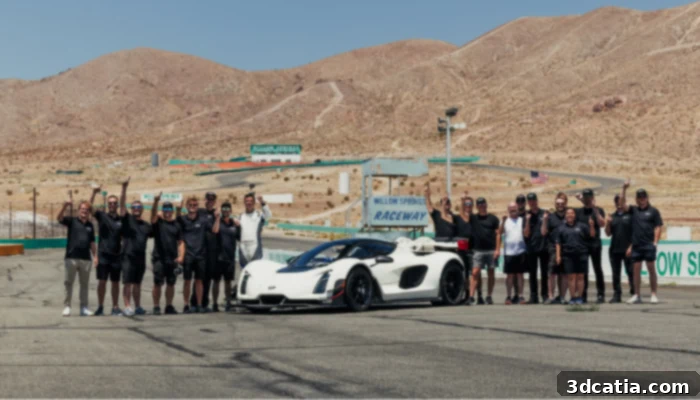
The raw performance data from the Gold Rush campaign speaks volumes about the 21C’s capabilities. At Thunderhill Raceway, the hypercar clocked an astounding lap time of 1:48.30. Shortly thereafter, at Willow Springs International Raceway, it achieved an equally impressive 1:19.73. Perhaps most compellingly, at the legendary Laguna Seca, the Czinger 21C not only set a new record but also managed to shave an additional 0.36 seconds off its own previous record, demonstrating continuous improvement and mastery of the track. These breathtaking attempts were meticulously validated using a state-of-the-art VBOX GNSS-based system, known for its extreme precision in GPS and inertial measurement. Furthermore, independent observers were present at each track to ensure the integrity and authenticity of every record-breaking run. This rigorous validation process leaves no doubt about the legitimacy and significance of Czinger’s achievements.
The chosen racetracks for the Gold Rush campaign are among the most challenging and celebrated in California, each presenting unique demands on a vehicle’s performance and handling. Sonoma Raceway, with its elevation changes and technical corners, tests a car’s chassis and braking capabilities. Laguna Seca is infamous for its iconic “Corkscrew” turn, demanding pinpoint precision and exceptional downforce. Thunderhill Raceway offers a blend of high-speed sections and tighter turns, while Willow Springs is renowned for its incredibly high-speed straights and sweeping corners. The Thermal Club, a luxury motorsports facility, provides a challenging and modern track environment. Conquering these diverse tracks, often requiring different car setups and driving styles, in such rapid succession, firmly cemented the 21C’s status as a versatile and dominant force in the hypercar world.
Beyond Speed: The 21C as a Testament to Continuous Innovation
Czinger’s strategic and extensive usage of 3D printing is a direct reflection of its overarching corporate culture, which is deeply rooted in continuous innovation, cutting-edge digital design, the exploration of advanced materials, and an unwavering commitment to high-performance engineering. The company’s holistic approach seamlessly integrates additive manufacturing throughout the entire vehicle, influencing everything from the fundamental structural supports that form the car’s backbone to the most intricate and complex aerodynamic elements designed to slice through the air with minimal resistance. This deep integration ensures that every component is optimized for its specific function, contributing to a hypercar that is not only exceptionally lightweight and highly efficient but also constantly pushing the boundaries of what is mechanically and aerodynamically achievable.
The 21C hypercar embodies a perfect synergy of advanced engineering and artistic design, where form meticulously follows function. The complex geometries enabled by 3D printing allow for optimized airflow, generating superior downforce and reducing drag, critical factors for stability and speed at extreme velocities. The ability to produce bespoke, high-strength alloys and composite structures through additive processes further enhances the vehicle’s performance envelope. Czinger’s commitment extends beyond mere component manufacturing; it encompasses a complete digital workflow from initial concept and simulation to final production, ensuring every aspect of the car is finely tuned for optimal results. This meticulous attention to detail and pioneering spirit firmly establishes the 21C as a benchmark for future automotive innovation.
A New Era: How 3D Printing is Shaping the Future of Performance Cars
The resounding success of the Czinger 21C signals a monumental shift in how advanced manufacturing technologies, particularly 3D printing, are capable of shaping the very future of performance automobiles. For decades, traditional manufacturing methods have largely dictated the limits of design and material use in car production. However, Czinger has boldly demonstrated that these limitations are now being shattered. The advent of precisely engineered 3D printed structures, combined with other cutting-edge technologies, has empowered Czinger to prove that additive manufacturing is not only a viable method for producing complex, high-performance components but also a technology that can consistently deliver record-breaking results.
This achievement is particularly significant as it moves 3D printing from a prototyping tool to a core production method for some of the world’s most exclusive and high-performance vehicles. As more automakers worldwide continue to experiment with and explore the vast potential of these transformative technologies, the 21C’s remarkable accomplishments may very well mark the dawn of a new era. This era will see hypercars engineered and built with an unprecedented level of customization, performance optimization, and material efficiency, largely driven by the adoption of additive manufacturing. The implications extend beyond just hypercars, promising to influence mainstream automotive design and production, leading to lighter, stronger, and more efficient vehicles across the board.
Czinger’s vision offers a compelling blueprint for the automotive industry’s future. It showcases how integrating digital design, advanced materials, and additive manufacturing from concept to production can yield vehicles with superior performance characteristics and a reduced environmental footprint. The 21C is more than just a fast car; it is a beacon of innovation, demonstrating that embracing disruptive technologies can lead to unparalleled levels of engineering and a truly exhilarating driving experience. The hypercar’s ability to seamlessly transition from public roads to world-class racetracks, setting records along the way, is a testament to the robust and versatile nature of its 3D printed architecture.
What do you think of the Czinger 21C’s groundbreaking achievements and the role of 3D printing in its success? We invite you to share your thoughts and opinions in a comment below, or connect with us on our LinkedIn or Facebook pages! Plus, don’t forget to sign up for our free weekly Newsletter to get the latest 3D printing news delivered straight to your inbox. You can also find all our compelling videos on our YouTube channel. If you are interested in more exciting 3D printing news specifically within the automotive and transportation sector, we encourage you to visit our dedicated page HERE.
*All Photo Credits: Czinger Vehicles