
Essentium Survey Reveals Major Strides in Industrial 3D Printing Adoption: Benefits, Challenges, and Future Outlook
In early February, Essentium, Inc., a leading innovator in industrial additive manufacturing solutions, unveiled the comprehensive findings from the second installment of its independent global research series. This insightful survey delves into the current landscape and future trajectory of industrial 3D printing across various sectors. Our previous coverage in 2019 highlighted the initial survey’s focus on the relatively slow adoption of additive manufacturing (AM) for mass production applications. The latest research, however, paints a much more dynamic picture, showcasing significant advancements in this critical area. It also illuminates the substantial benefits reaped by early adopters of industrial additive manufacturing, while candidly addressing the persistent challenges that still need to be overcome, particularly concerning the high costs associated with 3D printing technologies and materials. Despite these hurdles, the overall results are unequivocally promising, signaling robust growth in AM adoption and a clear indication that strategic investments in industrial 3D printing are indeed yielding tangible returns for a growing number of manufacturers worldwide. This ongoing research by Essentium serves as a vital barometer for the health and direction of the rapidly evolving additive manufacturing industry.
Essentium Survey Highlights the Transformative Benefits of Additive Manufacturing
The initial segment of Essentium’s survey findings, released in 2019, primarily aimed to capture the practical experiences and perceptions of key stakeholders within the manufacturing ecosystem. At that time, while 3D printing technology was recognized for its enormous potential, the industry’s pace in adopting it for true mass production was notably sluggish. The findings underscored that a significant portion of 3D printing applications remained concentrated on simple prototyping rather than integrating it for full-scale production parts or critical end-use components. However, there was a collective expectation for future growth in its application. This landscape appears to have undergone a dramatic transformation since 2019. The past year, in particular, served as a crucible for the additive manufacturing industry, demonstrating its unparalleled ability to step in and produce vast quantities of critical supplies at scale. This agility proved instrumental in maintaining the continuity of assembly lines and supporting essential operations, especially during periods of global disruption.
As Blake Teipel, Ph.D., CEO and Co-founder of Essentium, astutely observes, this paradigm shift represents a pivotal moment: “Manufacturing companies have finally cracked the code of AM for full-scale production runs of hundreds of thousands of parts, and there will be no turning back. This breakthrough signifies not just a technical achievement but a fundamental re-evaluation of manufacturing strategies. There is no longer any doubt whether AM investments deserve a central feature in the execution strategies of companies endeavouring to out-perform their peers. The agility, design freedom, and supply chain resilience offered by additive manufacturing are proving to be indispensable competitive advantages. By working collaboratively with our customers to drive innovation, optimize financial models, and enhance efficiency, we are actively helping them transition into a leaner, more agile, and ultimately more resilient future, powered by the transformative capabilities of additive manufacturing.” This statement underscores a significant shift in perception and application, moving AM from a niche prototyping tool to a core component of modern industrial production.
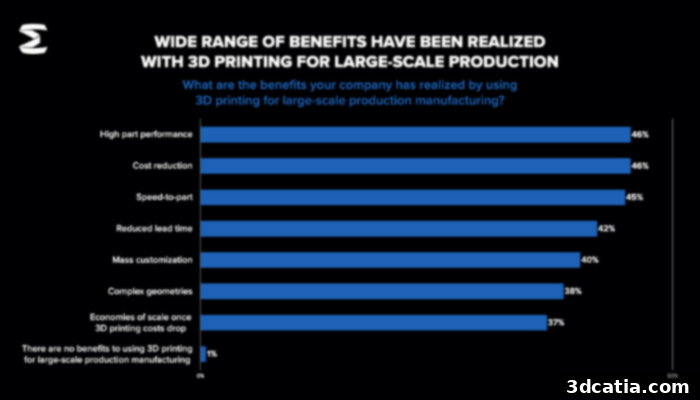
Respondents to the Essentium survey identified a range of significant benefits associated with industrial 3D printing (photo credits: Essentium)
Further reinforcing this positive outlook, the survey respondents provided concrete evidence that investments in industrial-scale 3D printing are indeed delivering substantial returns for companies. Among the most frequently cited and impactful benefits were high part performance, highlighted by an impressive 46% of respondents, and significant cost reduction, also reported by 46% of participants. These two factors are particularly noteworthy as they directly address critical drivers for manufacturing success. High part performance implies that additive manufacturing is no longer limited to non-critical components but is now capable of producing parts that meet stringent engineering requirements for durability, strength, and functionality. This is often achieved through optimized geometries, lightweighting, and material innovations that are difficult or impossible to realize with traditional manufacturing methods. Concurrently, the reported cost reduction is a testament to the technology’s ability to streamline production processes, reduce material waste, minimize inventory through on-demand manufacturing, and potentially eliminate expensive tooling, thereby driving overall operational efficiency. These findings collectively validate the economic viability and technical maturity of industrial additive manufacturing.
Navigating the Hurdles: Persistent Challenges in Industrial 3D Printing Adoption
While the Essentium survey unmistakably highlighted the burgeoning benefits of industrial 3D printing, it also provided a candid assessment of the continued challenges that users encounter in its broader adoption. A significant finding was the overwhelming consensus among respondents regarding the critical need for further innovation within the field. Specifically, a remarkable 98 percent of manufacturing executives surveyed emphasized the inherent value and necessity of improved materials in 3D printing. This strong sentiment stems from a variety of reasons, with 24 percent of respondents explicitly stating that current 3D printing materials often exhibit issues with reliability. Inconsistent material properties, limited mechanical performance, and difficulties in scaling production with existing materials can severely hinder the widespread implementation of AM for critical applications.
The survey also shed light on the specific types of materials urgently requiring development and enhancement, as clearly illustrated in the accompanying chart. Foremost among these are materials engineered for demanding industrial applications and high-volume industrial scale production. This includes a call for stronger, more durable polymers, high-performance composites, and advanced metals that can withstand harsh operating environments, elevated temperatures, and significant mechanical stress. Additionally, there is a growing demand for more sustainable materials, reflecting a broader industry trend towards environmentally conscious manufacturing practices. The development of recyclable, biodegradable, or bio-derived materials for additive manufacturing is becoming increasingly important as companies strive to reduce their ecological footprint and contribute to a circular economy. Addressing these material limitations is crucial for unlocking the full potential of industrial 3D printing across diverse industries.
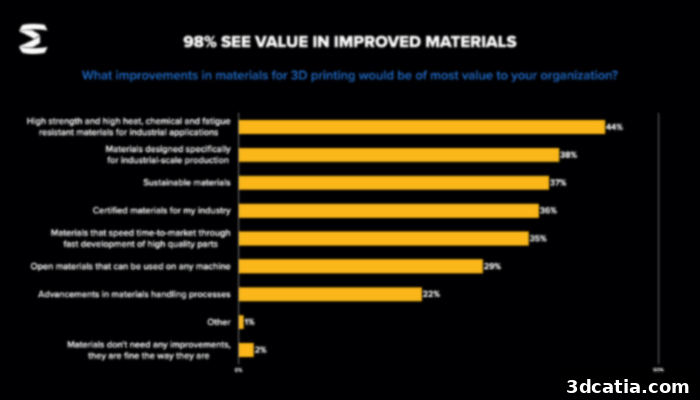
Many respondents to the Essentium survey underscored the critical need for improved materials in additive manufacturing (photo credits: Essentium)
Beyond material innovation, securing approvals for capital investment remains a significant challenge for industrial 3D printing in the foreseeable future, particularly highlighted for 2021. The financial barrier to entry is substantial, with 20% of executives reporting that industrial-scale 3D printing hardware is simply too expensive for their current budgets or return-on-investment calculations. This high initial capital outlay can be a deterrent, especially for small and medium-sized enterprises (SMEs) or companies with limited access to investment funds. Furthermore, 18% of respondents indicated that they already have substantial existing investments in other manufacturing technologies, making it difficult to justify additional, potentially disruptive, capital expenditures for additive manufacturing. An additional and critical point of concern, mentioned by 37% of participants, is the persistently high cost of 3D printing materials, which acts as a significant impediment to widespread adoption and scalability. This is not a novel issue within the additive manufacturing landscape. For industries with limited prior exposure to 3D printing and its underlying technologies, comprehending the true, long-term benefits of integrating such advanced technology can be an arduous task. The total cost of ownership, which includes not just hardware and materials but also training, software, and maintenance, often overshadows the perceived benefits if a clear business case isn’t well articulated.
To mitigate these significant financial and perceptual barriers, the survey findings and industry experts suggest several strategic approaches. One effective method is to intensify focus on specialized training in 3D printing. By educating the workforce on the capabilities, design principles, and operational aspects of AM, companies can build internal expertise, demystify the technology, and more clearly articulate its value proposition. This also helps in fostering a culture of innovation and enables organizations to better identify suitable applications for AM within their existing workflows. Another highly practical solution involves leveraging the services of specialized 3D printing bureaus or service providers. This “AM as a Service” model allows companies to access state-of-the-art 3D printing technology and expertise without incurring the hefty upfront capital expenditure of purchasing the hardware themselves. By outsourcing production or prototyping, companies can test the waters, evaluate the benefits of AM for specific parts or processes at a lower cost, and gain valuable insights before making a substantial investment. This approach significantly de-risks the adoption process and lowers the entry barrier for many manufacturers. You can delve deeper into the full findings and insights from the original press release by clicking HERE.
What are your thoughts on the compelling results of the latest Essentium survey? Are you seeing similar trends or encountering these challenges in your own operations? We invite you to share your perspectives and insights in a comment below or join the conversation on our Facebook, Twitter, and LinkedIn pages! Stay informed about the latest advancements and news in the dynamic world of 3D printing by signing up for our free weekly Newsletter here, delivering the most relevant updates straight to your inbox!