
Driving the Future: How 3D Printing is Revolutionizing Electric Vehicle Manufacturing
The pace of technological advancement in our modern era is nothing short of breathtaking. What seemed like science fiction a mere decade ago is now commonplace, from sophisticated artificial intelligence powering our daily lives to advanced robotics transforming industries. This relentless evolution is profoundly reshaping various sectors, and the automotive industry stands at the forefront of this transformation. Among the most significant shifts we’ve witnessed is the dramatic rise of electric vehicles (EVs), which are quickly moving from niche products to mainstream transportation solutions. Alongside this electric revolution, another groundbreaking technology, 3D printing (also known as additive manufacturing), is emerging as a pivotal force, promising to reshape how these innovative vehicles are designed, manufactured, and customized. The convergence of these two powerful trends heralds a new era of efficiency, sustainability, and unprecedented flexibility in automotive production.
Electric cars, motorcycles, and even commercial vans are increasingly populating our roads and urban landscapes. Their appeal extends beyond their sleek aesthetics, driven primarily by their significantly lower, often zero, emissions and the economic advantages they offer compared to traditional internal combustion engine vehicles. The fluctuating costs of gasoline and diesel, coupled with growing environmental consciousness, make EVs a compelling choice for a growing number of consumers and businesses. Indeed, the global automotive fleet now includes a substantial percentage of hybrid and fully electric vehicles, a testament to this ongoing paradigm shift. As the demand for EVs continues to surge, manufacturers are constantly seeking innovative methods to accelerate production, reduce costs, and enhance vehicle performance. This is where 3D printing steps in, offering a suite of solutions that are already being implemented by leading automotive brands, from rapid prototyping to the creation of end-use parts, fundamentally altering the traditional manufacturing landscape.
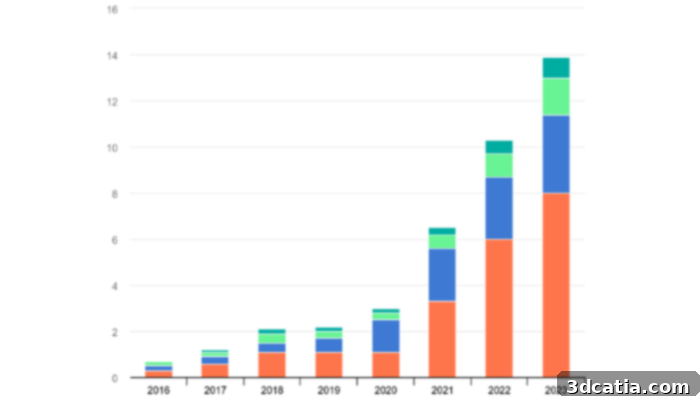
Electric car sales comparing China (orange), Europe (blue) and the USA (neon green) (image credits: IEA)
The Unstoppable Rise of Electric Vehicles: Why the Shift?
The decision to purchase an electric vehicle over a conventional gasoline or diesel car is multifaceted, reflecting a convergence of environmental awareness, economic pragmatism, and evolving regulatory landscapes. For many, the primary motivation is environmental stewardship. Electric vehicles produce zero tailpipe emissions, directly contributing to improved air quality in urban areas and a reduction in overall carbon footprint. This allows environmentally conscious drivers to actively participate in global sustainability efforts, aligning their transportation choices with a commitment to a greener future. The silent operation and smooth acceleration of EVs also contribute to a more pleasant driving experience, further enhancing their appeal.
Beyond environmental concerns, financial incentives play a significant role. While the initial investment for an electric car can sometimes be higher than a comparable gasoline model, the long-term cost savings are often substantial. The cost of electricity to charge an EV is typically much lower than the cost of gasoline or diesel for the same distance traveled. Furthermore, electric vehicles often require less maintenance due to fewer moving parts, reducing overall ownership expenses. Governments worldwide are also offering various incentives, such as tax credits, rebates, and reduced road taxes, making EVs an increasingly attractive financial proposition. Finally, evolving urban regulations and clean air zones in many cities are compelling some drivers to switch to electric vehicles to avoid restrictions and penalties, ensuring accessibility to certain areas.
Despite some skepticism, the data unequivocally supports the burgeoning trend of electric vehicle adoption. For instance, Statista reported that the U.S. electric vehicle market shattered previous records in 2022, with an estimated 918,500 light electric vehicles sold. This represented an astounding increase, more than two and a half times the sales figure from 2018, showcasing accelerated growth. This upward trajectory is mirrored globally and is evident in the remarkable success of pioneering brands like Tesla, whose innovative approach captivated early adopters. Simultaneously, established automotive giants such as Ford, General Motors, and Volkswagen have significantly ramped up their investments in electrification, unveiling a diverse range of hybrid and fully electric models to meet burgeoning consumer demand, cementing the EV revolution as an irreversible shift in personal mobility.
The Dawn of 3D Printing in Electric Vehicle Production
The integration of 3D printing into the automotive sector is not a entirely recent phenomenon, but its application in electric vehicle manufacturing marks a significant evolutionary step. For years, additive manufacturing has been instrumental in rapid prototyping, allowing designers and engineers to quickly iterate on component designs, reduce development cycles, and bring new models to market faster. However, its consumer-facing impact began to emerge approximately a decade ago, spearheaded by the “maker” community. These enthusiasts, equipped with personal 3D printers, started designing and producing small, custom parts for their vehicles. From unique aesthetic accessories to minor structural modifications, these early applications demonstrated the potential for personalization and on-demand manufacturing that 3D printing offered, laying the groundwork for broader adoption.

Strati, the first 3D printed electric car (photo credits: Car and Driver)
A landmark moment in this journey occurred in 2014 at the International Manufacturing Technology Show (IMTS) in Chicago, where Local Motors unveiled the Strati. This small, two-seater electric vehicle was revolutionary because its chassis and body were entirely 3D printed, a pioneering feat. With a design reminiscent of a beach buggy, the Strati comprised only 49 parts and was printed in less than 48 hours, a stark contrast to the thousands of components and lengthy assembly lines of traditional cars. Despite its groundbreaking nature, with a limited range of just under 200 km, the Strati did not achieve widespread commercial success, and initial plans for mass production in 2015 did not fully materialize. Nevertheless, it served as a powerful proof-of-concept, demonstrating the feasibility of printing an entire car and inspiring further innovation.
Building on this early groundwork, the landscape evolved rapidly. In 2018, the world was introduced to the LSEV, later known as the XEV YOYO. Developed by X Electrical Vehicle (XEV) in collaboration with Polymaker, this compact urban electric vehicle pushed the boundaries of additive manufacturing even further. Boasting an incredible printing time of just three hours for its core structure and composed of only 57 parts, the YOYO exemplified efficiency and simplified assembly. Launched in 2019, XEV has since grown from a small startup into a global entity, with dealerships in numerous countries and annual sales reaching thousands of units, showcasing the commercial viability of 3D-printed electric vehicles for specific market segments.
Looking back five years, 3D printing’s full integration into the mainstream automotive world, particularly for electric vehicles, was still nascent. While pioneering examples like the KILO Design and the 4ekolka demonstrated the potential for small-scale electric vehicles, and major manufacturers like Volkswagen and BMW utilized additive manufacturing for vehicle restoration or specialized tooling, the widespread application we see today was largely aspirational. The vision of creating complex, high-performance, and safety-critical components using 3D printing for electric vehicles was still a distant dream, one that the industry has rapidly pursued and is now turning into reality.
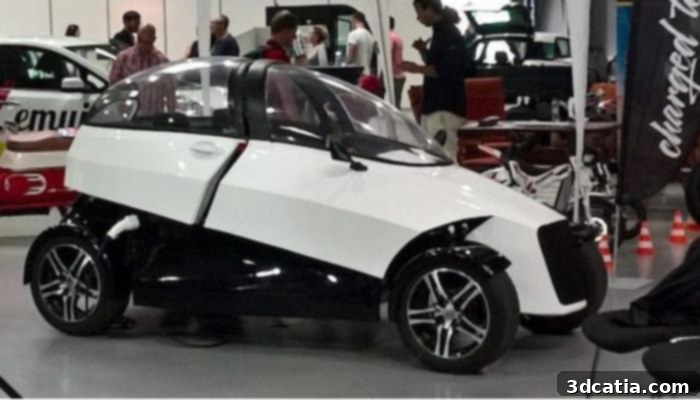
The first version of the 4ekolka on display at a motor show
Compatible 3D Printing Materials and Technologies for Electric Vehicles
Today, a vast array of automotive brands have embraced 3D printing, leveraging its capabilities for everything from producing small, specialized parts for electric vehicles (and conventional ones) to optimizing entire production lines. Companies like Volkswagen, Seat, Toyota, and Lexus are prominent examples, but the list of adopters continues to grow rapidly. Beyond 3D printers themselves, the broader ecosystem of 3D technologies, including advanced 3D scanners and sophisticated 3D design software, plays a crucial role in enhancing design, testing, and quality control processes within the automotive industry.
The choice of 3D printing technology often depends on the specific application and the desired material properties. Manufacturers frequently specialize in one or two primary technologies that best suit their production needs. For instance, luxury supercar manufacturer Koenigsegg extensively utilizes Fused Deposition Modeling (FDM) for thermoplastic parts and Stereolithography (SLA) for resin components, enabling them to create complex geometries and custom tooling. Volkswagen, on the other hand, has made significant strides with HP Metal Jet technology for producing high-strength metal parts efficiently. This highlights that there isn’t a single, universally “best” 3D printing technology for electric vehicles; rather, the selection is driven by the application’s unique requirements, whether it’s for prototyping, tooling, or creating functional end-use parts.
Initially, manufacturers employing additive manufacturing for EV components were largely confined to using plastics. However, advancements in materials science and 3D printing techniques have dramatically expanded this palette. Today, the range of compatible materials is incredibly diverse, encompassing various polymers, metals, and even ceramics. Among thermoplastics, materials such as ABS (Acrylonitrile Butadiene Styrene) and Nylon (Polyamide) remain popular choices due to their excellent mechanical properties, durability, and cost-effectiveness. Additionally, a wide spectrum of resins, offering varying degrees of stiffness, flexibility, and heat resistance, are extensively used for intricate details and smooth surface finishes.
While many of the parts printed with these polymer-based materials are non-critical components that do not directly impact the vehicle’s essential operation or handling, the capabilities of 3D printing extend far beyond. It is now entirely possible and increasingly common to 3D print safety-critical parts for electric vehicles. These components, which demand superior strength, durability, and thermal resistance, are typically produced using advanced metal additive manufacturing processes. Among the most frequently utilized materials for such applications are lightweight yet robust titanium and aluminum alloys. These metals offer exceptional strength-to-weight ratios, crucial for enhancing EV performance and efficiency, and enable the creation of complex geometries impossible with traditional manufacturing methods, thereby unlocking new design possibilities for critical vehicle systems.
Transformative Applications of Additive Manufacturing in EVs
Manufacturers are increasingly recognizing that 3D printed parts offer a compelling combination of advantages: they are often faster to produce, more cost-effective than their traditionally manufactured counterparts, and crucially, just as durable. This realization has driven extensive research and development, with printed parts undergoing rigorous testing to ascertain their limits and validate their suitability for integration into mainstream vehicle production. Whether these components are fabricated from high-strength metals, versatile plastics, or specialized ceramics, they must all pass stringent quality and performance assessments to meet the demanding standards of the automotive industry.
Initially, there was understandable hesitation among many companies to fully incorporate 3D printed parts into their vehicle designs, largely due to concerns about long-term reliability and structural integrity. However, with continuous advancements in materials and printing technologies, the solidity, robustness, and durability of these additive manufactured components have become undeniably evident. Today, numerous leading automotive brands are routinely integrating 3D printed parts into their production vehicles. Volkswagen, for example, is a prime innovator, featuring additive manufactured components in over 13 different car models, utilizing both metal and plastic printing technologies. Dr. Stefan Leest, Volkswagen’s Chief Technology Officer, emphatically confirms this shift, stating, “3D printed parts are as strong as parts manufactured by traditional methods,” highlighting the technology’s maturity and reliability.
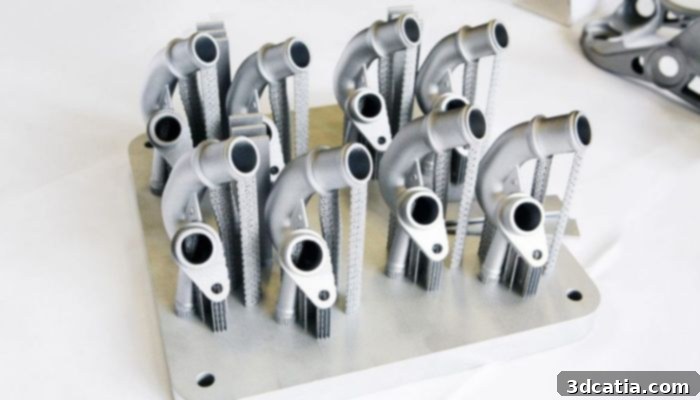
3D printed metal water connectors for Audi’s W12 engine (photo credits: Volkswagen Group)
The applications of 3D printing in electric vehicles are incredibly diverse, spanning both aesthetic and critical functional areas. Common examples include interior trim components like dashboards, custom seat frames, ergonomic control panels, efficient air vents and intricately designed cooling ducts, lighting fixtures, protective covers, and various console accessories. More significantly, additive manufacturing is increasingly being employed for crucial vehicle parts that directly influence performance and safety. These include lightweight mounting brackets, robust housings for electronic components, advanced double wishbone suspensions for improved handling, and sophisticated brake components, showcasing the technology’s capability to deliver high-performance, complex parts.
A compelling case study comes from LEXUS, which announced at the close of 2023 that its new version of the LEXUS LC500 sports car would incorporate 3D printed AT oil cooler ducts. This decision initially sparked questions, particularly concerning cost-effectiveness for low-batch production and the validation of quality for additive manufactured parts in a hybrid supercar. Tomohiro Ohno, LEXUS’s body designer, articulated these concerns: “The two main issues were whether the cost would be feasible, considering low batch production, and how to determine the quality of the parts made with 3D printers.” However, after extensive and rigorous testing, the project received approval, affirming the reliability and performance of the 3D printed components. As a result, the 2024 LEXUS LC500 is set to hit the roads featuring these innovative 3D printed parts, a testament to the technology’s growing acceptance in high-performance automotive applications.
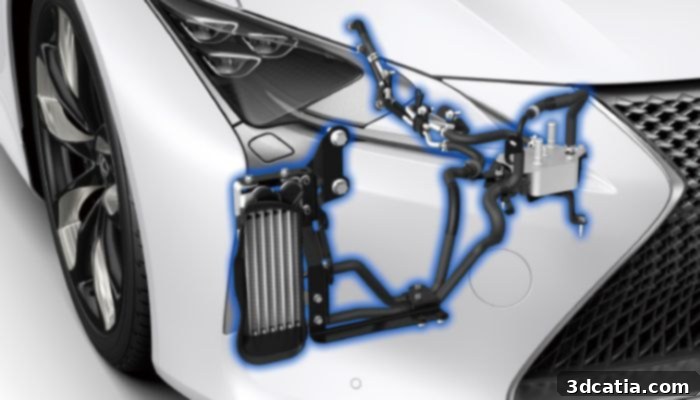
AT oil radiator ducts (photo credits: Solize and LEXUS)
Another prominent example of 3D printing’s significant impact on electric and hybrid vehicles is seen with the renowned hypercar manufacturer, Koenigsegg. This brand leverages FDM and resin 3D printers extensively to produce thousands of parts for its high-performance vehicles, integrating additive manufacturing deeply into its production workflow. This is all facilitated by specialized software like 3DPrinterOS, which streamlines the design-to-print process. Christian von Koenigsegg, the visionary founder and director of the brand, highlighted their innovative approach at The Quail during Monterey Car Week, revealing that they even formulate and produce their proprietary resins, though these are not commercially available. He elaborated on the broad range of applications, stating: “We’re printing housings for electronic controllers, nozzles for spraying under air vents, fins, those kinds of things are printed at high temperature,” underscoring the critical and diverse roles 3D printed components play in their cutting-edge hypercars.
Benefits and Challenges of Integrating 3D Printing for Electric Vehicles
The adoption of 3D printing in the electric vehicle industry is reaching unprecedented heights, marking a pivotal moment in its integration into automotive manufacturing. Many companies are now routinely utilizing these advanced technologies for a multitude of purposes, from rapidly creating prototypes to designing cost-effective components for their existing vehicle lines. As Dr. Werner Tietz, CUPRA’s engineering director, aptly notes, “3D printing allows us to create prototypes quickly and cost-effectively, which helps us to streamline the development process.” This accelerated prototyping capability drastically shortens design cycles, enabling engineers to test and refine concepts with unparalleled speed and efficiency, translating directly into faster innovation and reduced time-to-market for new EV models.
Beyond prototyping, the economic advantages of additive manufacturing extend to production. The cost of manufacturing parts using 3D printing can be impressively lower compared to traditional methods, especially for complex geometries or small to medium batch sizes. This cost efficiency, combined with dramatically reduced lead times, offers a competitive edge that traditional manufacturing processes simply cannot match. For instance, the ability to produce intricate, lightweight components in a single print job eliminates the need for multiple assembly steps, complex tooling, and extensive supply chains, leading to significant savings in both time and resources. This flexibility also enables on-demand production, reducing inventory costs and waste.
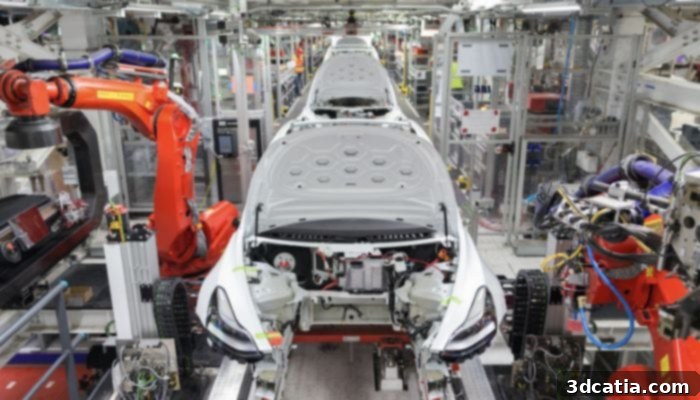
Tesla making giant molds by 3D printing to be able to mass produce cars (photo credits: Tesla)
Furthermore, automotive brands are increasingly employing 3D software not only for vehicle design but also for sophisticated control unit operations. For instance, MG Motors will integrate Snapdragon technology into its new MG Coupé model this year to manage various vehicle functions, demonstrating the increasing reliance on advanced digital tools. In the realm of vehicle testing, the use of 3D printing for creating test cars significantly reduces costs, making the iterative testing process far more economical. A notable example is Tesla, which is utilizing sand binder jetting for producing large molds, enabling them to reinvent car manufacturing and rapidly prototype large vehicle components for their electric fleet.
Another monumental benefit that additive manufacturing brings to the electric car industry is unparalleled customization. The capabilities offered by Industry 4.0 technologies, such as 3D printing, empower manufacturers with virtually limitless possibilities for creating and designing highly personalized electric vehicles. This level of bespoke design is already being capitalized on by several companies. XEV, with its widely acclaimed YOYO model, allows consumers to choose from multiple customizable designs, making each vehicle unique. Similarly, the Toyota Ubox concept car, though not fully developed for production, promised a customizable experience, highlighting the industry’s recognition of this growing consumer demand for personalized mobility solutions.
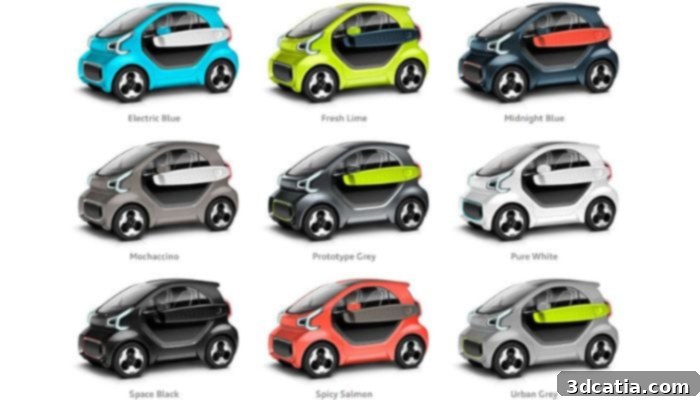
The small and customizable XEV and YOYO EVs (photo credits: XEV)
Despite these numerous and compelling benefits, the automotive additive manufacturing industry faces several inherent challenges that currently impede its full evolution and widespread development. One significant obstacle is the critical shortage of skilled manpower. To effectively design and produce 3D printed parts, there is a pressing need for highly specialized CAD designers proficient in automotive engineering, as well as trained machine technicians capable of operating and maintaining advanced 3D printing systems. While it is true that a deficit of professionals trained in both these burgeoning fields currently exists, academic institutions and vocational programs are increasingly addressing this gap, leading to a steady increase in individuals pursuing these vital professions.
Intellectual property (IP) theft represents another substantial barrier confronting additive manufacturing in the EV sector. The very nature of digital design and additive manufacturing, where designs can be easily shared and replicated, has created loopholes that make it challenging to protect proprietary designs and claim patents effectively. This lack of robust legal frameworks to safeguard the intellectual property of creators worldwide makes many brands and companies hesitant to fully commit to 3D printing electric vehicle components. This issue is not exclusive to EVs; it has been a concern across the broader automotive industry, as evidenced by Honda’s request to remove 3D printable files related to its brand a few years ago, underscoring the urgent need for updated IP protections in the age of digital manufacturing.
These two challenges, alongside others, highlight the hurdles new technologies must overcome to fully penetrate and transform the market. Another crucial consideration is the speed of mass production of parts. While 3D printing offers incredible speed for creating small series of components, prototypes, or unique parts, traditional manufacturing methods can still be faster and more cost-effective when it comes to true high-volume mass production. The creation of very large parts also remains an area where additive manufacturing is still somewhat limited compared to conventional techniques. However, continuous research and development are actively addressing these limitations, with advancements in machine size, print speed, and multi-material capabilities. As the years progress, there is a strong expectation that these challenges will be overcome, allowing 3D printing to establish an undeniable “before and after” in the EV industry, ushering in an era of even greater innovation and efficiency.
What Does the Future Hold for 3D Printing Electric Vehicles?
Having explored the past and present landscape of 3D printed electric vehicles, it’s natural to ponder what the future holds for this rapidly evolving sector. While precise predictions are always speculative, one certainty emerges from observing the trajectory of the last decade: the integration of 3D printing in EV manufacturing will undoubtedly continue its robust growth. This upward trend is substantiated by numerous projects confirmed by leading automotive brands for the coming years, many of which heavily involve additive manufacturing technologies. Companies like Liux, Seat, and Cupra are at the forefront of this movement, signaling a strong industry commitment to further embracing these innovative production methods.

The Volkswagen ID.4 XTREME (photo credits: Volkswagen)
The German automotive giant Volkswagen is also heavily invested in advancing this field. They are actively working to deepen the integration of 3D printing into their electric vehicle lines. A prominent example is the sportier, off-road version of its popular ID.4 GTX EV, known as the ID.4 XTREME. For this electric car, additive manufacturing plays a crucial role in the production of its design components, enabling the creation of specialized, lightweight, and robust parts that enhance both performance and aesthetics, pushing the boundaries of what’s possible in EV design.
Among the pioneering brands mentioned is Liux, a Spanish-origin company poised to disrupt the electric car industry with its innovative approach. After years of dedicated development, Liux is on the verge of bringing several groundbreaking electric cars to the market. The most anticipated among its upcoming models is the Liux Animal, an electric car that promises to marry sustainability with cutting-edge manufacturing. The Animal will not only incorporate sustainable materials like linen but will also leverage 3D printing extensively in its production, showcasing a holistic vision for eco-friendly and efficient vehicle manufacturing.
While the full scope of the future remains largely unwritten, it is abundantly clear that what we have witnessed so far is merely the genesis of a transformative era in the automotive industry. Visionary leaders recognize this profound impact. Elon Musk, CEO of Tesla and SpaceX, articulated his view on EVs, stating: “3D printed cars are an important step towards a more sustainable and efficient future in the transportation industry.” This sentiment is echoed by Jim Hackett, former CEO of Ford Motor Company, who emphasized the far-reaching potential: “3D printed electric cars have the potential to revolutionize the automotive industry, creating lighter, more efficient and sustainable vehicles.” These perspectives from industry titans underscore the immense potential of 3D printing to drive innovation, sustainability, and efficiency in the rapidly expanding electric vehicle market, paving the way for a truly revolutionary future in personal mobility.
What are your thoughts on the diverse uses and immense possibilities that 3D printing offers for electric vehicles? We’d love to hear from you! Let us know in a comment below or connect with us on our LinkedIn, Facebook, and Twitter pages! Don’t forget to sign up for our free weekly newsletter here, ensuring you receive the very latest 3D printing news directly to your inbox! You can also find all our engaging videos and exclusive content on our YouTube channel.