
Sustainable Building: How 3D Printed Recycled Plastic Beams are Transforming Construction
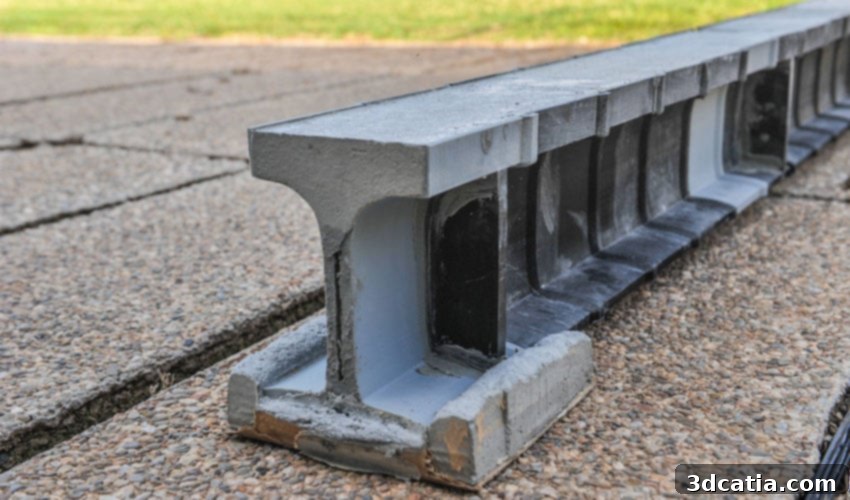
The construction industry, a cornerstone of global infrastructure, is constantly seeking innovative solutions to enhance efficiency, reduce environmental impact, and improve material performance. A groundbreaking development from the Polytechnic University of Valencia (UPV) signals a significant leap forward in this quest. A dedicated team of researchers has successfully engineered an compelling alternative to traditional reinforced concrete beams, leveraging the power of additive manufacturing to create structural components from recycled plastic. This pioneering approach promises a paradigm shift, as these novel beams boast an astonishing 80% weight reduction compared to their conventional counterparts. This drastic decrease in weight not only simplifies transportation logistics and dramatically lowers energy consumption during assembly but also paves the way for a more sustainable and economically viable future in building. The intricate design and modular nature of these 3D printed components allow them to be assembled with remarkable ease, much like LEGO bricks, offering unprecedented flexibility on construction sites.
Reinforced concrete has long been the undisputed champion in the construction sector, valued for its exceptional strength and durability. As its name suggests, this composite material combines the compressive strength of concrete with the tensile strength of metal, typically steel rebar. This synergy allows it to withstand significant loads and various stresses, making it indispensable for foundational structures, columns, and beams in buildings worldwide. However, the inherent properties of steel contribute substantially to the overall weight of reinforced concrete elements. This considerable heft presents numerous challenges, from increasing transportation costs and fuel consumption to requiring heavy machinery and larger workforces for on-site handling and installation. Recognizing these limitations, researchers embarked on a three-year intensive project dedicated to finding a lighter, more sustainable structural alternative.
José Ramón Albiol, a distinguished professor at the UPV’s Technical School of Building Engineering (ETSIE), articulates the core motivation behind their ambitious endeavor: “Our goal was to propose an alternative to the current reinforced concrete beams. These are made using profiles built for the length of the piece, which requires expensive installation and are hard to transport.” This highlights the dual challenge of high material weight and complex, costly installation processes that traditional methods impose. The environmental implications are equally significant, with cement production alone accounting for a substantial portion of global CO2 emissions. Therefore, developing an innovative solution that addresses both structural and ecological concerns became a primary objective for the UPV team, propelling them towards the transformative potential of advanced manufacturing and recycled materials.
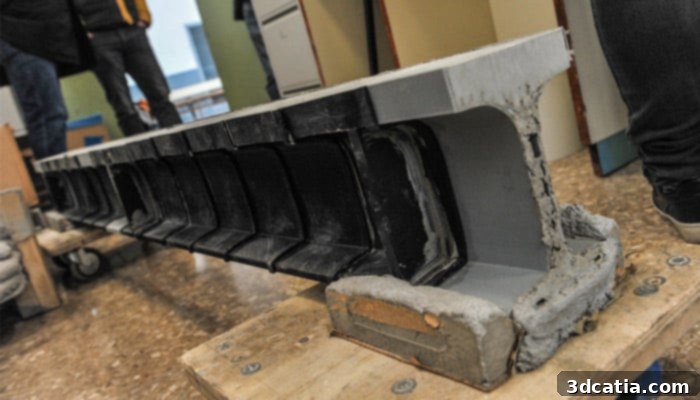
The different 3D printed blocks fit together like LEGO (photo credits: UPV)
Biomimicry in Action: 3D Printed Beams Inspired by Human Bone Structures
The methodology employed by the UPV researchers, while not entirely disclosed in its granular detail regarding the specific 3D printing process, emphasizes several key innovations. Central to their sustainable construction approach is the deliberate choice of recycled plastic as the primary material. This strategic decision drastically reduces the ecological footprint of the beams by diverting plastic waste from landfills and oceans, thereby fostering a more circular economy in building materials. Beyond material selection, the team drew profound inspiration from nature, specifically from the intricate and highly efficient structure of human bones, to inform their 3D models. Their objective was to replicate the architectural brilliance of the epiphysis, the end part of long bones. This section of bone is characterized by its remarkable strength-to-weight ratio, achieved through a complex network of internal layers that confer significant rigidity while maintaining inherent lightness. By harnessing the precision and versatility of additive manufacturing, the researchers were able to accurately mimic this alveolar, or porous, structure. This allowed them to place material only where it was absolutely necessary for structural integrity, a principle known as topology optimization, thereby maximizing efficiency and minimizing resource usage.
The adoption of recycled plastic, coupled with the sophisticated biomimetic design, culminates in a significant reduction in the total weight of these innovative beams. This is not merely due to the lighter density of plastic compared to steel but also a direct result of an optimized distribution of material throughout the beam’s structure. José Ramón Albiol further elaborates on this engineering marvel: “It is an alveolar structure, which makes it possible to decrease the amount of plastic used – and therefore its weight – while maintaining structural rigidity. This is what we have transferred to these revolutionary beams, specifically to their profiles. It is a very intelligent natural system and its reproduction in these beams awards them, with the low structural weight, very high mechanical capabilities.” This highlights the ingenious integration of natural design principles with advanced manufacturing techniques, producing a structural component that challenges conventional thinking about strength and lightness. The hollow, lattice-like internal structure ensures that stresses are distributed efficiently, allowing for robust performance without the need for excessive material, embodying the essence of smart and sustainable design.
Transforming Construction: Modular Design and On-Site Assembly
In practical terms, the UPV researchers have pioneered a system where individual blocks are precisely 3D printed. These blocks are designed with interlocking features, enabling them to fit together seamlessly, much like the familiar toy building bricks. Once these recycled plastic blocks are assembled to form the core of the beam, a final layer of concrete is applied, encapsulating the modular plastic structure to form the complete load-bearing beam. This hybrid approach capitalizes on the strengths of both materials: the lightweight, customizable plastic core and the well-understood compressive strength of concrete. This method yields a structure that is not only significantly lighter but also incredibly versatile, allowing for its modulation and adaptation according to the specific structural demands and design requirements of any construction project. The individual 3D printed blocks are inherently easier to transport due to their reduced size and weight, eliminating the logistical nightmares associated with moving bulky, monolithic reinforced concrete beams. Furthermore, the on-site assembly process simplifies the associated labor, potentially reducing the need for highly specialized equipment and accelerating project timelines. This modular approach heralds a future where construction is more agile, less wasteful, and profoundly more efficient.
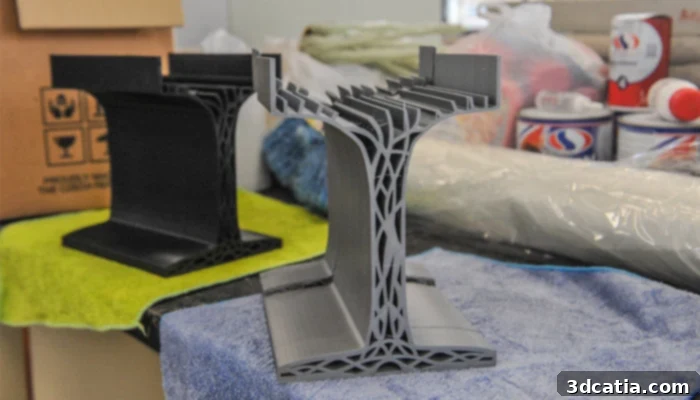
The lattice structure reduces the total weight of the beam
Sustainability and Customization at the Forefront of Building Innovation
The implications of this technology extend far beyond mere weight reduction and ease of assembly. Miguel Sánchez, from the UPV’s Department of Systems and Computer Science (DISCA), underscores the strategic advantages of this custom-built approach: “To be able to customise the beams in situ makes it possible to adapt the characteristics of each of them to the structural needs at each point of construction. The possibility to recycle polymeric materials to produce the beams significantly decreases their carbon footprint.” This ability to tailor structural components on-demand represents a monumental shift from standardized, mass-produced elements. Architects and engineers gain unprecedented freedom to design structures with optimized material use, where each beam’s properties are perfectly matched to its specific role, eliminating over-engineering and material waste. This level of customization, coupled with the foundational use of recycled polymeric materials, positions these 3D printed beams as a cornerstone of sustainable building practices. They embody the principles of the circular economy by transforming waste into valuable resources, drastically reducing the demand for virgin materials and mitigating the environmental impact associated with traditional construction material production and transportation. The reduced carbon footprint associated with both manufacturing and logistics makes these beams an exemplary model for green construction initiatives globally.
The widespread adoption of such innovations could lead to significant reductions in the overall embodied energy of buildings. From the energy-intensive process of steel production and cement manufacturing to the fuel consumed during the transport of heavy materials, every stage of traditional construction carries a considerable environmental cost. By substituting heavy elements with lightweight, recycled plastic components, the UPV team offers a viable pathway to dramatically lower these energy demands. Moreover, the modular nature of the beams could facilitate faster project completion times, translating into economic savings for developers and reducing disruptions in urban environments. This technology is not just about building lighter structures; it’s about constructing a more sustainable, efficient, and adaptable future for our built environment. It represents a confluence of biomimicry, advanced manufacturing, and material science, all geared towards addressing some of the most pressing challenges facing the modern construction industry. As the world moves towards more eco-conscious and resource-efficient practices, these 3D printed recycled plastic beams stand as a beacon of innovation, demonstrating how ingenuity can transform waste into structural brilliance and pave the way for greener, more resilient communities.
What are your thoughts on these revolutionary 3D printed beams and their potential to redefine the construction landscape? We invite you to share your perspectives in a comment below or join the conversation on ourFacebook,Twitter, andLinkedIn pages! Don’t miss out on the latest advancements in additive manufacturing—sign up for our free weeklyNewsletter here, delivering the freshest 3D printing news directly to your inbox!