
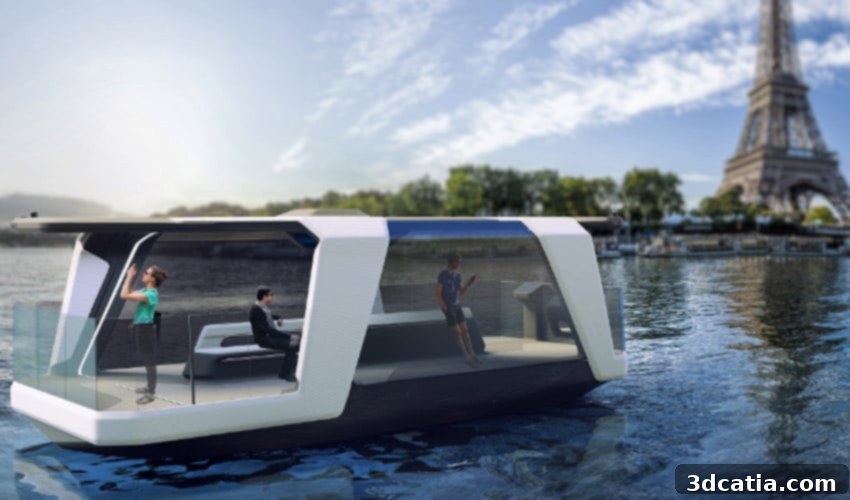
3D Printed Autonomous Ferries: Charting a Sustainable Course for the Paris 2024 Olympics
The anticipation for the Summer Olympics in Paris 2024 is building, and it’s already clear that 3D printing technology is set to play a pivotal role in ensuring the event is not only spectacular but also environmentally responsible. A groundbreaking initiative spearheaded by Vois Navigables de France (VNF), the French inland waterway authority, aims to revolutionize urban transportation for athletes and visitors during the Games. Their quest for environmentally friendly river shuttles has led to the selection of three innovative projects, one of which stands out for its embrace of additive manufacturing: a collaboration between Holland Shipyards Group, Sequana Développement, and Roboat. What makes this project particularly exciting is the commitment to construct the ferry’s hull entirely from recycled materials using advanced 3D printing techniques. This sustainable vessel will be capable of transporting up to 35 people along the iconic Seine River, the very heart of the aquatic events, setting a new standard for eco-conscious event logistics.
The global spotlight will turn to Paris on July 26th, 2024, as the world’s most prestigious sporting event commences. Beyond the thrilling competitions, the French capital is deeply committed to hosting a “Green Olympics,” challenging all involved parties to prioritize environmental preservation and sustainable practices. This commitment extends to every facet of the Games, from infrastructure and housing to venue development and, crucially, transportation. VNF’s official press release underscored this vision, stating: “River transport offers a major opportunity to meet the climate and environmental challenge as an alternative to road transport for the mobility of people and the logistics of goods.” This statement highlights a strategic shift towards leveraging Paris’s natural waterways as a viable and sustainable alternative to traditional road transport. VNF is actively collaborating with transport operators, local authorities, and industrialists to explore novel uses for waterways, including last-mile logistics and the integration of innovative, low-carbon propulsion systems. It was within this context of environmental stewardship and technological innovation that the call for eco-friendly, zero-emission autonomous boats was launched, setting the stage for a new era of urban mobility.
Paris 2024: A Commitment to Sustainable Olympics
The Paris 2024 Olympic and Paralympic Games are not just about athletic prowess; they are also poised to be a benchmark for sustainability in major global events. France has made a resolute commitment to deliver the most environmentally friendly Games ever, aiming to halve carbon emissions compared to previous editions. This ambitious target permeates every aspect of the event’s planning and execution. From using existing infrastructure to minimize new construction to sourcing local and sustainable materials, the organizing committee is demonstrating a holistic approach to environmental responsibility. The focus on river transport directly aligns with this overarching strategy. By promoting waterways as a primary mode of transport, Paris aims to reduce road congestion, lower air pollution, and provide a picturesque, low-carbon travel experience for participants and spectators alike. The initiative for autonomous, zero-emission ferries is a tangible manifestation of this commitment, showcasing how innovative technology can be harnessed to achieve ambitious environmental goals.
The role of Vois Navigables de France (VNF) in this endeavor is central. As the national authority responsible for managing and developing France’s inland waterways, VNF is uniquely positioned to drive sustainable transport solutions. Their ongoing experiments with various stakeholders aim to unlock the full potential of river networks, not just for the Olympics but as a permanent fixture of urban mobility. This includes exploring advanced propulsion methods, such as electric and hydrogen power, and integrating smart, autonomous navigation systems. The objective is clear: to establish river transport as a dependable, efficient, and environmentally superior alternative to road-based logistics and passenger services. The challenge laid before innovators was to design vessels that are not only emission-free but also capable of operating autonomously, enhancing safety and efficiency while minimizing human intervention. This forward-thinking approach perfectly encapsulates the spirit of the Paris 2024 Games – blending tradition with cutting-edge innovation for a sustainable future.
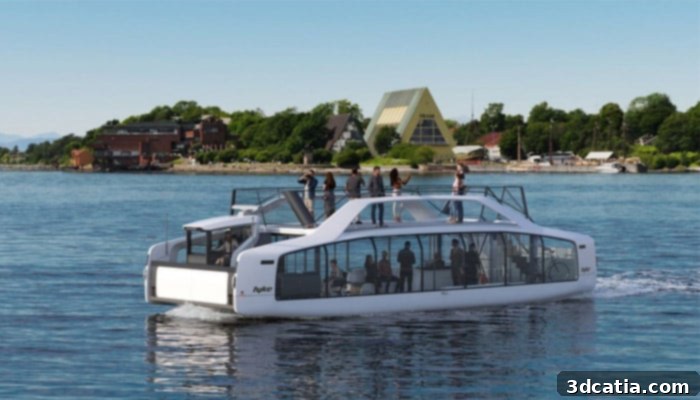
Hyke Rivercat is one of three companies selected for this project (photo credits: Hyke Rivercat)
The Innovative Partnership: Holland Shipyards Group, Sequana Développement, and Roboat
Among the three distinguished projects selected by VNF, the consortium of Holland Shipyards Group, Sequana Développement, and Roboat stands out for its pioneering reliance on additive manufacturing. The name “Roboat” might resonate with many as an initiative spearheaded by a team from the Massachusetts Institute of Technology (MIT). This ambitious project originated in Amsterdam with the goal of developing autonomous boats for urban waterways, demonstrating how robotics and AI can transform aquatic transport. For the specific demands of the 2024 Olympics, the Roboat design will manifest as a 9-meter long and 3.9-meter-wide structure, embodying advanced features such as electric propulsion for zero emissions and an sophisticated automatic docking system for seamless operation. These vessels are engineered to navigate the bustling Seine with precision and efficiency, offering a glimpse into the future of urban mobility.
Our particular interest lies in the construction of the hull for this future river shuttle. It will be fabricated using 3D printing technology, leveraging recycled materials, which is a significant leap towards truly sustainable shipbuilding. This choice of manufacturing method offers numerous advantages. Firstly, it champions the circular economy by repurposing waste materials, significantly reducing the environmental footprint typically associated with boat construction. Secondly, 3D printing allows for complex geometries and optimized designs that might be challenging or costly to achieve with traditional methods. This could lead to lighter, more hydrodynamic hulls, further enhancing energy efficiency. While the exact manufacturing style of the hull remains under wraps, it is highly plausible that large-format additive manufacturing techniques will be employed. This could involve either advanced extrusion machines capable of printing large polymer structures or sophisticated robotic arms equipped with extrusion nozzles, capable of building up layers of recycled material to form the robust and intricate hull structure. This approach not only innovates the shipbuilding process but also sets a powerful precedent for sustainable manufacturing practices in the maritime industry.
The Power of 3D Printing in Sustainable Maritime Transport
The decision to utilize 3D printing, especially with recycled materials, for the Olympic river shuttles is more than just a technological choice; it’s a statement about the future of manufacturing and sustainability. Additive manufacturing offers unparalleled benefits in terms of design freedom, allowing engineers to create optimized structures that are both lightweight and strong. For marine applications, this translates directly into reduced energy consumption for propulsion and enhanced performance. Furthermore, the ability to use recycled plastics and composite materials addresses the growing global concern over plastic waste, transforming it into valuable, high-performance components. This closed-loop approach minimizes waste and reduces reliance on virgin resources, aligning perfectly with the ethos of a “Green Olympics.”
Beyond environmental advantages, 3D printing also offers significant operational benefits. It can accelerate prototyping and production cycles, allowing for rapid iteration and customization. This flexibility is crucial for a project with a tight deadline like the Olympic Games. Should modifications be necessary or additional shuttles be required, 3D printing can adapt much more quickly than conventional manufacturing. The precision offered by robotic arms and large-scale extrusion systems ensures consistent quality and structural integrity, critical for passenger safety. This innovative application of 3D printing in shipbuilding could serve as a blueprint for future sustainable urban transport systems worldwide, demonstrating how cutting-edge technology can deliver practical, eco-friendly solutions on a grand scale. The deployment of these state-of-the-art autonomous shuttles during the Paris 2024 Olympics will undoubtedly be a testament to human ingenuity and our collective commitment to a more sustainable future.
Looking Ahead: The Impact and Legacy of Autonomous 3D Printed Ferries
As the countdown to the Paris 2024 Olympic Games continues, the focus remains on ensuring that every aspect of the event is both successful and sustainable. The introduction of these 3D printed autonomous river shuttles represents a significant step forward in achieving this dual objective. While it remains to be seen how many of these innovative vessels will ultimately be deployed along the Seine, their presence will undoubtedly offer a unique and environmentally conscious transportation experience for thousands of athletes and visitors. This project is not merely about fulfilling a logistical need for the Games; it’s about showcasing the potential of combining advanced manufacturing, artificial intelligence, and sustainable materials to create practical solutions for urban challenges.
The legacy of these autonomous ferries will extend far beyond the closing ceremony of the Olympics. They serve as a powerful proof-of-concept for future smart cities looking to integrate sustainable and efficient public transport systems. By demonstrating the viability of 3D printing with recycled materials in large-scale applications like shipbuilding, the project encourages broader adoption of circular economy principles across various industries. Furthermore, the integration of autonomous navigation technologies paves the way for smarter, safer, and more accessible urban waterways. The success of these shuttles in Paris could inspire other major cities around the globe to re-evaluate their transport strategies, leveraging their natural assets like rivers and canals to create greener, more enjoyable urban environments. In the meantime, enthusiasts and industry professionals can find the official press release for more details HERE, offering deeper insights into this pioneering venture.
What are your thoughts on these innovative 3D printed autonomous ferries for the upcoming Summer Olympics? We invite you to share your perspectives and engage in the conversation! Leave us a comment below or connect with us on our social media channels: LinkedIn, Facebook, and Twitter! Don’t miss out on the latest advancements in additive manufacturing; sign up for our free weekly Newsletter here to get the freshest 3D printing news delivered straight to your inbox! For more visual content, remember you can also find all our videos on our dedicated YouTube channel.