

Revolutionizing Home Cooling: The Eco-Friendly 3D Printed Terracotta Air Cooler
The year 2023 marked an undeniable milestone, officially recognized by scientists worldwide as the hottest summer in recorded history. This escalating heat has naturally driven an increasing number of people indoors, seeking respite within air-conditioned environments. However, the paradox of modern comfort is striking: conventional air conditioning units, while providing immediate relief, are significant contributors to the very climate crisis they help us escape. They consume vast amounts of electricity, placing a heavy burden on power grids and often relying on fossil fuel-generated energy. Furthermore, the refrigerants commonly used, such as fluorocarbons, are potent greenhouse gases known to deplete the ozone layer, thus exacerbating global warming. This urgent environmental challenge calls for innovative, sustainable cooling solutions. Fortunately, a beacon of hope has emerged from the intersection of ancient wisdom and cutting-edge technology: a group of visionary designers has leveraged the power of 3D printing to create an ingenious terracotta air cooler, presenting a truly eco-friendly alternative to traditional AC systems.
Additive manufacturing, more widely known as 3D printing, has rapidly cemented its position as a pivotal technology for projects aiming to guide humanity towards a more sustainable and greener future. Its versatility allows for the transformation of ideas into tangible objects with unprecedented efficiency and reduced waste. We’ve witnessed its application in diverse eco-conscious initiatives, from creating furniture and footwear using recycled materials to pioneering efforts in developing man-made coral reefs to revitalize marine biodiversity. These examples merely scratch the surface of how 3D printing is being harnessed to significantly improve sustainability across various sectors. The latest project, this innovative 3D printed air cooler, stands proudly among these environmentally conscious endeavors. It masterfully combines time-honored cooling principles with the transformative capabilities of modern additive manufacturing, offering a compelling vision for the future of sustainable climate control.
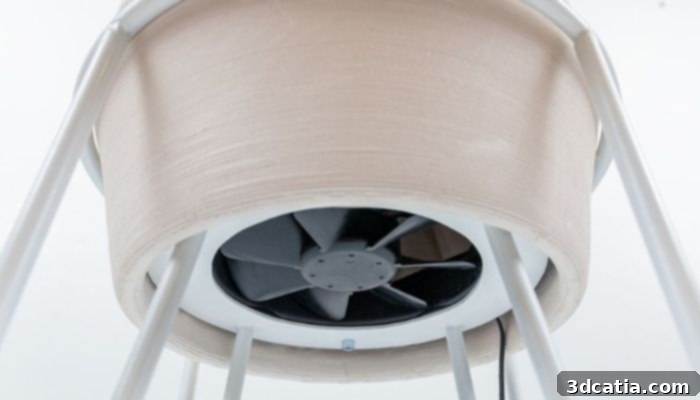
A fan integrated into the 3D printed terracotta structure for optimized air flow distribution.
Unveiling the Eco-Friendly Terracotta Air Cooler: A Fusion of Ancient Wisdom and Modern Technology
This groundbreaking project is the visionary brainchild of the Entreautre design agency, spearheaded by the talented designer Simon Pavey. Their core idea was elegantly simple yet profoundly impactful: to develop a porous terracotta container, meticulously crafted and designed to be filled with water. The magic of cooling in this extraordinary device is entirely natural, drawing inspiration from ancient practices perfected over centuries in the Middle East and North Africa. The fundamental principle at play is the evaporative cooling effect, where the natural evaporation of water from the porous surface of the terracotta container draws heat from the surrounding air, thereby lowering its temperature.
At the heart of this eco-friendly innovation lies the so-called Water Evaporative Evaporator Effect (WEEE). This phenomenon is not new; it has been utilized in various forms throughout history, from simple clay pots keeping water cool to elaborate architectural cooling systems. In the context of the 3D printed air cooler, the WEEE operates by facilitating the continuous interaction between an airflow and the moist terracotta surface. As air passes over and through the water-saturated porous ceramic, the water molecules on the surface absorb thermal energy from the air, transitioning from liquid to gas (evaporation). This energy absorption results in a significant drop in the air’s temperature, producing a refreshing stream of cool air without the need for energy-intensive compressors or harmful refrigerants. This low-tech, high-impact approach offers a sustainable pathway to personal and localized cooling, harking back to efficient methods that predated modern mechanical refrigeration.
The Innovative Leap: Marrying Tradition with Additive Manufacturing
While the core principle is ancient, the designers’ genius lies in their modern interpretation and enhancement. To significantly boost the cooling efficiency of this terracotta air cooler, Entreautre and Simon Pavey sought to maximize the wet wall surface area in direct contact with the ventilated air. Achieving this required pushing the boundaries of traditional manufacturing. They explicitly noted that ceramic 3D printing proved absolutely integral for experimenting with and fabricating complex, intricate volumes that would be impossible or prohibitively expensive to create using conventional methods. This advanced manufacturing technique enabled them to explore innovative design concepts, such as “differential growth.”
Biomimicry: Nature’s Blueprint for Enhanced Efficiency
The concept of differential growth, a cornerstone of this project’s design philosophy, is deeply rooted in biomimicry. This field involves drawing inspiration from nature’s brilliant engineering solutions to solve human challenges. In this context, the designers observed how lines and surfaces in biological systems fold, curve, and branch upon themselves to dramatically increase their surface area within a confined space. Think of the intricate folds of the human brain or the vast network of roots in a plant – these are natural examples of maximizing surface for function. By applying these biomimetic principles, the designers could create an internal structure for the terracotta cooler that features an incredibly large and intricate wet surface area, thereby enhancing the evaporative cooling effect and the overall performance of the device. This approach not only optimizes functionality but also often results in aesthetically pleasing, organic forms.
Customized 3D Printing for Terracotta
The fabrication of this unique air cooler unit was made possible through the use of a custom-built 3D printer, a remarkable creation by the Dutch artist and inventor Olivier Van Herpt. This specialized machine operates on principles similar to a classic Fused Deposition Modeling (FDM) printer, which is typically used for plastics. However, instead of plastic filaments, this bespoke printer precisely extrudes terracotta as a thin, continuous filament, building the complex structure layer by layer. This highly specialized process allows for the creation of intricate internal geometries and porous textures that are crucial for the cooler’s efficiency. The technique shares notable characteristics with concrete 3D printing, particularly in its method of extruding a viscous, paste-like material, and also bears resemblance to ArchiREEF’s innovative process for creating terracotta tiles for coral reef restoration. This fusion of material science and additive manufacturing allows for unprecedented control over material distribution and structural integrity, specifically tailored for the unique properties of terracotta.
Precision Design with Parametric Tools: The Grasshopper Advantage
To further optimize the intricate internal and external geometries of the air cooler and ensure its maximum efficiency, the design team employed Grasshopper, a powerful visual programming language and graphical algorithm editor tightly integrated with Rhino 3D modeling software. Traditional Computer-Aided Design (CAD) programs often struggle with the generation and manipulation of such highly complex, parametric pieces, especially those influenced by organic or biomimetic principles. Grasshopper provided the essential flexibility and control needed to develop these intricate designs.
This advanced parametric design tool was instrumental in incorporating and fine-tuning a multitude of critical parameters simultaneously. Designers could dynamically adjust everything from the lining thickness and overall porosity of the terracotta structure to its structural resistance, the precise water volume it could hold, and the crucial surface exchange area between the ceramic, the airflow, and the water. This iterative design process, facilitated by Grasshopper, allowed the team to explore countless variations rapidly, optimizing for factors like airflow dynamics, evaporative efficiency, material usage, and structural integrity. The ability to parametrically control these elements ensures that each component of the air cooler is precisely engineered for optimal performance, marrying form and function in a truly sophisticated manner.
Beyond Cooling: Performance, Aesthetics, and Future Outlook
Currently, this aesthetically pleasing and highly functional cooling system is undergoing rigorous testing. These evaluations are crucial for accurately assessing its performance, ensuring long-term durability, and verifying its overall efficiency as a sustainable cooling solution. While the specific numerical results of these tests are eagerly awaited, the initial promise is undeniable. The mere existence of such a thoughtfully designed, eco-friendly alternative highlights a critical truth: 3D printing technology is continuously opening more and more doors to new, environmentally conscious possibilities across numerous industries. It empowers designers and engineers to create products that are not only innovative and functional but also align with the urgent global need for sustainability. This terracotta air cooler is a powerful demonstration of how advanced manufacturing can revive ancient concepts and adapt them for modern challenges, offering a tangible step towards a greener future for personal climate control. For those interested in delving deeper into the specifics of this project, more information can be found on Simon Pavey’s dedicated website HERE.
Join the Conversation: Your Thoughts Matter!
What are your thoughts on this innovative, environmentally friendly air cooler? Do you believe it offers a viable and compelling alternative to conventional air conditioning systems, especially as global temperatures continue to rise? We’d love to hear your perspective and insights! Share your comments below or engage with us on our social media platforms. You can find us on LinkedIn, Facebook, and Twitter. Don’t miss out on the latest advancements and news in the world of additive manufacturing; sign up for our free weekly Newsletter here to receive the freshest 3D printing news straight to your inbox! Additionally, explore a wealth of compelling content and demonstrations by visiting our YouTube channel, where you can find all our videos.
*All Photo Credits: Entreautre Design Agency