

University of Waterloo Pioneers Global Additive Manufacturing with Landmark Investment
The University of Waterloo, nestled in the heart of Ontario, Canada, is making a monumental stride in the realm of advanced manufacturing and education. With a visionary commitment to technological innovation, the institution has proudly unveiled its latest investment in state-of-the-art 3D printing technology, poised to transform the industrial landscape. This ambitious initiative is backed by significant funding, totalling an impressive $27 million, earmarked for the establishment of a cutting-edge additive manufacturing lab. This substantial financial commitment underscores a collaborative effort from various governmental bodies, including an $8.9 million injection from the Federal Economic Development Agency for Southern Ontario (FedDev) and an additional $6.2 million already provided by the Government of Ontario. Such a comprehensive investment positions the University of Waterloo as a global leader, fostering a vibrant ecosystem for research, development, and industrial application in the rapidly evolving field of additive manufacturing.
By spearheading the creation of this advanced additive manufacturing lab, the University of Waterloo aims to significantly accelerate the adoption and integration of industrial additive manufacturing across various sectors. This ambitious goal will be realized through a multi-faceted approach, emphasizing robust research initiatives, cultivating 18 new strategic partnerships with industry leaders, and proactively generating skilled employment opportunities. The lab is projected to create at least 80 new jobs within the manufacturing and technology sectors, further solidifying Ontario’s position as a hub for innovation and advanced production techniques. These new roles will encompass a broad spectrum of expertise, from material scientists and mechanical engineers to software developers and robotics specialists, reflecting the interdisciplinary nature of modern additive manufacturing. This investment is not just about equipment; it’s about nurturing talent, fostering collaboration, and building a sustainable future for advanced manufacturing in Canada and beyond.

Among the array of advanced equipment acquired, these metal 3D printers represent a cornerstone of the new facility, made possible by the recent funding. Photo courtesy of Flora Pan/CBC.
Upon its completion, the University of Waterloo’s additive manufacturing lab is poised to become one of the top ten largest university-based facilities of its kind worldwide, a testament to its scale and ambition. This world-class facility will be fully equipped with an extensive array of cutting-edge machinery and instrumentation, establishing it as a preeminent hub for groundbreaking research. The lab’s core focus will revolve around several critical areas essential for advancing the frontier of additive manufacturing. These include the development of next-generation processes within metal 3D printing, pushing the boundaries of what is possible with advanced alloys and complex geometries. Researchers will also concentrate on integrating innovative sensors directly into the printing process, enabling real-time monitoring and control for unparalleled precision and material integrity. Furthermore, a significant effort will be dedicated to creating sophisticated quality assurance software, crucial for ensuring the reliability and repeatability required for industrial applications. Finally, the lab will delve deep into improving machine intelligence, leveraging artificial intelligence and machine learning to optimize printing parameters, predict outcomes, and automate complex manufacturing tasks, paving the way for truly autonomous and highly efficient additive manufacturing systems. This holistic approach ensures the lab will not only contribute to academic knowledge but also directly impact industrial practices.
Feridun Hamdullahpur, the esteemed president and vice chancellor at the University of Waterloo, articulated the profound implications of this venture. “Additive manufacturing is poised to fundamentally change the way things are made,” he emphasized, highlighting the disruptive potential of this technology. He further elaborated on the university’s unique position to lead this transformation: “Fueled by a culture of innovation and backed by broad expertise in the advanced manufacturing sector, we look forward to playing a key role with our partners in unlocking the potential of this exciting technology.” This statement encapsulates the university’s commitment to not only pushing scientific boundaries but also translating research into tangible industrial and economic benefits. The University of Waterloo has long been recognized for its entrepreneurial spirit and strong ties to industry, making it an ideal environment for nurturing advancements in such a critical field. The investment in this lab is a natural extension of its legacy, leveraging its intellectual capital and collaborative ethos to drive the next industrial revolution.
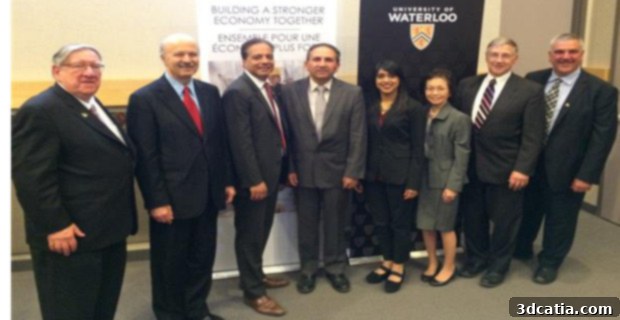
Insights into the collaborative environment fostering innovation at the University of Waterloo’s new facility. Photo courtesy of 570 News – Erin Anderson.
For the province of Ontario, this new additive manufacturing lab represents a critical strategic asset, viewed as the cornerstone for maintaining and enhancing its competitive edge in the global manufacturing sector. In an increasingly competitive global economy, regions must continuously innovate to stay relevant, and this lab provides Ontario with a distinct advantage. It is expected to significantly contribute to the progression and diversification of the region’s economy, fostering a high-tech ecosystem that attracts investment and talent. The advancements made here will ripple through key industries such as aerospace, automotive, medical devices, and defense, offering unparalleled capabilities for rapid prototyping, complex part production, and supply chain optimization. The lab will serve as a beacon for industrial partners seeking to explore and implement additive manufacturing solutions, providing them with access to cutting-edge research, equipment, and highly skilled personnel. Furthermore, the specialized training and research opportunities offered by the lab will help create a pipeline of skilled workers, addressing the growing demand for expertise in advanced manufacturing technologies. While a specific opening date for the lab has not yet been announced, anticipation is building both locally and across the international scientific and industrial communities. Stakeholders worldwide are eagerly awaiting the groundbreaking innovations in additive manufacturing that are expected to emerge from this facility, setting new benchmarks for efficiency, customization, and sustainability in production.
The implications of such a significant investment extend far beyond the university campus. The University of Waterloo’s initiative is poised to establish a robust framework for future research and development in additive manufacturing, addressing critical challenges and unlocking new opportunities. By focusing on areas like advanced metal 3D printing processes, the lab aims to overcome current limitations related to material properties, part size, and production speed, making additive manufacturing viable for an even broader range of industrial applications. The integration of innovative sensors will revolutionize process control, allowing for real-time adjustments and significantly reducing material waste and production errors. This level of precision is crucial for industries where component reliability is paramount, such as aerospace and medical implants. Similarly, the development of sophisticated quality assurance software will instill greater confidence in additively manufactured parts, accelerating their adoption in critical applications where regulatory compliance is a key concern. Furthermore, pioneering research into machine intelligence will lead to more autonomous and efficient printing systems, reducing human intervention and increasing overall productivity. Imagine 3D printers that can self-diagnose, optimize their own parameters, and even learn from past projects to improve future prints—this is the future the University of Waterloo is actively building. This ambitious vision aligns perfectly with Canada’s broader innovation agenda, emphasizing research and development as key drivers for economic growth and global competitiveness.
Considering the transformative potential demonstrated by the University of Waterloo’s proactive steps, it raises a pertinent question for the broader educational landscape: should more academic institutions and universities globally follow this pioneering example? The benefits of such investments are multifaceted, extending from nurturing future talent and driving scientific discovery to bolstering regional economies and fostering industrial innovation. Sharing resources and expertise through collaborative ventures, similar to the partnerships being forged at Waterloo, could accelerate the global adoption of advanced manufacturing techniques. We invite you, our readers, to share your thoughts on this exciting development. Do you believe that widespread academic investment in additive manufacturing labs is essential for future technological progress and economic resilience? Let us know your perspective in a comment below, or join the conversation on our Facebook and Twitter pages! For all the latest breaking news and insights from the world of 3D printing delivered straight to your inbox, ensure you sign up for our weekly newsletter today!