
Top 5 3D Printing Innovations This Week: Revolutionizing Industries
Welcome to our highly anticipated weekly compilation of the most inspiring and groundbreaking developments in the dynamic world of additive manufacturing! Each week, we meticulously curate and present the TOP 5 3D printing videos that are not just trending, but genuinely shaping the future of countless sectors. From critical medical breakthroughs and advanced industrial solutions to sustainable material innovations and transformative design methodologies, 3D printing continuously demonstrates its unparalleled versatility and immense potential. This week’s hand-picked selection vividly illustrates how forward-thinking innovators and leading companies are harnessing this revolutionary technology to achieve remarkable feats, pushing the boundaries of what was once considered impossible. We invite you to delve into our comprehensive list below, explore these fascinating advancements in detail, and share your thoughts on which innovation captured your imagination the most! Your active participation enriches our community, so please don’t hesitate to leave your comments or connect with us on our social media platforms like Facebook and Twitter. Join us as we explore the ever-evolving and exciting landscape of 3D printing!
This Week’s Top 5 3D Printing Innovations: A Deep Dive
TOP 1: Transforming Orthodontics with Precision 3D Printing Technology
The dental and orthodontic industries are currently undergoing a significant and exciting transformation, largely driven by the unprecedented precision, speed, and customization capabilities offered by 3D printing technology. This week, we shine a spotlight on the pioneering efforts of Proto3000, a company already recognized for its innovative applications – you might recall their impressive work on the 3D printed surfboard utilized by professional surfer Mick Fanning. Now, they are channeling their expertise towards revolutionizing dental care, particularly within the field of orthodontics.
The featured video provides an exclusive look into their latest work, where you’ll meet Eyal Geiger, a key innovator who demonstrates how Proto3000 is effectively leveraging the power of additive manufacturing for sophisticated orthodontic applications. This technology enables the rapid and accurate creation of highly detailed, patient-specific models, custom surgical guides, individualized aligners, and even intricate prosthetic components. Unlike traditional methods that often involve time-consuming and sometimes uncomfortable impression-taking processes, 3D printing seamlessly converts digital scans into physical models, significantly streamlining clinical workflows and vastly improving the patient experience. The advantages extend far beyond mere comfort; the superior precision inherent in 3D printing results in better-fitting devices, more predictable treatment outcomes, and ultimately, a much higher degree of patient satisfaction. This innovation isn’t just about accelerating production; it’s fundamentally about enhancing quality, enabling greater personalization, and increasing accessibility to advanced dental solutions, thereby pushing the established boundaries of modern orthodontics and digital dentistry.
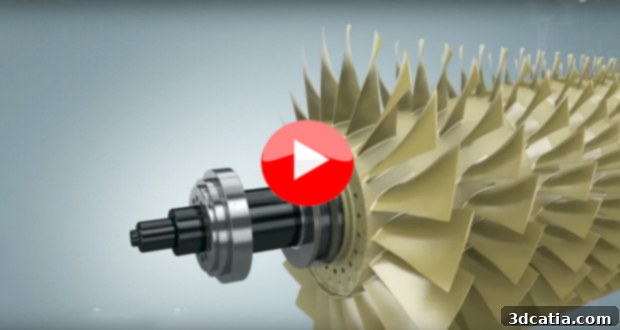
TOP 2: Siemens’ Groundbreaking 3D Printed Turbine Ready for Open Seas
The marine industry represents another critical sector where 3D printing is undeniably making significant and impactful waves. While our readers may recall our previous feature on the innovative boat propeller created using 3D printing by RAMLAB, this week, the global engineering powerhouse Siemens commands our attention. They are proudly showcasing a monumental achievement: robust 3D printed metal blades specifically designed for integration into large ship turbines. This is far from being merely a conceptual prototype; it represents a fully functional, highly durable component engineered to withstand the rigorous and demanding conditions encountered on the open seas.
The accompanying video offers an exclusive and fascinating glimpse into this remarkable “breakthrough” in metal additive manufacturing. It meticulously traces the entire journey, from the initial intricate design phase and the precise execution of the printing process using advanced techniques, all the way to the rigorous testing and validation of the final, exceptionally durable product. By employing sophisticated metal 3D printing, Siemens has successfully overcome traditional manufacturing limitations, producing complex geometries that would be exceedingly challenging, if not impossible, to achieve with conventional methods. These innovatively designed blades are not only significantly lighter, contributing to improved fuel efficiency, but also exhibit enhanced durability and performance, making them ideally suited for the harsh marine environment. The capability to rapidly produce such critical components drastically reduces lead times for both initial manufacturing and subsequent repairs, offering unparalleled operational flexibility and considerable cost efficiencies for shipbuilding and maintenance operations globally. This innovation powerfully underscores the immense potential of 3D printing to revolutionize heavy industries, providing bespoke, high-performance solutions that extend the operational lifespan of vital machinery, ensuring marine vessels can operate more reliably, efficiently, and sustainably across the world’s oceans.
TOP 3: Pioneering Environmentally Friendly 3D Printing Ink from Cellulose Nanocrystals
As global consciousness increasingly pivots towards sustainable and eco-friendly practices, the realm of 3D printing technology is also embracing critical innovations that prioritize environmental responsibility. This week’s particularly exciting breakthrough emerges from the dedicated researchers at Epam, who have successfully developed a groundbreaking 3D printing ink derived entirely from cellulose nanocrystals. This is not merely an incremental improvement; it signifies a substantial leap forward in the quest to create truly environmentally responsible additive manufacturing solutions. Cellulose nanocrystals, sourced directly from abundant and renewable plant-based materials such as wood, represent a sustainable and inexhaustible resource for the development of the next generation of printable materials.
This novel, bio-based ink is deservedly generating considerable excitement and discussion within the broader 3D printing community. Its potential implications are vast and far-reaching, promising to usher in an era of fantastic innovations, especially within the critical domains of 3D bioprinting and other specialized applications where superior biocompatibility and complete biodegradability are paramount. Envision the future possibilities: medical implants that naturally dissolve and degrade within the human body after fulfilling their therapeutic purpose, or consumer products that, upon disposal, leave absolutely no lasting environmental footprint. Beyond the medical sphere, this cellulose-based ink opens up unprecedented opportunities for sustainable manufacturing across a diverse range of industries, including advanced packaging, eco-friendly textiles, and innovative composites, thereby significantly reducing our collective reliance on petroleum-based plastics. The continuous development and widespread adoption of such green materials are absolutely crucial for ensuring the long-term sustainability and ecological viability of additive manufacturing, seamlessly aligning technological advancement with imperative ecological responsibility. This innovation not only powerfully highlights the inherent versatility and potential of natural resources but also actively paves the way for a future where advanced manufacturing processes can thrive without compromising the health and integrity of our planet.
TOP 4: Villeroy & Boch Embraces 3D Printing for Enhanced Industrial Design and Prototyping
In the intensely competitive landscape of industrial design and product development, the attributes of speed, accuracy, and the capacity for rapid iteration are absolutely paramount for success. This fundamental need is precisely why esteemed companies such as Villeroy & Boch, a brand globally synonymous with unparalleled quality, innovative design, and timeless elegance in the ceramics and bathware industry, are increasingly integrating 3D printing into their core operational strategies. Additive manufacturing distinguishes itself as an unrivaled technology for both rapid prototyping – enabling quick conceptualization and testing – and the direct creation of functional end products, allowing designers and engineers to swiftly transform abstract conceptual ideas into tangible, physical forms. This capability brilliantly illustrates the ‘what could be’ in remarkably compressed timeframes, drastically accelerating the design cycle.
The insightful video offers a comprehensive look into how Villeroy & Boch strategically leverages this transformative technology across their product development lifecycle. You’ll gain valuable insights from Johan de Groot, who eloquently articulates how 3D printing is fundamentally altering traditional design and manufacturing paradigms within their highly specialized industry. For a company that places immense emphasis on aesthetic appeal, intricate detailing, and functional excellence, 3D printing facilitates the rapid production of highly accurate and complex models and prototypes. This capability is critical for expediting design validation, conducting thorough ergonomic testing, and performing detailed aesthetic evaluations with unprecedented speed. Consequently, this drastically reduces the development cycles and significantly cuts down on the prohibitive costs traditionally associated with conventional tooling and molding processes. By enthusiastically embracing 3D printing, Villeroy & Boch is not only substantially enhancing its creative freedom and accelerating its ability to introduce groundbreaking designs to the market but also strategically positioning its business for robust future growth and maintaining a significant competitive advantage in an ever-evolving global marketplace. This powerful integration unequivocally demonstrates how additive manufacturing empowers established and renowned brands to remain at the absolute forefront of design innovation and manufacturing efficiency.
TOP 5: The Architectural Thought Process Magnified by 3D Printing
At the very core of every significant architectural design lies a profound and inquisitive thought process, invariably propelled by the fundamental question of ‘why.’ This critical line of inquiry is absolutely essential, not only for conceptualizing innovative structures and challenging existing norms but also for effectively translating those complex ideas into precise and compelling physical representations. In this context, 3D printing has rapidly emerged as an indispensable tool throughout this creative journey, empowering architects, urban planners, and students alike to explore, visualize, and refine their designs with unparalleled ease, accuracy, and speed. It skillfully bridges the crucial gap between abstract, often theoretical concepts and tangible, highly detailed models, making even the most complex geometries, spatial relationships, and structural challenges readily comprehensible and discussable.
This week’s final illuminating highlight powerfully showcases how a dedicated student, operating under the expert guidance of his professor, is strategically utilizing this powerful questioning approach in conjunction with advanced 3D printing technology to push the very boundaries of contemporary architectural design. The captivating video beautifully illustrates how 3D printed models serve as far more than mere physical representations; they transform into interactive, dynamic tools for rigorous critical analysis, collaborative problem-solving, and highly effective communication among design teams and stakeholders. From creating incredibly intricate building facades and detailed interior layouts to developing comprehensive urban planning models, 3D printing facilitates the rapid and cost-effective production of sophisticated physical models. These models provide invaluable insights, foster superior understanding, enhance stakeholder engagement, and enable the crucial early identification of potential design flaws or opportunities for improvement. This technological integration not only dramatically accelerates the iterative design process but also cultivates an environment of greater creativity and innovation. Ultimately, it propels modern architectural practice forward, inspiring future generations of designers to bring their most ambitious and complex visions to life with newfound efficiency, precision, and conceptual clarity. It strongly underscores how cutting-edge technology, when thoughtfully combined with a foundational and inquisitive thought process, possesses the profound capability to truly innovate and shape the future of our built environment, fostering sustainable and inspiring spaces for all.