
Exploring the Future: Top 5 Revolutionary 3D Printing Innovations Changing Our World
Welcome to this week’s captivating journey through the most groundbreaking applications of 3D printing technology. From profoundly personal experiences to societal advancements, additive manufacturing continues to push boundaries in ways we could scarcely imagine just a few years ago. This curated collection of videos highlights innovations ranging from creating tangible memories of unborn children to revolutionizing how we build homes and even prepare our food. Each segment showcases the incredible versatility and transformative potential of 3D printing, underscoring its pivotal role in shaping our future across numerous industries. Remember to check back every Sunday for a fresh batch of insights into this dynamic field, ensuring you never miss the latest developments.
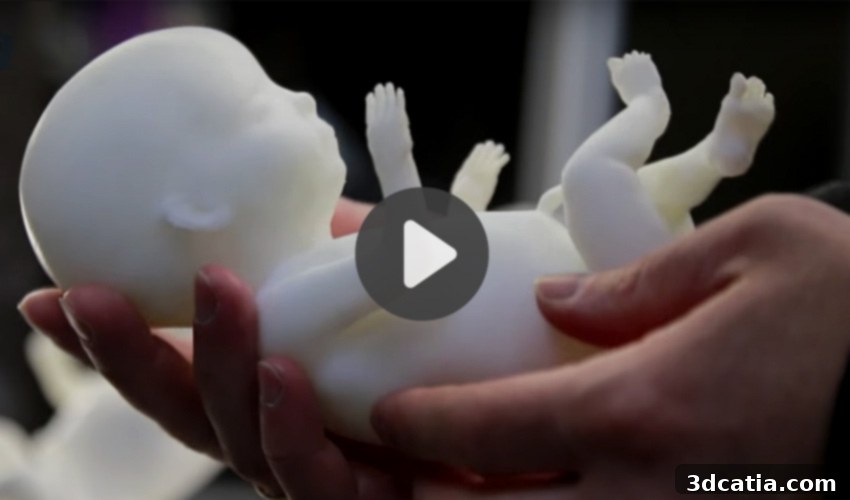
1 – Creating Lifelong Memories: 3D Printed Baby Embryos
The anticipation of welcoming a new child is an unparalleled experience, often accompanied by the desire to connect with the baby even before birth. While ultrasounds provide crucial medical insights and glimpses of the unborn, a Russian 3D printing service based in Ufa has taken this connection to an entirely new level. They are pioneering the ability to 3D print a replica of a baby while it is still in the womb. This innovative service offers expectant mothers and families an unprecedented opportunity to visualize and even hold a physical representation of their child months before delivery. Unlike the two-dimensional images or even rudimentary 3D renderings from an ultrasound, a physical model provides a much more tactile and intuitive understanding of the baby’s form, features, and size. This tangible keepsake can deepen the emotional bond between parents and their unborn child, offering a unique and cherished memory. The process typically involves converting detailed ultrasound or MRI scans into a printable 3D model, which is then accurately reproduced using advanced 3D printing techniques. This application highlights the profound human impact of 3D printing, bridging the gap between medical imaging and personal connection in a truly remarkable way, making the miracle of life feel even closer.
2 – The Future of Gastronomy: 3D Printed 8-bit Sushi
Imagine a world where your meals are not only prepared but precisely customized to your exact dietary needs and aesthetic preferences by a machine. Open Meals’ extraordinary video provides a glimpse into this impending reality, demonstrating how the culinary landscape is on the cusp of a rapid and revolutionary transformation through 3D printing. Instead of the traditional model of ordering food prepared by a chef, the future envisions advanced 3D food printers meticulously assembling your dish of choice. Open Meals is at the forefront of this innovation, specifically targeting the intricate art of sushi. Their vision involves utilizing cutting-edge additive manufacturing technology to create highly personalized, precise, and even visually artistic sushi pieces. This could mean adjusting nutrient content, altering flavors, or even designing novel edible geometries, pushing the boundaries of what’s possible in food presentation. The project, backed by a Japanese patent pending, signifies a serious commitment to bringing this futuristic dining experience to fruition. Food 3D printing promises to redefine not just how we eat, but also how food is produced, potentially offering solutions for sustainability, personalized nutrition, and reducing waste, while opening up an entirely new realm of culinary creativity. This advancement could transform commercial kitchens, home dining, and even offer customized meals for specific medical or dietary requirements.
3 – Ushering in a New Era: The World’s First 3D Printed Consumer Car
The automotive industry has long been a proving ground for advanced manufacturing techniques, and 3D printing is now driving a significant paradigm shift. The LSEV (Low Speed Electric Vehicle) stands poised to make history as arguably the world’s first mass-produced 3D printed consumer car. While various 3D printed car prototypes, like the intriguing Blade supercar, have captured imaginations, they haven’t yet reached the crucial stage of regular volume production for sale to the public. The LSEV, on the other hand, with its scheduled release in April 2019, aims to break this barrier, becoming a tangible reality for consumers. This vehicle represents a monumental leap forward, demonstrating the viability of additive manufacturing for complex, functional products on a commercial scale. What makes the LSEV particularly remarkable is its construction material: it’s largely 3D printed from a corn-based material, highlighting a commitment to sustainability alongside innovation. The benefits of using 3D printing in automotive manufacturing are profound, including reduced part count, significant weight savings, enhanced design flexibility, and accelerated prototyping cycles. Furthermore, the LSEV has already garnered over 7,000 preorders, signaling strong consumer interest and confidence in this pioneering approach. This success not only validates the potential of 3D printing in the automotive sector but also paves the way for a future where vehicles are lighter, more customizable, and manufactured with greater environmental consciousness. It’s a clear indicator that additive manufacturing is moving beyond niche applications and into mainstream consumer markets.
4 – Additive Manufacturing: Revolutionizing Global Production
Beyond specific product innovations, additive manufacturing, more commonly known as 3D printing, is fundamentally transforming the very fabric of global manufacturing processes. This technology operates by building objects layer by layer from a digital design, offering advantages that traditional subtractive or formative manufacturing methods simply cannot match. Its impact spans across several critical areas:
- Cost Reduction per Unit: By optimizing material usage and streamlining production workflows, 3D printing can significantly lower the cost of producing individual parts, especially for complex geometries or small batch runs.
- Faster Time-to-Market: The ability to rapidly create functional prototypes and iterate designs quickly means products can move from concept to market much faster, providing a competitive edge.
- Design Freedom and Complexity: Additive manufacturing enables the creation of highly complex internal structures and geometries that are impossible with conventional methods, leading to lighter, stronger, and more efficient components.
- On-Demand Manufacturing: Parts can be produced only when needed, reducing inventory costs and eliminating the need for extensive warehousing. This is particularly beneficial for spare parts and customized products.
- Supply Chain Simplification: Localized production reduces reliance on complex global supply chains, making manufacturing more resilient and agile.
It’s for these compelling reasons that high-stakes industries such as aerospace, medical, and space exploration have been among the quickest to adopt additive manufacturing. In aerospace, 3D printed components lead to lighter aircraft, improving fuel efficiency and performance. In the medical field, patient-specific implants, prosthetics, and surgical guides are revolutionizing treatment and improving patient outcomes. For space applications, the ability to print complex parts on demand, even in extraterrestrial environments, reduces launch weight and enables in-situ repairs. The transition to additive manufacturing signifies a monumental shift from mass production to mass customization, promising a future of unprecedented innovation, efficiency, and resource optimization across virtually every sector.
5 – Building a Better Tomorrow: 3D Printed Houses for Affordable Housing
One of the most pressing global challenges is the provision of affordable, safe, and sustainable housing, particularly in developing regions. 3D printing technology is emerging as a powerful solution to tackle this issue head-on. The charity New Story has brilliantly teamed up with construction technology company ICON to harness the power of large-scale additive manufacturing to build 3D printed houses, specifically with the noble goal of creating affordable housing for communities in the developing world. This collaboration represents a groundbreaking approach to addressing homelessness and inadequate shelter. The core advantage lies in the drastically reduced costs and accelerated construction timelines compared to traditional housebuilding methods. The companies report that these structurally sound and durable homes can be printed for as low as $5,000 each, a price point that makes homeownership a realistic dream for many who previously had no access to it. The process involves a massive robotic printer extruding a specialized concrete-like material layer by layer to form the walls of the house, often completing the structural shell in less than 24 hours. This speed, combined with the significant cost savings on labor and materials, makes 3D printed housing a game-changer for humanitarian efforts, disaster relief, and rapidly expanding urban areas. This initiative not only provides shelter but also creates resilient communities, demonstrating 3D printing’s immense potential for social impact and its role in building a more equitable and sustainable future for all.
This week’s selection of videos truly encapsulates the boundless innovation driven by 3D printing, showcasing its impact from the personal realm of family memories to the global challenge of affordable housing. We’ve seen how this technology is personalizing experiences, revolutionizing industries like automotive and manufacturing, and even redefining the future of food. Each example underscores the rapid evolution and transformative power of additive manufacturing in creating solutions for today’s complex world. What are your thoughts on these incredible advancements? We’d love to hear your perspective and insights! Please share your comments below or engage with us on our Facebook and Twitter pages. For all the latest news, breakthrough innovations, and exclusive content in the world of 3D printing delivered directly to your inbox, don’t forget to sign up for our free weekly Newsletter. Stay connected and stay informed about the future being built, layer by layer!