

Volkswagen Drives Innovation: 3D Printing Transforms Automotive Spare Parts Production
The automotive industry, a sector renowned for its relentless pursuit of innovation and efficiency, has progressively embraced additive manufacturing, commonly known as 3D printing. Major global brands like BMW and Audi have long integrated this technology into their operations, primarily for rapid prototyping and the creation of specialized tooling. What was once a laborious and time-consuming process for developing new components and vehicle models has been significantly streamlined by 3D printing, transforming tedious tasks into remarkably efficient workflows. This inherent capability to accelerate design cycles, reduce material waste, and offer unparalleled design freedom has made additive manufacturing an increasingly attractive option, leading more and more companies to implement it across various stages of their production processes.
Building on this momentum, the German automotive giant Volkswagen has now launched a significant new initiative, strategically extending its use of 3D printing beyond prototyping. Volkswagen’s latest endeavor focuses on leveraging this powerful technology for the production of spare parts, marking a pivotal step in the company’s manufacturing strategy. This move signifies a deeper integration of 3D printing into their core operations, promising to revolutionize how essential components are sourced and manufactured for their vast global fleet.
Volkswagen’s Groundbreaking Pilot Project: A New Era for Spare Parts
Just recently, Volkswagen officially announced the commencement of a pilot project designed to explore and implement 3D printing for the production of critical spare car parts. This ambitious undertaking is a collaborative effort, involving close cooperation between the company’s Development and Technological Planning Departments. The primary objective is to harness the precision and flexibility of additive manufacturing to create on-demand spare components, addressing a range of long-standing challenges in the automotive aftermarket.
This new development is poised to generate considerable excitement among several key demographics. Enthusiasts and collectors of antique automobiles, who frequently struggle with the scarcity and high cost of original replacement parts, stand to benefit immensely. Similarly, owners of older car models, for whom traditional supply chains often present difficulties in acquiring specific components, will find this initiative particularly appealing. By embracing 3D printing for spare parts, Volkswagen is not only innovating its production methods but also ensuring the longevity and continued operability of its vehicles across generations, thereby fostering greater customer satisfaction and brand loyalty.
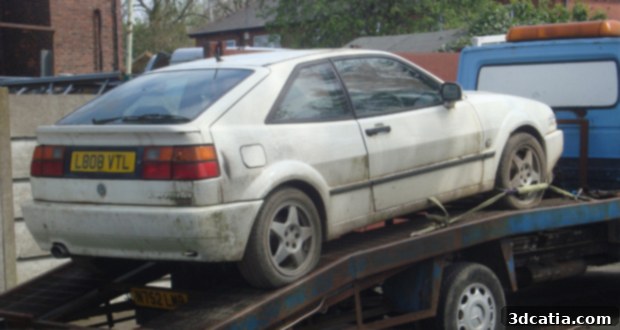
The first spare part was manufactured for the VW Corrado – image via Wikipedia
Strategic Vision: From Prototypes to Production
According to Tobias Pape, the astute purchasing manager of Volkswagen AG, 3D printing represents far more than just a technological advancement; it is a strategic solution poised to unlock an unprecedented array of new possibilities for the automotive giant. Pape emphasizes that while 3D printing has historically been utilized within the Volkswagen Group primarily for prototype development and specialized equipment construction, the time has come to expand its application significantly. “3D printing in the Volkswagen Group has been used so far only in the areas of prototype and equipment construction. Now, we want to apply this internal know-how to the production of spare parts,” Pape stated, underscoring the shift towards integrating additive manufacturing into actual production lines for end-use components.
This transition is not merely about adopting a new tool; it’s about leveraging accumulated internal expertise to optimize the entire spare parts supply chain. By bringing this manufacturing capability in-house, Volkswagen aims to gain greater control over production, reduce reliance on external suppliers for obsolete parts, and potentially lower costs associated with warehousing and logistics. The ability to produce parts on demand could dramatically shorten lead times, making spare parts readily available even for vehicles that have been out of production for decades. This strategic pivot promises to transform the efficiency and responsiveness of Volkswagen’s after-sales service, enhancing the ownership experience for millions of drivers worldwide.
The VW Corrado Adapter: A Case Study in Precision
To comprehensively demonstrate the extensive potential of 3D printing in a real-world application, Tobias Pape and his dedicated team established three stringent prerequisites for their initial selection of spare parts to be manufactured. The chosen component had to meet these critical criteria: it must not be visible after installation, ensuring aesthetic integration; it must be completely safe, upholding Volkswagen’s rigorous quality standards; and it must be as small as possible, allowing for easier initial experimentation and showcasing the technology’s ability to handle intricate details. These criteria were strategically chosen to minimize risk during the pilot phase while thoroughly testing the capabilities of additive manufacturing for precise, functional components.
The first component successfully printed under this initiative was an adapter designed for the iconic VW Corrado. This small yet crucial part serves a specific function: preventing a handle from causing damage to the car’s interior leather. Reproducing this adapter proved to be a significant engineering challenge, particularly due to its exceptionally fine internal and external grooving. The intricate gear structure demanded an extreme level of precision to ensure perfect fitment and functionality. The original part, a testament to German engineering, was first manufactured in Braunschweig, Germany, and is remarkably smaller than a 1-cent coin, highlighting the micro-level accuracy required for its replication via 3D printing.
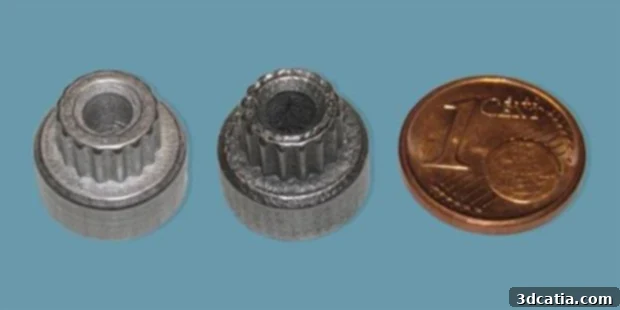
The spare part of the VW Corrado is smaller than a 1 cent – via 3Ders
Overcoming Challenges and Embracing Iteration in Additive Manufacturing
One of the most formidable challenges encountered during the iterative process of creating the Corrado adapter was ensuring consistent quality. Additive manufacturing, while offering incredible design freedom, can also present complexities in achieving repeatable, high-quality results, especially for parts with fine tolerances and intricate geometries. After initially gathering comprehensive data and producing several prototypes that, unfortunately, did not meet the stringent quality standards Volkswagen sought, the team made the crucial decision to re-adjust their approach and meticulously re-polish their designs. This initial refinement, however, still yielded unsatisfactory results, underscoring the deep complexities involved in translating digital designs into flawless physical components via 3D printing.
Undeterred, the engineering team embarked on a new, more innovative route. They began implementing a process of pre-treating the scanned data before it was sent to the 3D printer. This involves advanced digital manipulation and optimization of the 3D model, ensuring that the printer receives the most precise and error-free instructions possible. This meticulous pre-processing step aims to compensate for any inherent material or printer-specific deviations, thereby significantly improving the accuracy and surface finish of the final printed part. This cutting-edge process is currently undergoing rigorous testing and validation, but if Pape and his dedicated team have gained any fundamental insight from this demanding journey, it is the timeless truth that trial and error, even when navigating the frontiers of new technologies, inevitably calls upon and sharpens the innate problem-solving prowess characteristic of a classical engineer.
The Broader Impact: Revolutionizing the Automotive Aftermarket
Volkswagen’s strategic adoption of 3D printing for spare parts extends far beyond the production of a single adapter. This initiative has profound implications for the entire automotive aftermarket and supply chain. By enabling on-demand production, Volkswagen can significantly reduce the need for extensive physical inventories of legacy parts, which often incur substantial storage and management costs. This lean manufacturing approach also mitigates the risk of part obsolescence, ensuring that even for rare or older models, components can be produced precisely when and where they are needed, rather than being stockpiled for years.
Moreover, the ability to print parts locally or in smaller batches opens up possibilities for a more agile and sustainable supply chain. It reduces transportation costs and carbon footprint, aligning with global efforts towards environmentally responsible manufacturing. This localized production capability could also lead to new business models, potentially allowing authorized service centers to print specific parts directly, reducing delivery times and improving customer satisfaction for repairs. For consumers, this translates to faster service, greater availability of parts for beloved classic cars, and potentially more affordable repair options, extending the life and value of their vehicles.
Looking ahead, the success of this pilot project could pave the way for printing a much wider range of components. While initial efforts focus on smaller, less visible parts, advancements in material science and 3D printing technology could soon allow for the additive manufacturing of larger, more complex, and even critical structural components. This vision aligns perfectly with the principles of Industry 4.0, where digital manufacturing processes are seamlessly integrated to create highly flexible, efficient, and responsive production systems. Volkswagen’s pioneering move not only secures its position at the forefront of automotive innovation but also sets a compelling precedent for the entire industry to embrace the transformative power of additive manufacturing.
What do you anticipate will be the long-term impact of Volkswagen’s innovative 3D printing initiative? Share your thoughts and predictions in the comments section below or engage with us on our Facebook and Twitter pages. Don’t miss out on the latest advancements in additive manufacturing—be sure to sign up for our complimentary weekly newsletter, delivering all the essential 3D printing news directly to your inbox!