
Exploring the Cutting Edge: 3D Printing Innovations in Construction, Materials, and Digital Capture
Welcome to our weekly compilation exploring the most fascinating advancements in the world of 3D printing and additive manufacturing. This week, we delve into groundbreaking applications that are reshaping industries from construction to digital entertainment. We’ll witness how an industrial-sized 3D printer is constructing concrete homes on-site with unprecedented speed, celebrate a decade of innovation from one of the leading desktop 3D printer manufacturers, and gain a deeper understanding of a versatile engineering material. Additionally, we’ll explore how a major university is fostering future advancements and see how 3D scanning technology is bringing Olympic moments to life in augmented reality. Prepare to be amazed by the transformative power of these technologies. Happy reading — Enjoy!
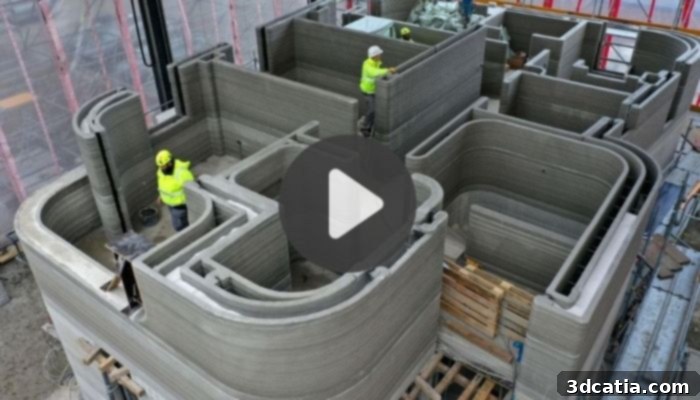
Top 1: Concrete House 3D Printed in 48 Hours – Revolutionizing Construction
For several years now, 3D concrete printing has been making a significant impact on the construction sector. This revolutionary technique offers the promise of erecting structural walls more quickly and at a substantially lower cost compared to traditional construction methods. It’s a game-changer, especially for addressing housing shortages and providing more sustainable building solutions. In the captivating video below, the innovative company SQ4D showcases its remarkable capability to design and construct entire houses in an astonishingly short timeframe—just 48 hours. What’s even more impressive is that these homes are built using a material as robust and durable as conventional concrete, ensuring longevity and structural integrity. This process significantly reduces labor costs, minimizes construction waste, and accelerates project timelines, making homeownership more accessible and sustainable. The potential for creating affordable, resilient housing solutions on a global scale is immense. One thing is certain, the continuous evolution of additive manufacturing in construction will never cease to amaze us, promising a future where homes are built faster, cheaper, and with a smaller environmental footprint.
Top 2: Nylon PA 12—A Deep Dive into 3D Printing Materials
Nylon, a versatile and widely used polymer in the additive manufacturing market, has established itself as an indispensable material for a vast array of applications. Today, nylon for 3D printing is readily available in various forms, including filament for fused deposition modeling (FDM) and powder for selective laser sintering (SLS) machines. Among the different types of polyamides, PA 12 stands out as one of the most famous and highly sought-after. This particular grade of nylon is renowned for its exceptional mechanical and thermal properties, making it an ideal choice for demanding engineering applications. PA 12 offers very high rigidity, excellent impact strength even at very low temperatures, and remarkable resistance to stress and various chemical products. These attributes make it suitable for producing durable, functional parts that can withstand harsh environments. From intricate prototypes to robust end-use components, PA 12’s combination of strength, flexibility, and chemical resistance provides engineers and designers with unparalleled design freedom. The material’s ability to produce complex geometries with fine detail and smooth finishes further cements its position as a go-to material for high-performance 3D printing applications. In the informative video below, the company Hubs provides a comprehensive review of the main characteristics and benefits of this extraordinary material, offering valuable insights for anyone looking to leverage PA 12 in their projects.
Top 3: Sydney Manufacturing Hub – Driving Innovation in Additive Manufacturing
The University of Sydney is positioning itself at the forefront of the additive manufacturing industry through its state-of-the-art Sydney Manufacturing Hub (SMH). This cutting-edge facility leverages the university’s profound expertise and advanced resources to propel the future of 3D printing. By actively partnering with industry leaders, the SMH is dedicated to the comprehensive research and development of novel materials, innovative processes, and diverse applications for 3D printing technology across a wide spectrum of sectors. These critical collaborations are accelerating breakthroughs in fields such as biomedicine, where personalized implants and prosthetics are becoming a reality; construction, exploring new ways to build with complex geometries and sustainable materials; and aerospace, focusing on lightweight, high-performance components that enhance efficiency and safety. The hub serves as a vital bridge between academic research and industrial implementation, fostering an ecosystem of innovation that not only pushes the boundaries of what’s possible with additive manufacturing but also addresses real-world challenges. Their work encompasses everything from exploring advanced metal printing techniques to developing sustainable polymer solutions, ensuring that 3D printing continues to evolve as a cornerstone of modern manufacturing and design. The contributions from such dedicated research hubs are essential for the continued growth and adoption of additive manufacturing globally.
Top 4: Celebrating 10 Years of Ultimaker – A Decade of Desktop FDM Excellence
This year marks a significant milestone for Ultimaker, one of the pioneers and leading manufacturers of desktop FDM 3D printers. Celebrating its 10th anniversary, Ultimaker has played a pivotal role in democratizing 3D printing, making this powerful technology accessible to professionals and enthusiasts alike. To commemorate this decade of innovation, one of its esteemed distributors has produced a compelling compilation showcasing some of the best and most impactful applications realized using Ultimaker’s reliable and user-friendly machines. This inspiring video highlights the incredible versatility of FDM 3D printing across numerous industries. You will discover diverse examples from the medical sector, where custom anatomical models and surgical guides are revolutionizing patient care; the automotive industry, benefiting from rapid prototyping and functional tooling; the robotics field, creating custom components and intricate assemblies; and the vast realm of consumer goods, where product development cycles are significantly shortened. Whether the need is to manufacture highly specific tooling parts for production lines, create detailed prototypes for design validation, or even produce small series of end-use products, FDM 3D printing with Ultimaker machines has firmly established its indispensable place in the industry of tomorrow. Their consistent focus on quality, open-source principles, and a strong community has enabled countless innovations worldwide.
Top 5: Google AR Olympics 2020 3D Scanning Process – Bringing Sports to Life
In an exciting convergence of sports and advanced technology, Olympic Bronze medalist PV Sindhu had her signature badminton moves meticulously captured by a sophisticated 3D scanning process for Google’s innovative augmented reality (AR) feature. This groundbreaking application demonstrates how 3D technologies are enhancing user experiences and bringing dynamic content closer to fans than ever before. Thanks to this detailed 3D scanning, anyone with a compatible device can now view the Indian professional badminton player’s powerful and intricate signature moves up close and to scale, as if she were right there in their living room. The process involves capturing thousands of data points from various angles to create a highly accurate digital model, preserving every nuance of her athletic prowess. This not only offers an unprecedented level of engagement for sports enthusiasts but also opens up new avenues for coaching, analysis, and interactive educational content. Beyond the realm of sports, 3D scanning and AR are poised to revolutionize how we interact with digital information, offering immersive experiences in fields like education, entertainment, retail, and even cultural heritage preservation. Imagine exploring ancient artifacts or historical sites in vivid detail, right from your device, made possible by precise 3D capture. This particular application is a fantastic example of how technology can bridge the gap between physical and digital worlds, making information more accessible and engaging.
What do you think of this week’s incredible compilation of 3D printing videos and technological advancements? From expedited concrete housing to advanced material insights and immersive AR experiences, the landscape of additive manufacturing continues to expand at an astonishing rate. We’d love to hear your thoughts and insights on these innovations. Let us know in a comment below or join the conversation on our Facebook and Twitter pages. To stay fully informed about all the latest news, breakthroughs, and applications in the dynamic world of 3D printing, don’t forget to sign up for our free weekly newsletter. Get all the essential updates delivered straight to your inbox, ensuring you never miss out on the future of manufacturing!
Cover Photo Credit: Ina Fassbender/Getty Images