
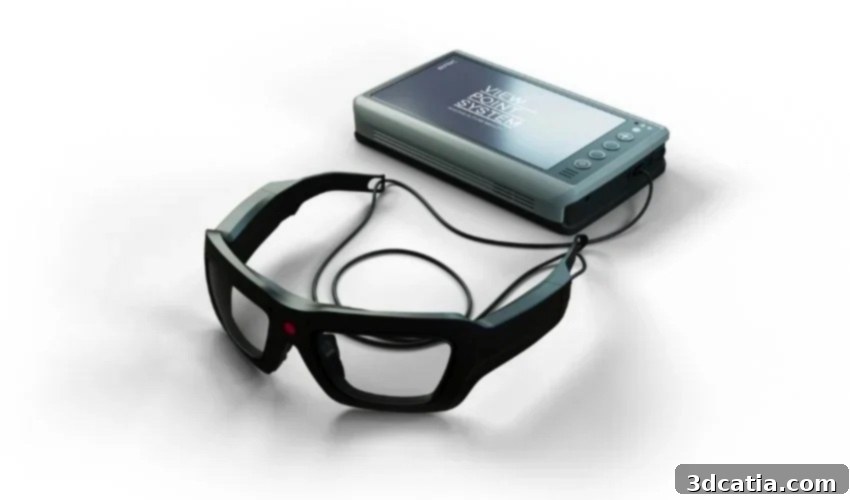
Viewpointsystem Smart Glasses: Pioneering Industrial Innovation with Additive Manufacturing and 3D Printing
In an era where the lines between human expertise and machine capability are increasingly blurring, Vienna-based deep-tech startup Viewpointsystem is at the forefront of this convergence. The company has dedicated extensive research and development to create a groundbreaking solution: advanced smart glasses meticulously crafted with scientific know-how in optics. But what precisely is the role of cutting-edge additive manufacturing in achieving such a high-tech feat? Remarkably, a significant number of components within these innovative smart glasses are produced using 3D printers. This strategic integration of additive manufacturing has not only accelerated product development but also facilitated unprecedented human-machine collaboration at a distance, empowering businesses with robust remote support and efficient remote maintenance capabilities.
To delve deeper into this transformative approach, we had the privilege of speaking with Frank Linsenmaier, CTO of Viewpointsystem. Linsenmaier shared invaluable insights into the company’s extensive use of additive manufacturing for their smart glasses, outlining the profound benefits this technology has brought to their operations and their vision for the future of industrial wearables.
Viewpointsystem: A Deep-Tech Journey into Smart Wearables Production

Frank Linsenmaier – CTO at Viewpointsystem (Image: Viewpointsystem)
Viewpointsystem, a dynamic deep-tech enterprise hailing from Vienna, specializes in the development and production of sophisticated smart glasses exclusively for the B2B sector. Established in 2016 as a spin-off from the prestigious University of Natural Resources and Applied Life Sciences, Vienna, the company has rapidly expanded its global footprint, now serving customers across three continents and employing a dedicated team of approximately 60 professionals. Viewpointsystem proudly stands as one of the pioneering companies in Austria to embrace additive manufacturing, commonly known as 3D printing, for industrial series production on such a significant scale.
This commitment to advanced manufacturing is evident in their product design: a total of twelve distinct components within their smart glasses are additively manufactured. This includes crucial structural elements like the frame, ergonomic features such as nose pads, and intricate inner technical parts – a number that continues to grow as the company explores new applications for 3D printing. Frank Linsenmaier’s personal journey with additive manufacturing began much earlier, in 2005, where he gained initial experience in prototype and low-volume production for a major automotive supplier. He quickly recognized the inherent advantages of this technology, especially its potential for complex designs and rapid iteration.
“Compared to other technologies, additive manufacturing always offered the most degrees of freedom in design, and prototypes could be produced rapidly in terms of time,” Linsenmaier explains. “This gave us the invaluable opportunity to quickly analyze feasibility and demonstrate new parts with unmatched efficiency, speeding up the entire product development cycle.”
When Linsenmaier joined Viewpointsystem in 2016, the company’s components were still being manufactured using traditional injection molding techniques. However, it soon became apparent that additive manufacturing presented a far more suitable alternative, particularly for a wearable device like smart glasses. The technology’s ability to create designs that are simultaneously stable and flexible – a critical requirement for comfortable and durable smart glasses worn for extended periods – offered a distinct advantage over conventional methods. This pivotal shift to additive technology was instrumental in enabling Viewpointsystem to quickly transition their product from development into full series production, a feat that would have been significantly more challenging with conventional manufacturing processes. Looking ahead, Linsenmaier envisions even greater potential for pushing the boundaries of this innovative technology within Viewpointsystem’s future product lines, including enhanced functionality and mass customization.
The Core Role of Additive Manufacturing: HP Jet Fusion and PA 12 for Smart Glasses
Additive manufacturing is not merely a supplementary process at Viewpointsystem; it is fundamental to their entire production philosophy, deeply integrated into their quest for innovation. In their state-of-the-art production facility located in Vienna’s Urban Lakeside, the company has established a dedicated production line for the series manufacturing of their data glasses. This sophisticated setup is the result of a close collaboration with industry leaders HP and d4pro, harnessing the power of the HP Jet Fusion printing solution.
The HP Jet Fusion system is specifically optimized for high-volume industrial component production, offering reliability and efficiency essential for continuous operations. With multiple build units integrated into their workflow, Viewpointsystem can achieve a tandem operation of the printing system, enabling robust 24/7 production capabilities. This ensures a consistent supply of high-quality components for their smart glasses. The printing process itself typically spans between eight and twelve hours, depending on the load, followed by a controlled cooling phase. Once the spectacle blank emerges from the printer, it undergoes a series of crucial post-processing steps. These classic finishing procedures include bead blasting, meticulously performed to remove any residual powder and densify the surface, ensuring a smooth and durable finish. This is followed by impregnation coloring, which further enhances the aesthetic and protective qualities of the components, making them resistant to wear and tear.
A critical consideration for any wearable device is material safety, and Viewpointsystem addresses this with utmost diligence. All materials utilized in their smart glasses are certified biocompatible, guaranteeing they are demonstrably neutral and safe for prolonged skin contact. The Multi Jet Fusion process, a cornerstone of their production, predominantly uses PA 12 (Nylon 12). This versatile thermoplastic is chosen for its exceptional properties, including excellent dimensional stability and uniform mechanical strength across all axes. These characteristics are particularly advantageous for creating the organic, ergonomic shapes integral to Viewpointsystem’s smart glasses, ensuring both comfort and long-term durability. Furthermore, the PA 12 material has successfully passed rigorous testing according to EN 166 standards, qualifying it for use in safety glasses – a testament to its robustness and reliability in demanding environments. Initially, there might have been skepticism regarding the surface quality achievable with 3D printing, but Viewpointsystem found that, especially for a wearable device, the uniform roughness of the additively manufactured components actually provides optimal wearing comfort during extended use sessions, significantly enhancing the overall user experience.
Accelerating Innovation and Sustainable Production through Additive Manufacturing
The integration of additive manufacturing empowers Viewpointsystem with a significant competitive edge, particularly as a young company operating in the fast-paced, dynamic technology landscape. The ability to innovate at an incredibly rapid pace is a game-changer. “We can make changes quickly and also try things out of the box,” Frank Linsenmaier emphasizes. This agility allows for unparalleled flexibility in design and iteration, fostering a culture of continuous improvement and groundbreaking product development.
The contrast with their previous manufacturing methods, specifically classic injection molding, starkly highlights the paradigm shift in innovation cycles. Where product developments were once planned on a monthly basis, additive manufacturing enables Viewpointsystem to plan and execute product developments on a weekly schedule. This drastically reduced development timeline not only leads to lower development costs due to minimal tooling requirements but also fosters an environment where the company can make much bolder design decisions and validate them with unprecedented speed. The iterative nature of 3D printing means that new ideas can be prototyped, tested, and refined within days, translating directly into faster market entry for enhanced products, keeping Viewpointsystem ahead of the curve.
Beyond speed and cost efficiency, additive manufacturing brings several other important advantages, including demand-driven production and enhanced sustainability. Unlike conventional manufacturing, which often necessitates large minimum order quantities and substantial upfront investments in tooling, additive manufacturing allows Viewpointsystem to produce components in smaller batches at comparatively manageable costs. This eliminates the need to hold vast quantities of components in stock, significantly reducing inventory requirements and storage capacity – a strategy that is as economically sensible as it is environmentally sustainable. By printing parts only as needed, material waste is minimized, and the environmental footprint of their manufacturing process is considerably reduced, aligning with modern corporate responsibility goals and contributing to a greener future for manufacturing.
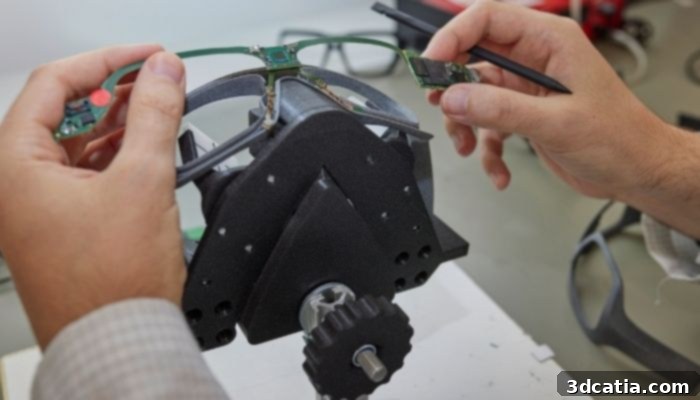
Additive manufacturing is even used for internal technical parts (photo credits: Viewpointsystem)
VPS 19 Smart Glasses: Bridging Distances and Enhancing Industrial Collaboration
The VPS 19 Smart Glasses are meticulously designed to address critical operational needs for corporate customers across the globe. Their primary functionalities revolve around facilitating remote maintenance of intricate machinery and systems, and providing robust remote support. In an era marked by increasing climate awareness and, more recently, by pandemic-induced contact restrictions, the demand for sophisticated remote collaboration solutions has surged dramatically. Viewpointsystem’s smart glasses offer an elegant and powerful answer to this pressing need, enabling seamless interaction and problem-solving without geographical limitations.
With these innovative wearables, companies can instantly connect employees and technical experts anywhere in the world, eliminating the need for time-consuming and costly travel. Imagine a scenario where a production worker on one continent encounters an issue with complex machinery. Instead of flying in a specialist, a remote expert can precisely instruct the worker in real-time, providing visual guidance directly through the smart glasses. This not only significantly reduces a company’s carbon footprint and operational budget but also minimizes downtime, boosting productivity and operational efficiency. The integrated eye-tracking technology is a cornerstone of this capability. It discreetly projects the wearer’s exact point of view onto the remote expert’s display, allowing them to know precisely where the wearer is focusing their attention in real time. This crucial feature ensures lossless communication and precise instruction, even across language barriers and in notoriously noisy industrial environments, providing an unparalleled level of precision and clarity for critical tasks.
Beyond remote maintenance and support, the versatility of Viewpointsystem’s data glasses extends to a multitude of other valuable applications. They are indispensable tools for comprehensive training and detailed documentation, finding widespread utility across various sectors including industry, medicine, and security. For instance, in industrial settings, new procedures can be demonstrated and recorded with a first-person perspective, making training more immersive, standardized, and effective for new employees. In medicine, surgeons can receive remote consultation from specialists worldwide or document complex surgical procedures with unparalleled visual accuracy for teaching and legal purposes. Furthermore, these smart glasses prove invaluable for research and analysis, particularly in tracking and understanding human behavior in real-world contexts, opening new avenues for psychological studies, ergonomic assessments, and market research by capturing precise gaze data.
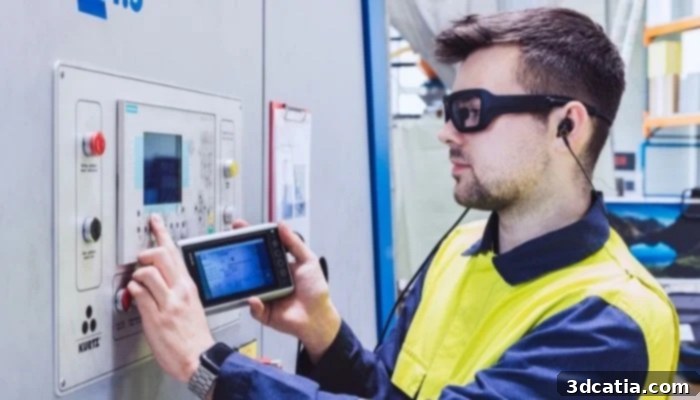
The smart glasses from Viewpointsystem can be used in a variety of ways (photo credits: Viewpointsystem)
The Future of Viewpointsystem: Mass Customization and Advanced Eye-Tracking Modules
Looking ahead, Viewpointsystem is poised for significant growth and continued innovation. The company plans to further scale up the production of its smart glasses throughout the current year, driven by the escalating global demand for advanced remote support solutions. A key aspect of their future strategy involves a robust pipeline of hardware developments, where additive manufacturing will continue to play a pivotal and enabling role in bringing these next-generation products to market faster and more efficiently.
While Frank Linsenmaier remained tight-lipped about some of the more proprietary developments, he hinted at exciting projects leveraging the full potential of 3D printing. One particularly intriguing area is the concept of “mass customization,” specifically targeting nose pads tailored precisely to individual wearers. These bespoke nose pads will be manufactured individually based on 3D scans of the user’s nose, ensuring an absolutely perfect fit for many hours of continuous wear. This level of personalized ergonomics represents a significant leap forward in user comfort and adoption for professional-grade wearables, directly addressing a common pain point for users who require extended use of such devices.
Another pioneering initiative is Viewpointsystem’s new eye-tracking module series. The first prototypes of these cutting-edge modules were impressively showcased at the AWE Augmented World Expo in California late last year, generating considerable industry buzz. With these pre-configured, high-performance modules, Viewpointsystem is empowering manufacturers of augmented reality (AR) and virtual reality (VR) glasses with the capability to quickly and seamlessly integrate advanced eye data and sophisticated eye-tracking functions into their own systems. Eye tracking is becoming increasingly indispensable for a wide array of extended reality (XR) functions, such as foveated rendering – a technique that optimizes graphics processing by rendering the foveated (central vision) area in high detail while reducing detail in the periphery, thereby conserving computational power and enhancing visual fidelity. Beyond technical optimizations, eye tracking is also crucial for understanding precisely what information the wearer is interested in at any given moment, providing invaluable insights for content development, user interface design, and even psychological research within immersive environments, making XR experiences more intelligent and responsive.
Additive Manufacturing: An Addictive Mindset at Viewpointsystem
In his concluding remarks, Frank Linsenmaier unequivocally underscored the transformative impact of additive manufacturing on Viewpointsystem’s journey. “We at Viewpointsystem would not be where we are today without additive manufacturing,” he asserted, highlighting its indispensable role in the company’s success and rapid growth. As a young deep-tech enterprise, Viewpointsystem constantly operates at the very limits of what is technologically feasible. Thanks to the inherent capabilities and flexibility of additive manufacturing, a completely new “school of thought” has firmly taken root within the company’s culture. This new mindset is characterized by an insatiable technical curiosity, a readiness to embrace bold challenges, and a commitment to rapid, iterative development cycles. This approach fosters an environment where product innovations are not just incremental but often surprising even to the team that creates them, driving continuous breakthroughs.
Internally, additive manufacturing has earned an affectionate moniker at Viewpointsystem: “addictive manufacturing.” This playful term perfectly encapsulates the enthusiasm and motivation it instills across the design and manufacturing teams. Linsenmaier expressed profound satisfaction in witnessing his colleagues eagerly tackle new challenges daily, consistently realizing significant improvements for current products while simultaneously bringing visionary ideas for future innovations to life. The tangible nature of this process is also a key motivator: “Decision-making with real parts in your hands is much more meaningful than just seeing them on a screen,” he concluded, emphasizing the profound difference between theoretical concepts and practical, physical prototypes. This hands-on approach fuels creativity, enhances problem-solving, and ultimately delivers superior, user-centric smart glasses that meet the rigorous demands of the B2B sector.
For those interested in learning more about Viewpointsystem’s pioneering work and their innovative smart glasses, additional information is available HERE.
What are your thoughts on the groundbreaking smart glasses from Viewpointsystem and their innovative use of additive manufacturing? We invite you to share your perspectives in a comment below or connect with us on our Linkedin, Facebook, and Twitter pages! Don’t miss out on the latest 3D printing news – remember to sign up for our free weekly Newsletter here, delivered straight to your inbox. You can also explore all our insightful videos on our YouTube channel, featuring more innovations in additive manufacturing.
*Cover Photo Credits: Viewpointsystem