
Essentium Study Reveals Widespread Demand for Open Ecosystems in Industrial 3D Printing
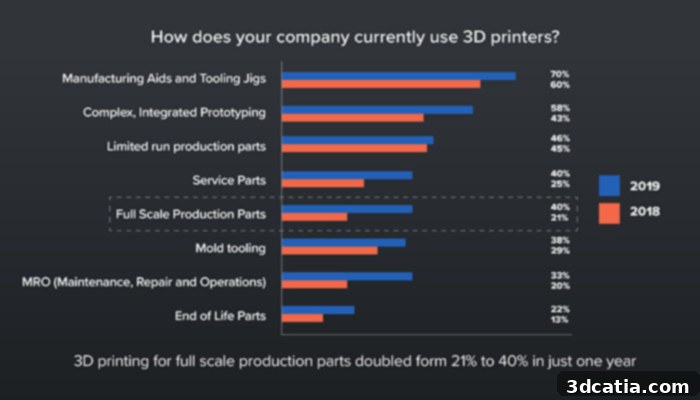
Towards the close of last year, we shared insights from Essentium’s pivotal study regarding the evolving landscape of industrial scale 3D printing. The findings were stark and significant: between 2018 and 2019, the number of manufacturers actively leveraging 3D printing for full-scale production applications more than doubled, surging from 21% to a remarkable 40%. This dramatic increase underscored a pivotal shift in how industries perceive and integrate additive manufacturing into their core operations. Building on this momentum, the Texas-based company has recently unveiled a new set of comprehensive findings that delve deeper into manufacturers’ perspectives on the industrialization journey of 3D printing. Specifically, Essentium conducted an extensive survey involving 162 managers and executives drawn from prominent manufacturing companies across the globe. The objective was clear: to gather their current experiences and expectations concerning 3D printing within high-volume production environments, thereby painting a clearer, more nuanced picture of the industry’s trajectory.
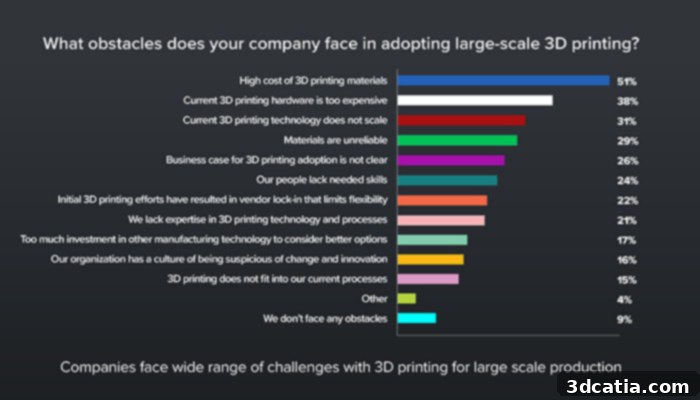
The latest study by Essentium offers compelling revelations, particularly highlighting a near-unanimous consensus among manufacturing executives. An overwhelming 99% of those surveyed expressed their firm belief that an open ecosystem is not merely beneficial but absolutely essential for advancing 3D printing to a truly industrial scale. This striking statistic indicates a powerful, collective desire for greater flexibility and choice within the additive manufacturing landscape. Beyond this central theme, two other significant trends emerged from the survey. Firstly, a substantial majority of manufacturers, specifically 85%, articulated their conviction that industrial-scale additive manufacturing (AM) possesses immense potential to significantly increase revenue for their businesses. This perception is rooted in AM’s capabilities for innovation, speed-to-market, and customizable production. However, this optimism is tempered by a notable concern: 22% of respondents reported feeling that their operational flexibility has been considerably limited by prevalent vendor lock-in practices. This dual perspective — the promise of AM juxtaposed with the frustrations of proprietary systems — sets the stage for a critical discussion on the future direction of the industry.
Credits: Essentium
The Pervasive Challenge of Closed Systems and Vendor Lock-in
It is an undeniable truth that the industrial additive manufacturing market has, for a significant period, been characterized and largely dominated by closed systems. In these proprietary environments, customers often find themselves inextricably tied to a single manufacturer’s specific hardware, intricate processes, and often limited material offerings. While technological barriers concerning economics, production scale, part strength, and speed of manufacturing have progressively diminished, paving the way for the increased adoption of 3D printing for full-scale production, the issue of closed systems has persisted. This has created a bottleneck for many companies looking to fully integrate AM into their workflows. For example, when examining various additive technologies, there are indeed a fair number of open Fused Deposition Modeling (FDM) systems available on the market, offering users a greater degree of freedom in material selection and parameter adjustments. However, the same cannot be readily said for Selective Laser Sintering (SLS) and Stereolithography (SLA) solutions, which frequently remain ensconced within highly proprietary ecosystems. This disparity highlights a critical industry demand: manufacturers are increasingly vocal in their calls for truly open ecosystems. Their primary motivation is to overcome inherent system inflexibility, expand their material choices significantly, and ultimately drive innovation without being confined by a single vendor. The Essentium study further underscores this urgent need, revealing that a staggering 50% of companies explicitly stated their requirement for high-quality, yet affordable, materials to effectively meet the ever-growing demand for industrial 3D printed parts.
The Vision for an Open Additive Manufacturing Future
Blake Teipel, the insightful CEO of Essentium, articulates this strategic imperative with clarity and conviction. He explains, “At Essentium, we strongly believe that an open ecosystem will be key to the evolution of additive manufacturing. Being locked into proprietary solutions that limit flexibility and choice is no longer an option if 3D printing is to become a serious contender as an industrial process for end-use products. An open market focused on developing new materials and better and faster machines is the only way for manufacturers to unlock new applications and new business opportunities. With this approach, the future belongs to the customer, not to the OEM.” Teipel’s statement encapsulates a fundamental paradigm shift: moving away from a vendor-centric model towards one that prioritizes customer empowerment and unrestricted innovation. For 3D printing to truly realize its potential as a mainstream industrial process capable of producing end-use parts at scale, it must break free from the constraints of proprietary systems. This means fostering an environment where different hardware, software, and material providers can seamlessly interact, allowing manufacturers the freedom to select the best components for their specific applications, rather than being forced into a single, restrictive package. This openness not only drives down costs but also accelerates the pace of technological advancement across the entire additive manufacturing supply chain, from novel material development to the creation of increasingly efficient and rapid 3D printers.
The demand for open ecosystems stems from several critical needs identified by manufacturers. Firstly, material innovation is severely hampered by closed systems. Many proprietary platforms limit users to a specific, often expensive, range of materials provided by the machine manufacturer. This restricts the ability of companies to experiment with new polymers, composites, or metals that might be perfectly suited for their unique product requirements or offer significant performance advantages. An open ecosystem, conversely, encourages a competitive marketplace for materials, leading to more affordable options and a wider array of specialized materials designed for diverse industrial applications. Secondly, flexibility in production processes is paramount. Manufacturers often need to optimize print parameters, integrate third-party software for design or post-processing, or even combine different additive technologies. Closed systems typically prevent this level of customization and integration, leading to inefficiencies and limiting the scope of what can be achieved. An open approach allows for greater interoperability, enabling manufacturers to fine-tune their operations and integrate AM seamlessly into their existing digital manufacturing workflows. This ability to mix and match technologies and workflows is crucial for agile and competitive production environments.
Credits: Essentium
Driving Forward with Collaborative Open Ecosystems
In response to this clear industry demand, it is imperative that more initiatives aligned with an open ecosystem philosophy come to the fore. Essentium, recognizing this critical need, has seen growing demand for its own open ecosystem approach. This system is not merely a theoretical concept but a tangible, collaborative effort developed in conjunction with global powerhouses. Notably, Essentium has partnered with multinational chemical giant BASF, a leader in advanced materials, and 3D software development pioneer Materialise NV. This strategic alliance represents a clear and unequivocal indication that an open ecosystem approach is directly addressing previously unmet needs within the industrial additive manufacturing market. These collaborations are vital because they bring together expertise from different facets of the AM value chain – hardware, materials, and software – to create a truly integrated and flexible solution for end-users. BASF contributes its extensive knowledge in material science, enabling the development of high-performance, cost-effective polymers suitable for a wide range of industrial applications. Materialise provides its robust software platforms, facilitating seamless data flow, sophisticated print preparation, and efficient workflow management. Essentium, in turn, offers its advanced hardware, designed to be compatible with diverse materials and software. This synergistic approach ensures that manufacturers are not limited by proprietary constraints but can instead leverage the best-in-class solutions from multiple providers.
The ripple effect of such open collaborations is profound. They foster an environment of accelerated innovation, as companies are free to develop specialized materials or software without needing explicit approval or integration from a single hardware provider. This promotes healthy competition, leading to faster development cycles, improved product performance, and ultimately, a more robust and resilient additive manufacturing industry. As 3D printing continues its rapid spread into full-scale production environments across various sectors, from automotive and aerospace to medical and consumer goods, the adaptability of the industry will be paramount. The transition from niche prototyping to mainstream manufacturing demands systems that can evolve quickly, integrate seamlessly with existing production lines, and offer the economic advantages necessary for mass customization and efficient localized production. The push for open ecosystems is not just about technology; it’s about empowering manufacturers to innovate, compete, and ultimately shape the future of industrial production. We eagerly anticipate witnessing how the broader industry will continue to adapt to these transformative changes, embracing openness and collaboration to unlock the full potential of additive manufacturing. For those interested in delving deeper into Essentium’s ongoing research and developments, more information can be found HERE.
What are your thoughts on these groundbreaking findings? Do you concur with the manufacturing executives that customers have indeed been locked into restrictive proprietary solutions? We invite you to share your perspectives and engage in the conversation by leaving a comment below, or by connecting with us on our vibrant Facebook and engaging Twitter pages! Don’t miss out on the latest advancements and breaking news in the dynamic world of 3D printing – be sure to sign up for our free weekly Newsletter, delivering all the essential updates straight to your inbox!