
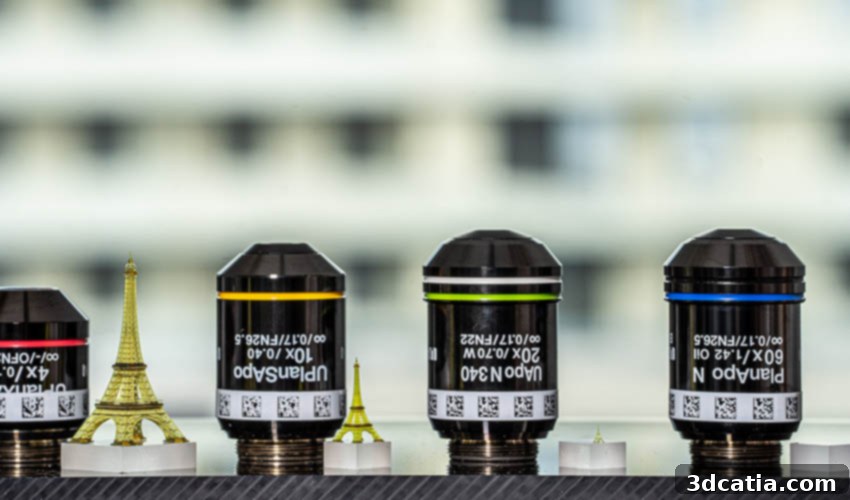
UpNano Pioneers Next-Generation Microscale 3D Printing: Unlocking Unprecedented Speed and Precision for Industrial Applications
In the dynamic world of additive manufacturing, innovation is constant, and leading this charge at the micro and nanoscale is UpNano, a pioneering company based in Vienna. This forward-thinking enterprise has recently unveiled a groundbreaking, high-resolution microscale 3D printing technology that promises to redefine possibilities across numerous industries. At its core, UpNano’s revolutionary approach leverages the advanced 2-photon polymerization (2PP) process, a sophisticated technique renowned for its ability to craft incredibly intricate structures.
What sets UpNano’s technology apart is its unparalleled combination of speed and precision. Unlike traditional methods, their novel technique excels at rapidly fabricating plastic components across an astonishing range of volumes, from minuscule 100 to expansive 1012 cubic micrometers, all achievable within mere minutes. This remarkable capability is complemented by true nanoscale resolution, allowing for the creation of features previously thought impossible on such a scale. Born as a successful spin-off from the prestigious TU Wien, UpNano is strategically deploying its cutting-edge technology to accelerate research and development (R&D) efforts and enable transformative applications across a diverse array of sectors, including medical, optical, and electronics. To delve deeper into the transformative capabilities of their technology and their ambitious plans for the future, we had the privilege of speaking with Denise Mandt, a key figure in the company’s leadership.
The Visionaries Behind UpNano: Denise Mandt’s Journey into High-Resolution 3D Printing
Denise Mandt introduces herself as a co-founder of UpNano, where she adeptly manages the crucial areas of marketing and sales. Her professional journey into the realm of 3D printing began remarkably early, fueled by a robust academic foundation in materials technology and biology. This interdisciplinary background provided her with a unique perspective, enabling her to appreciate the intricate interplay between advanced materials and biological applications – a synergy that is absolutely vital for cutting-edge micro-additive manufacturing.
Her formative experiences with 3D printing were solidified during her master’s thesis, where she immersed herself in the practical application of high-resolution 3D printing for creating highly customized microfluidic chips. This early work was not merely an academic exercise; it was a foundational exploration into the potential of additive manufacturing to create complex, functional devices at a microscopic scale, laying the groundwork for her future endeavors. Today, Denise, alongside her esteemed co-founders Peter Gruber and Bernhard Küenburg, leads UpNano – a dynamic and rapidly growing high-tech company poised to revolutionize various sectors with its advanced printing solutions. Their collective expertise and shared vision are driving UpNano to the forefront of the micro-3D printing landscape, transforming intricate designs into tangible realities.
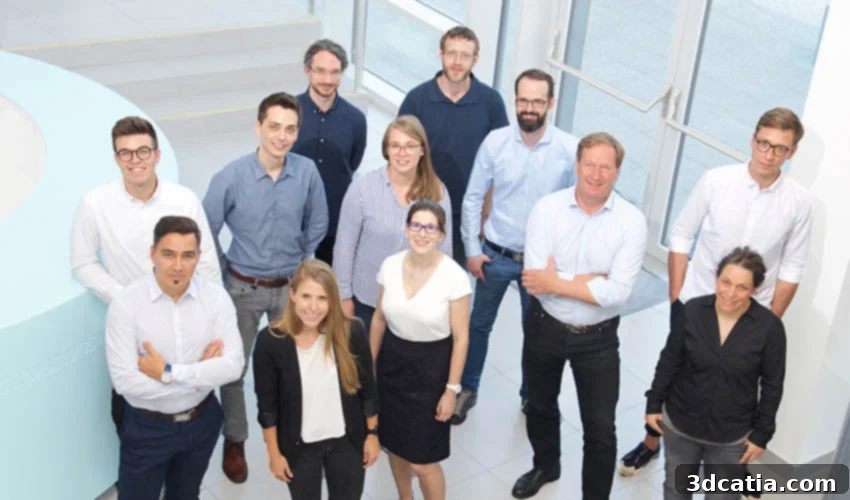
The dedicated UpNano team, driving innovation in micro-additive manufacturing.
The Disruptive Power of Nano/Micro-Scale 3D Printing: Speed, Precision, and Versatility
Denise emphasizes that high-resolution 3D printing, especially at the nano and micro-scale, represents a profoundly disruptive technology because it facilitates the creation of parts that were previously considered impossible to manufacture with conventional methods. The core of this transformative capability lies in the two-photon polymerization (2PP) process. Unlike classic Stereolithography (SLA), which builds objects layer by layer and is inherently limited by layer thickness, 2PP operates independently of this constraint. This fundamental difference allows for truly three-dimensional fabrication with exceptional isotropy and feature resolution that goes far beyond what traditional layer-based processes can achieve, enabling highly complex geometries and smooth surfaces even at the nanoscale.
UpNano is particularly proud to definitively challenge and overcome the long-standing prejudice that “2PP printing is meant to be slow.” Historically, while 2PP offered unparalleled resolution, its speed was a significant barrier to industrial adoption. UpNano’s patented innovations have dramatically boosted the throughput, making it a viable solution for both rapid prototyping and small-batch production. This breakthrough in speed, combined with its inherent precision, positions UpNano’s technology perfectly to meet the demands of an accelerating global trend: miniaturization. For years, industries across the spectrum – from medical and electronics to aerospace and telecommunications – have been relentlessly pursuing smaller, lighter, and more precise components. UpNano’s technology is perfectly attuned to this pulse of time, offering solutions for these increasingly stringent requirements.
The main benefits customers derive from UpNano’s process are multifaceted. Firstly, they gain access to unmatched printing speed, drastically reducing development cycles and time-to-market for new products. Secondly, the technology boasts an impressive scalability, capable of producing structures ranging from the sub-micrometer (nanoscale) up to centimeter-scale components, all while maintaining exquisite detail. This wide range of printable dimensions opens up vast possibilities for integration and functionality. Thirdly, a significant advantage lies in its potential for biological applications. The ability to print with biocompatible materials and embed living cells directly into intricate structures opens doors for advanced tissue engineering, bespoke medical implants, and sophisticated drug delivery systems. Remarkably, UpNano delivers all these powerful capabilities within a compact, user-friendly desktop system, making advanced micro-3D printing accessible to a broader range of researchers and industrial partners.
From Academic Breakthrough to Industrial Powerhouse: The Genesis and Mission of UpNano
The origins of UpNano are deeply rooted in the pioneering research conducted at TU Wien, specifically within a group that possessed a strong biological focus. The primary objective of their academic endeavors was truly ambitious: to develop a method that would allow for the direct embedding of living cells within a precisely 3D-printed matrix. This pioneering work aimed to create intricate biological scaffolds and advanced biomedical devices. Achieving this ambitious goal necessitated not only the development of highly biocompatible materials – a complex challenge in itself – but also a revolutionary leap in printing speed. Traditional 2PP processes, while precise, were simply too slow for practical biological applications requiring viable cell integration.
It was within this context that the brilliant minds of Peter Gruber and Aleksandr Ovsianikov made a pivotal breakthrough. They successfully engineered and patented an innovative 2PP process that achieved a previously unmatched high throughput. This technological advancement dramatically accelerated the printing process without compromising the exquisite resolution that 2PP is known for. As word of this unprecedented speed and capability spread, interest in their technology surged, extending far beyond the initial biological research community. It quickly became evident that this innovation had significant industrial potential, thus planting the seed for the spin-off company, UpNano, which was established to commercialize and further develop this game-changing technology.
Today, UpNano’s main mission is clear and ambitious: to bridge the critical gap between high-resolution prototyping and true industrial manufacturing. The remarkable synergy of high resolution, which allows for intricate details down to the nanoscale, combined with the groundbreaking throughput, now makes batch and small-series production feasible for the first time. This capability is absolutely fundamental for industrial applications that require rapid iteration, mass customization, or specialized component fabrication. UpNano aims to occupy a “sweet spot” in the additive manufacturing landscape, distinguishing itself from traditional, slower 2PP technologies on one end and less precise micro stereolithography on the other. Their ultimate goal is to enable the efficient and cost-effective fabrication of polymer micro parts, spanning an impressive scale from true nanostructures up to centimeter-sized components, thereby catering to the burgeoning demand for precision parts across diverse industries.
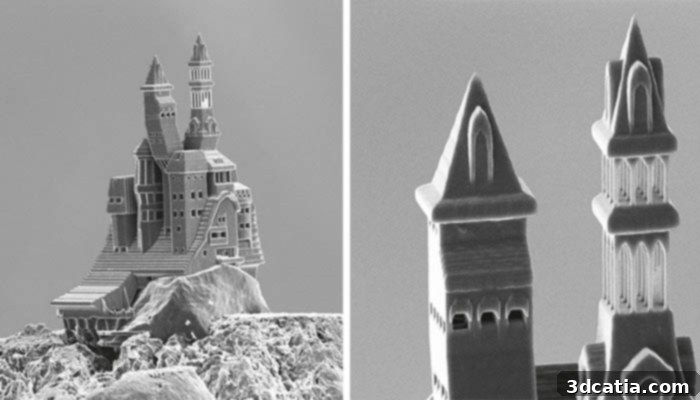
An intricately 3D printed micro castle, measuring 230 µm x 250 µm x 360 µm, demonstrating the extraordinary precision of UpNano’s 2PP technology, delicately positioned atop a pencil. | Photo Credits: UpNano
Diverse Applications and Impactful Projects: UpNano’s Global Reach
Denise highlights the remarkable diversity of projects UpNano is involved in, underscoring that their advanced micro-3D printing technology finds utility across a spectrum as broad and varied as their global customer base. These applications span critical fields, from cutting-edge medical devices designed for diagnostics and surgical intervention to sophisticated optical components demanding extreme precision, and intricate electronic components vital for next-generation devices. UpNano has successfully collaborated with a wide array of entities, including leading universities and prestigious research institutes pushing the boundaries of scientific discovery, as well as international corporations seeking innovative manufacturing solutions.
A notable trend observed recently is a significant surge in demand from the medical sector. This heightened interest has been particularly pronounced, exacerbated by global health challenges. In response to crises, such as the recent pandemic, numerous researchers and medical professionals have strategically redirected their efforts and resources towards developing novel testing methodologies, pioneering treatment protocols, and advanced monitoring systems. UpNano’s technology, with its capacity for rapid prototyping of highly specific, biocompatible micro-parts, became an invaluable tool in accelerating these crucial research and development efforts, providing solutions for components like specialized microfluidic chips for diagnostics, intricate drug delivery systems, or customized implants. The ability to quickly iterate and produce complex, functional prototypes at the microscale is proving to be a game-changer in accelerating medical innovation.
Transforming Industries: Where Microscale Additive Manufacturing Makes the Biggest Impact
When discussing the sectors poised for the most significant impact from microscale additive fabrication, Denise points to a key differentiator: the need for a high degree of customization and increasingly shorter product development cycles. These two factors create an ideal environment for additive manufacturing to thrive, offering unparalleled advantages over traditional manufacturing techniques. Micro-3D printing excels in scenarios where ‘one-size-fits-all’ solutions are inadequate, or where rapid iteration and bespoke designs are paramount.
The medical industry stands out as a prime example. Here, the demand for patient-specific devices, implants, and surgical tools is constantly growing. Microscale additive manufacturing allows for the creation of customized prosthetics, tailor-made drug delivery systems with intricate internal structures, and highly specialized micro-instruments that can conform to individual patient anatomies or specific procedural requirements. The ability to rapidly prototype and produce these bespoke components significantly improves patient outcomes and accelerates medical innovation. Beyond customization, the agility to adapt designs quickly to new research findings or regulatory changes further solidifies micro-AM’s role in healthcare.
Similarly, the consumer electronics sector is ripe for disruption. In an industry characterized by relentless innovation, shrinking form factors, and intense competition, rapid product cycles are the norm. Microscale 3D printing enables the fast development of novel components, such as micro-lenses for advanced imaging systems, miniature sensors for wearables, or custom connectors and intricate housings for compact devices. The capability to iterate designs quickly and produce functional prototypes with high precision means companies can bring cutting-edge products to market faster, staying ahead of technological trends and consumer demands. Furthermore, other emerging sectors like micro-robotics, advanced photonics, and specialized aerospace components also stand to gain immensely from the unparalleled design freedom and rapid fabrication capabilities offered by UpNano’s high-resolution additive manufacturing solutions.
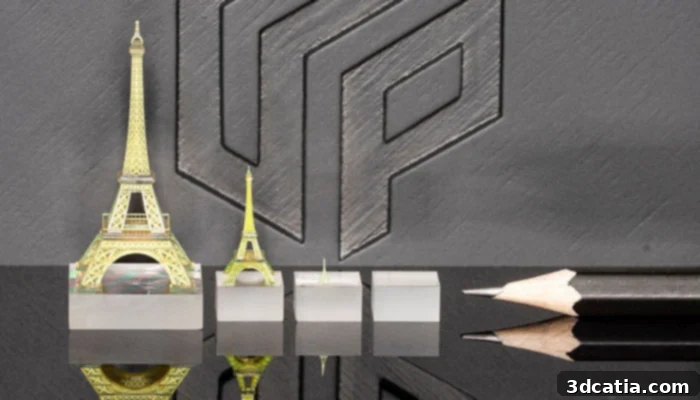
The Future of Micro-Additive Manufacturing: From Prototyping to Industrial Production
Looking ahead, Denise Mandt expresses a strong conviction that 3D printing, especially high-resolution micro and nano printing, is unequivocally a future-oriented technology destined for profound evolution. This belief is underpinned by the accelerating pace of technological advancement, which continually compresses the development cycles for new innovations across all industries. In such a fast-evolving landscape, additive manufacturing offers an invaluable advantage: the ability to dramatically save time, particularly during the critical early phases of product development. By enabling rapid iteration and testing of designs, micro-AM significantly enhances interaction cycles between design and functional verification, ultimately leading to superior product results and faster market entry.
While the current capabilities in development and prototype production are highly impressive, UpNano envisions a much grander, long-term objective: firmly establishing this technology within mainstream industrial production. This transition from bespoke prototyping to reproducible, large-scale manufacturing is where the true disruptive potential of micro-3D printing will be realized. To achieve this, UpNano is working at full speed on developing advanced solutions. A key focus is the introduction of a new machine line engineered with even higher levels of automation. This next generation of systems is being specifically designed to manufacture identical components with unparalleled reproducibility and consistency, crucial for meeting stringent industrial quality standards and volumes. This includes integrating features like automated material handling, in-situ monitoring, and integrated quality control to minimize human intervention and maximize output.
Beyond automation and the inherent speed of their 2PP process, UpNano recognizes that the materials themselves and their precise characteristics are absolutely decisive for successful industrial applications. The performance, durability, and specific functionalities of the printed parts are directly dependent on the properties of the resins used. Therefore, a significant and core competence of UpNano lies in its robust in-house material development and rigorous testing programs. This vertical integration allows them to engineer specialized photopolymers tailored to specific industrial requirements – whether it’s for enhanced mechanical strength, specific optical transparency, high-temperature resistance, or advanced biocompatibility for medical applications. By controlling both the printing hardware and the material science, UpNano ensures that its customers have access to fully optimized solutions, pushing the boundaries of what is achievable in microscale additive manufacturing and paving the way for its widespread adoption in high-value production environments.
Beyond Technology: Fostering Innovation and Collaborative Growth in Additive Manufacturing
Denise concludes by emphasizing a crucial, yet often overlooked, aspect of adopting advanced 3D printing technologies: it’s not merely an investment in new hardware or processes, but fundamentally an investment in new knowledge and expertise. The paradigms of component design and construction undergo a radical transformation with additive manufacturing, opening up entirely new approaches and possibilities that were previously unimaginable. This foray into a “new terroir” of design freedom requires active guidance and support, which UpNano proudly offers to its customers. They don’t just sell printers; they partner with clients to help them unlock the full potential of micro-3D printing, from initial design conceptualization to optimized production strategies. This collaborative approach ensures that customers can fully leverage the benefits of high-resolution additive manufacturing and push the boundaries of their own innovations.
UpNano expresses profound pride in being an integral part of the ongoing evolution and development of additive manufacturing (AM). They are particularly pleased to witness the collective commitment from various companies across the industry, which is steadily succeeding in overcoming historical prejudices and misconceptions surrounding 3D printing. As a result, additive manufacturing is becoming more and more established as a credible, powerful, and essential technology across an increasing number of industrial applications. This widespread acceptance and integration are testaments to the continuous advancements in speed, precision, material science, and automation that companies like UpNano are championing. Their dedication not only contributes to their own growth but also to the broader advancement of the entire AM ecosystem, fostering a future where complex, customized, and micro-fabricated parts are not just possible but commonplace.
For readers interested in exploring the cutting-edge innovations and comprehensive solutions offered by UpNano, further detailed information is readily available HERE. We encourage you to discover how their pioneering work in 2-photon polymerization is setting new benchmarks for speed and precision in microscale 3D printing, enabling breakthroughs in fields ranging from biomedicine to advanced optics.
We invite your thoughts on this groundbreaking startup and their impact on the future of manufacturing! Share your perspectives in the comment section below, or engage with us on our Facebook and Twitter pages. To stay informed about all the latest developments and news in the exciting world of 3D printing, don’t miss out on signing up for our free weekly Newsletter, delivered directly to your inbox!