
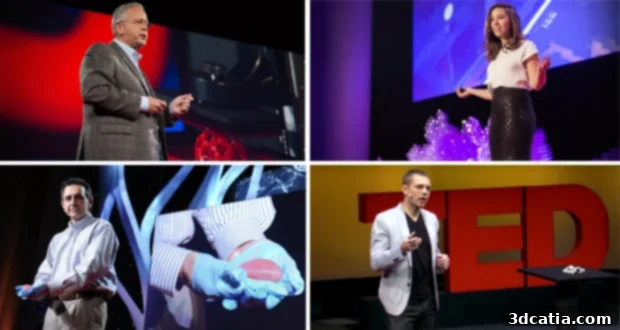
Unlocking Innovation: The Most Inspiring TED Talks on 3D Printing and Additive Manufacturing
TED Talks have long served as a global platform for sharing “ideas worth spreading,” bringing together brilliant minds from diverse fields to discuss groundbreaking concepts in technology, entertainment, and design. Since 2009, countless talks have been made freely available online, democratizing access to cutting-edge insights and inspiring millions worldwide. Among the most revolutionary topics frequently featured is 3D printing, also known as additive manufacturing. This transformative technology is reshaping industries, pushing the boundaries of what’s possible, and offering innovative solutions to some of humanity’s most pressing challenges. From medical breakthroughs to sustainable construction and personalized fashion, 3D printing’s impact is profound and ever-expanding.
In this curated collection, we embark on a journey through the most compelling and insightful TED Talks dedicated to 3D printing. We’ve meticulously selected presentations that not only showcase the latest advancements but also delve into the visionaries behind them, offering a glimpse into the future they are actively shaping. Prepare to be inspired by pioneers who are revolutionizing bioprinting, accelerating manufacturing processes, democratizing design, and even reimagining how we build our homes and consume our food. Each talk provides unique perspectives, deep dives into specific applications, and a clear understanding of why additive manufacturing is one of the most exciting technological frontiers of our time. Join us as we explore these fascinating discussions and discover the incredible potential of 3D printing through the eyes of its most ardent advocates and innovators.
Anthony Atala: The Promise of 3D Bioprinting for Regenerative Medicine
Bioprinting stands as one of the most critical and awe-inspiring applications of 3D printing, promising a future where damaged organs and tissues can be repaired or replaced. Dr. Anthony Atala, a distinguished professor and Director of the Wake Forest Institute for Regenerative Medicine, is at the forefront of this medical revolution. His pioneering work focuses on refurbishing diseased or damaged cells and tissues using the body’s own healthy cells, a concept that could fundamentally change the landscape of transplant medicine and personalized healthcare. Traditionally, organ transplantation relies on a scarce supply of donor organs and often involves lifelong immunosuppressive therapies for recipients. Bioprinting offers a potential alternative by creating patient-specific tissues and organs, minimizing rejection risks and addressing critical shortages.
During his captivating TEDMED talk, Dr. Atala provides a vivid demonstration of the current realities and immense potential of bioprinting. He showcases incredible progress made by his team, including 3D printing functional kidney structures, growing human bladders for patients, and fabricating cartilage and muscle tissue. His presentation not only demystifies the complex process of cellular scaffolding and layering but also highlights the ethical considerations and regulatory challenges inherent in this groundbreaking field. Dr. Atala’s vision extends to a future where bioprinted organs could be created on demand, tailored precisely to a patient’s needs, offering hope to millions suffering from organ failure and degenerative diseases. His work underscores how additive manufacturing is not just about creating objects, but about creating life-saving solutions.
Joseph DeSimone of Carbon 3D: Revolutionizing Manufacturing Speed with CLIP Technology
One of the long-standing limitations of conventional 3D printing has been its speed. While additive manufacturing offers unparalleled design freedom and customization, the layer-by-layer deposition process can be painstakingly slow, hindering its adoption for mass production and rapid prototyping in many industries. This fundamental challenge became the focus of Joseph DeSimone’s impactful TED Talk in March 2015. As the co-founder of Carbon 3D, DeSimone set out to dramatically transform the pace of 3D printing, addressing the bottleneck that often prevented it from competing effectively with traditional manufacturing methods.
DeSimone introduced the world to Carbon3D’s groundbreaking technology known as CLIP (Continuous Liquid Interface Production). Unlike traditional methods that cure layers one at a time, CLIP utilizes a continuous process inspired by the liquid-like scene from Terminator 2, growing objects from a resin bath. By precisely controlling the interaction of light and oxygen, CLIP can print solid parts continuously, eliminating the stop-start motion of conventional printers. This innovation allows for printing speeds that are up to 100 times faster than those achievable with older additive manufacturing techniques. During his captivating 10-minute presentation, DeSimone famously demonstrated the instantaneous fabrication of a highly complex object right before a live audience, illustrating the revolutionary potential of CLIP to accelerate product development, enable on-demand manufacturing, and unlock new possibilities for customized consumer goods and industrial components. His vision not only solved a critical problem but also ushered in a new era of high-speed additive manufacturing.
Danit Peleg: The Future of Fashion Through 3D Printing
Imagine a world where you could download a design for a skirt, jacket, or even a pair of shoes, and print it right in your own home. This revolutionary vision is at the core of Danit Peleg’s work. A talented graduate of the Shenkar College of Engineering and Design in Israel, Peleg stumbled upon 3D printing during her university years and immediately recognized its immense potential to merge with her passion for fashion. She saw an opportunity to move beyond traditional textile manufacturing and embrace a future where clothing could be customized, produced on demand, and even made sustainable through digital fabrication.
Peleg dedicated herself to extensive experimentation, meticulously searching for flexible and wearable filament materials that could be used for 3D printed garments. Her persistence paid off, leading to the creation of her groundbreaking final collection entirely composed of 3D-printed apparel. This collection was not merely a proof of concept; it was a stunning display of aesthetic beauty and innovative design, proving that additive manufacturing could create comfortable, stylish, and durable clothing. Through her inspiring talks and continued efforts, this visionary Israeli designer is actively contributing to the democratization of 3D technologies. She is a vocal advocate for a future where consumers have the power to print their own clothes, reducing waste, fostering individuality, and transforming the entire fashion industry from mass production to personalized creation. Her work challenges our perceptions of haute couture and everyday wear, presenting a tangible pathway to a more sustainable and accessible fashion landscape.
Behrokh Khoshnevis: Contour Crafting for Automated Construction
The construction industry, often characterized by its labor-intensive nature, material waste, and lengthy timelines, is ripe for disruption. As early as 2012, Behrokh Khoshnevis, a distinguished professor of Industrial & Systems Engineering and the Director of the Manufacturing Engineering Graduate Program at the University of Southern California, was already envisioning and developing a groundbreaking solution: 3D printing for construction. Khoshnevis understood that while traditional building methods had served humanity for centuries, they were inefficient and often unsustainable in the face of rapidly growing global housing needs, disaster relief efforts, and the desire for more complex architectural designs.
In his compelling TED Talk, Khoshnevis powerfully demonstrates the transformative capabilities of what he calls “Contour Crafting.” This innovative method employs a large-scale robotic system that uses additive manufacturing principles to rapidly construct entire buildings, layer by layer, directly on site. Instead of relying on manual labor for bricklaying or pouring concrete into molds, Contour Crafting extrudes structural materials with incredible precision, capable of building walls, and potentially even integrating utilities like electrical conduits and plumbing, all automatically. Khoshnevis vividly illustrates how this technology offers a significantly better alternative to current construction practices, promising faster build times, reduced labor costs, enhanced safety, and minimal waste. His vision extends beyond simply building homes; he sees Contour Crafting as a solution for affordable housing in developing nations, rapid deployment of emergency shelters, and even the potential for constructing infrastructure on other planets. This talk provides a powerful glimpse into a future where automated 3D printing reshapes urban landscapes and solves pressing global housing challenges.
Lynette Kucsma: The Potential of 3D Printed Food
Could your next meal be 3D printed? This intriguing question is at the heart of Lynette Kucsma’s work. As the Co-founder and CMO at Natural Machines, Kucsma is pushing the boundaries of culinary innovation with 3D food printing. While the concept of 3D printed food might seem futuristic, it has already found its niche in the market, primarily with confectionery items like chocolates and elaborate cake decorations. However, Kucsma believes this is just the tip of the iceberg, arguing that additive manufacturing holds the immense potential to revolutionize not just the aesthetics of our food, but also its nutritional value and preparation methods.
In her talk, Lynette challenges conventional thinking about food preparation by suggesting that 3D printing could enable us to not only print complex food designs but also to cook healthy, personalized meals directly in our homes. She envisions a future where food printers could use cartridges of fresh ingredients – proteins, carbohydrates, vitamins – to create customized dishes tailored to individual dietary needs, preferences, or even medical requirements. This technology could reduce food waste by using precise amounts of ingredients, allow for greater creativity in food design, and make healthy eating more accessible by simplifying the cooking process. Kucsma’s discussion delves into the practicality of such a device, the types of food that can be printed, and the long-term implications for our kitchens, supply chains, and overall relationship with food. It’s a fascinating exploration into how 3D printing can move beyond industrial applications and into our daily culinary lives, offering convenience, customization, and potentially enhanced nutrition.
Skylar Tibbits: The Emergence of 4D Printing and Self-Assembling Materials
Skylar Tibbits, an enthusiastic maker and researcher, has long been captivated by the potential of additive manufacturing. Yet, he identified a persistent challenge: while 3D printing excels at creating complex components, assembling these parts into a functional whole can still be a time-consuming and labor-intensive process, sometimes taking hours or even days. The true power of 3D printing, he argues, would be unleashed if objects could be printed directly as a complete, functional entity or even, more remarkably, if they could assemble themselves. This insight led him to introduce the groundbreaking concept of 4D printing.
In his captivating TED Talk, Tibbits unveils 4D printing, an evolution of 3D printing that incorporates a fourth dimension: time. This technology involves creating individual, 3D-printed components from “smart materials” that are programmed to transform their shape or properties when exposed to external stimuli such as water, heat, or light. In collaboration with Stratasys, a pioneer in 3D printing, Tibbits showcases a series of remarkable objects crafted from various materials that are completely autonomous in their transformation. Imagine a flat sheet that folds itself into a box when submerged in water, or a pipe that can expand or contract to adapt to fluid flow. This ability for objects to self-assemble or self-transform significantly reduces the need for manual assembly, opens doors for creating adaptive structures, and introduces entirely new possibilities for materials science, engineering, and robotics. Tibbits’ vision of 4D printing moves beyond static objects, heralding an era of dynamic, programmable matter that can adapt and evolve in response to its environment, pushing the boundaries of what additive manufacturing can achieve.
The Future and Diversity of 3D Printing
Aaron Jennings: Embracing the Diverse Applications of 3D Printing
3D printing is more than just a single technology; it’s a versatile toolkit that offers an unprecedented array of innovations and techniques across countless sectors. Its inherent diversity empowers professionals from engineering, design, medicine, education, and many other fields to achieve new levels of efficiency, creativity, and problem-solving that were previously unimaginable. In his insightful TEDx talk, Aaron Jennings eloquently highlights the broad spectrum of applications for 3D printing, showcasing its power as a truly transformative force.
Jennings delves into various real-world examples, illustrating how additive manufacturing is being utilized today. He touches upon its role in rapid prototyping for product development, allowing engineers and designers to quickly iterate and test concepts. He explores its use in creating custom medical devices, prosthetics, and even surgical guides, tailor-made for individual patients. Furthermore, he emphasizes its impact in education, enabling students to bring complex designs to life, fostering hands-on learning and innovation. Beyond these examples, Jennings discusses the broader advantages that 3D printing provides, such as increased customization, waste reduction, creation of complex geometries impossible with traditional methods, and the decentralization of manufacturing. His presentation serves as an excellent overview for anyone looking to understand the expansive and ever-growing potential of additive manufacturing as a diverse tool for progress across a multitude of industries.
Jasper Bouwmeester: Envisioning the Future of Additive Manufacturing
By 2017, it was already evident that 3D printing was poised to fundamentally alter numerous industries, disrupting established paradigms and creating entirely new possibilities. However, predicting the full scope of this technology’s long-term effects – both within specific industrial sectors and on broader societal and environmental scales – remained a complex challenge. In his thought-provoking TEDxZwolle talk, Jasper Bouwmeester takes on this challenge, offering a compelling vision for the future of 3D printing. He addresses many questions that have arisen concerning this burgeoning technology, providing informed answers and insightful perspectives.
Bouwmeester explores how additive manufacturing is not just an incremental improvement but a paradigm shift that will continue to drive innovation in fields like personalized medicine, sustainable manufacturing, and localized production. He discusses the environmental benefits of 3D printing, such as reduced material waste, energy efficiency in manufacturing, and the potential for repairing rather than replacing parts. He also delves into the economic implications, from creating new business models to empowering small-scale entrepreneurs and fostering local economies. Furthermore, he considers the impact on design and engineering, where complex, optimized geometries become easily achievable, leading to lighter, stronger, and more efficient products. Bouwmeester’s talk is a comprehensive outlook on the trajectory of 3D printing, offering a valuable framework for understanding its evolving role in our lives and the world at large, and providing answers to many critical questions about what comes next for this transformative technology.
Lisa Harouni: Demystifying 3D Printing Technology for Everyone
The rapid advancements in 3D printing technology, coupled with decreasing costs, have led to a significant increase in the accessibility of personal desktop 3D printers. What was once confined to industrial settings and specialized laboratories is now finding its way into more and more households, schools, and small businesses. This growing availability, however, also highlights a critical need: the education and training of individuals in the principles and applications of 3D printing. Many are curious but lack a foundational understanding of how this powerful technology works and what it can truly accomplish. In her informative TED Talk, Lisa Harouni provides an exceptionally useful and accessible introduction to the core concepts of additive manufacturing.
Harouni expertly demystifies the technology, explaining how 3D printers construct three-dimensional objects layer by layer from digital designs. She covers the basic types of 3D printing processes, the range of materials that can be used, and the fundamental benefits that make it so revolutionary. Her talk emphasizes how 3D printing simplifies the creation of complex geometries and intricate designs, making previously challenging manufacturing tasks much easier to achieve. She illustrates how this technology empowers designers, engineers, and even hobbyists to rapidly prototype, customize products, and even create functional end-use parts. For anyone seeking a clear, concise, and engaging primer on 3D printing – whether they are new to the concept or looking to deepen their understanding – Harouni’s presentation is an invaluable resource. It serves as an excellent entry point into the world of additive manufacturing, inspiring individuals to explore its potential and understand its transformative impact on innovation and production.
Bastian Schaefer: 3D Printing a Jumbo Jet and Shaping Aerospace Innovation
The aerospace industry operates at the cutting edge of engineering, constantly seeking innovations that enhance performance, reduce weight, and improve fuel efficiency. In this demanding sector, 3D printing has emerged as a truly revolutionary technology, uniquely capable of delivering exactly what is needed: extreme complexity and significantly reduced weight. These attributes are crucial for aircraft design, where every gram saved translates into fuel efficiency and increased payload capacity. In his insightful TED Talk, Bastian Schaefer, an expert in aerospace innovation, delves into the transformative role of 3D printed components and envision the future of planes and the broader aerospace industry.
Schaefer explores how additive manufacturing is enabling the creation of intricate, lightweight structures that are impossible to produce with traditional methods. He discusses the potential for 3D printing to fabricate highly optimized components, from internal engine parts with complex cooling channels to structural elements that mimic organic designs for maximum strength-to-weight ratios. Beyond the core aircraft structure, he even touches upon the customization of individual cabin elements, such as seats tailored for passenger comfort or innovative interior features. Schaefer’s presentation challenges our perception of aircraft manufacturing, moving beyond simple component production to a future where entire sections, or even an entire jumbo jet, could be largely 3D printed. He explores the benefits of on-demand part production, reduced supply chain complexities, and the ability to rapidly iterate designs. This talk is a must-watch for anyone interested in how additive manufacturing is propelling the aerospace industry into a new era of efficiency, performance, and imaginative design.
This extensive list of TED Talks offers a comprehensive overview of how 3D printing is not merely a technological trend but a fundamental shift in how we design, produce, and interact with the physical world. From saving lives through bioprinting to accelerating industrial production, personalizing fashion, building sustainable housing, reimagining our food, creating self-assembling materials, and revolutionizing aerospace, additive manufacturing truly embodies “ideas worth spreading.” These speakers—innovators, researchers, and visionaries—provide invaluable insights into the current capabilities and future potential of this dynamic technology.
What are your thoughts on these groundbreaking 3D printing TED Talks? Do you have a favorite, or perhaps another influential talk you believe should be on this list? We’d love to hear your feedback! Share your comments below or connect with us on our Facebook and Twitter pages. To stay completely up-to-date with all the latest developments in the world of additive manufacturing, don’t forget to sign up for our free weekly Newsletter, delivering the freshest news directly to your inbox!