
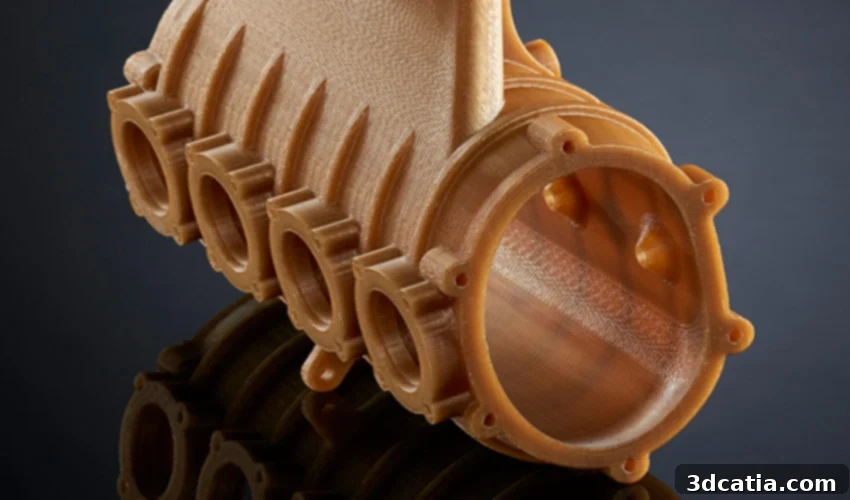
ULTEM (PEI) in 3D Printing: A Comprehensive Guide to High-Performance Thermoplastics
In recent years, the landscape of 3D printing has undergone a significant transformation, evolving beyond its initial role as a rapid prototyping technology to become a robust method for producing functional, finished parts. This paradigm shift has naturally led to a heightened demand for advanced materials capable of meeting stringent performance criteria. Consequently, high-performance thermoplastics have emerged as indispensable assets in additive manufacturing. These sophisticated polymers offer a compelling blend of properties that make them an economical and efficient alternative to traditional materials like certain metals, finding widespread adoption across demanding sectors such as aerospace, medical, automotive, and industrial tooling.
Within this esteemed family of high-performance materials, Polyaryletherketone (PAEK) compounds, including the well-known PEEK and PEKK, are celebrated for their exceptional thermal resistance and mechanical strength. However, a much more accessible and cost-effective alternative exists: Polyetherimide (PEI). This amorphous thermoplastic is widely recognized by its prominent trade name, ULTEM®. Available as a filament specifically engineered for FDM (Fused Deposition Modeling) 3D printers, ULTEM is compatible with a growing range of industrial machines, including those manufactured by industry leaders like Stratasys. This article delves into the core characteristics, processing requirements, and diverse applications of ULTEM, highlighting why it has become a cornerstone material in advanced additive manufacturing.
The Evolution and Legacy of ULTEM (PEI)
The story of Polyetherimide (PEI) began in the 1980s with its pioneering development by Joseph G. Wirth. General Electric’s Plastics Division quickly recognized its potential and began marketing the material under the now-iconic trade name ULTEM®. This introduction marked a significant advancement in polymer science, providing industries with a material that offered an impressive balance of high-temperature performance, mechanical strength, and chemical resistance. In 2007, a pivotal moment occurred when General Electric divested its plastics business to Saudi Basic Industries Corporation (SABIC), a global leader in diversified chemicals. This acquisition transferred the associated patents and proprietary knowledge of ULTEM to SABIC, which has since continued to innovate and expand the material’s applications.
While ULTEM® was initially embraced by many industrialists for its superior mechanical properties in traditional manufacturing processes like injection molding, its integration into additive manufacturing faced technological hurdles. The material’s high melting point necessitated specialized equipment. It was only with the significant advancements in high-performance FDM/FFF printers that ULTEM became truly viable for mass production via 3D printing. These industrial-grade machines are equipped with sophisticated heating systems, capable of achieving the extreme extruder temperatures, often up to 350°C, required to melt and precisely deposit the ULTEM thermoplastic filament. This technological synergy between material innovation and printer capability has unlocked ULTEM’s full potential in modern additive manufacturing, allowing for the creation of complex, high-performance components.
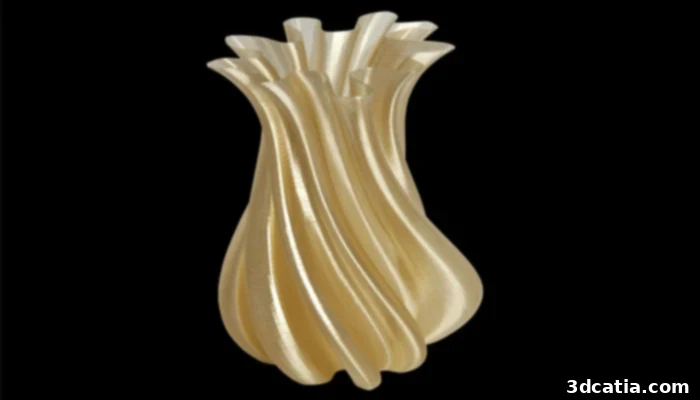
Photo credits : GEWO3D
Production and Key Characteristics of ULTEM (PEI) Filaments
ULTEM® represents a versatile group of amorphous thermoplastic materials derived from Polyetherimide (PEI). What truly sets ULTEM apart are its exceptional performance characteristics, making it suitable for some of the most demanding engineering applications. A standout feature is its outstanding flame retardancy, characterized by high resistance to ignition, remarkably low smoke generation, and minimal toxicity when exposed to fire. These critical safety properties are rigorously validated through excellent performance in Flame, Smoke, Toxicity (FST) tests, which are essential for applications in industries like aerospace and transportation where occupant safety is paramount. Furthermore, ULTEM exhibits remarkable resistance to elevated temperatures, boasting a relative thermal index (RTI) of up to 180°C, signifying its ability to maintain mechanical integrity over prolonged exposure to high heat.
Beyond thermal and flame properties, ULTEM materials are distinguished by their superior strength, impressive rigidity, and excellent dimensional stability, ensuring that printed parts retain their precise geometry under varying conditions. The material also offers exceptional creep resistance, meaning it resists deformation under sustained mechanical stress, and robust chemical resistance to a wide array of aggressive substances. Various formulations of ULTEM are available, each designed to optimize specific properties. Collectively, they offer a high weight-to-strength ratio, enabling them to effectively replace heavier metal components in many applications while often simplifying complex geometries and maintaining excellent machinability in post-processing stages.
ULTEM materials are manufactured in a diverse range of colors, encompassing both transparent and opaque options, offering design flexibility. Their inherent chemical inertness allows them to retain strength and resist stress corrosion cracking even when exposed to a broad spectrum of challenging substances, including common automotive and aircraft fluids, aliphatic hydrocarbons, alcohols, acids, and weak aqueous solutions. Among the notable variants, ULTEM® 1010 stands out for its exceptional tensile strength and superior durability. It also possesses critical certifications such as NSF 51 for food contact, making it safe for use in food processing equipment and kitchen utensils, and is capable of withstanding repeated steam sterilization cycles, which is vital for medical applications.
To further broaden the application scope, ULTEM copolymers have been developed. These advanced formulations offer even higher temperature resistance and can be tailored to meet diverse chemical and elastic property requirements, providing engineers with greater design freedom. Demonstrating a commitment to sustainability, SABIC has also introduced an ISCC+ certified renewable range of ULTEM materials. These eco-friendly variants are engineered from recycled scrap and residue, significantly reducing their environmental footprint, while delivering performance and machinability entirely comparable to traditional ULTEM derived from fossil fuels. SABIC’s strategic move underscores a growing industry trend towards sustainable manufacturing, with renewable ULTEM materials projected to constitute more than 25% of SABIC’s total ULTEM offerings by mid-2023, showcasing a clear path towards a greener future for high-performance thermoplastics.
SABIC currently provides an extensive portfolio of over 140 distinct ULTEM® variants, each optimized for specific end-use applications. Illustrative examples include ULTEM™ 9085 CG, a particularly popular grade widely utilized in the aerospace and railway sectors for critical cabin interior components, thanks to its excellent FST performance and high strength-to-weight ratio. Another significant variant is ULTEM HU1010, which is specifically designed for stringent medical devices and pharmaceutical applications, leveraging its inherent biocompatibility and ability to withstand aggressive sterilization protocols, ensuring patient safety and regulatory compliance.
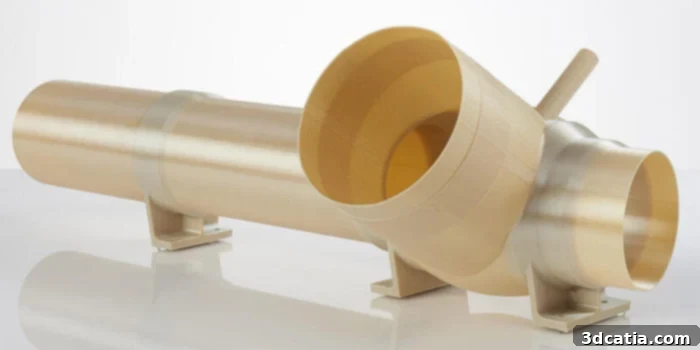
Photo credits: Stratasys
Optimizing 3D Printing with ULTEM: Critical Considerations
Achieving optimal results when 3D printing with ULTEM® necessitates meticulous and accurate temperature control throughout the entire build process. This is paramount due to ULTEM’s high glass transition temperature (Tg), which is the point at which an amorphous polymer transitions from a rigid, glassy state to a more flexible, rubbery state. For example, ULTEM 1010 has a Tg of 217°C, while ULTEM 9085 has a Tg of 185°C. Maintaining a consistently controlled print chamber temperature, ideally slightly below the material’s glass transition temperature, is of utmost importance. Any significant deviations in chamber temperature can lead to a host of issues, including warping, delamination between layers, and poor dimensional accuracy, ultimately compromising the desired mechanical properties of the printed parts.
Beyond the heated print chamber, other temperature parameters are equally critical. The extruder nozzle temperature typically needs to be very high, often ranging from 340°C to 380°C, to ensure proper melting and flow of the high-performance filament. The heated build plate, crucial for initial layer adhesion and preventing warping, usually operates between 110°C and 160°C. Furthermore, pre-drying the ULTEM filament is a non-negotiable step. PEI is hygroscopic, meaning it readily absorbs moisture from the air. Printing with moist filament can lead to bubbling, poor layer adhesion, and significant degradation of mechanical properties. Filaments should be dried thoroughly in a dedicated filament dryer at appropriate temperatures (e.g., 80-120°C for several hours) before and during printing.
Due to these demanding temperature requirements and the need for precision, ULTEM is predominantly printed on industrial-grade FDM machines that feature fully enclosed and actively heated build chambers. These professional systems are designed to maintain the consistent thermal environment essential for successful ULTEM prints, minimizing thermal stresses and maximizing part quality. While some advanced desktop machines can attempt ULTEM printing, they often struggle to achieve the necessary chamber temperatures and stability, making industrial printers the preferred choice for reliable and high-quality production of ULTEM components.
Diverse Applications of ULTEM (PEI) in Modern Industry
Polyetherimide (PEI), and specifically the ULTEM® 9085 grade, has found extensive utility across a myriad of demanding industries, primarily owing to its exceptional characteristics previously outlined. Its unparalleled combination of high strength-to-weight ratio, flame retardancy, and thermal stability makes it a go-to material in the aerospace industry. Here, ULTEM is used for manufacturing crucial cabin interior components such as seat parts, air ducts, wire clips, and paneling, where FST compliance and light weighting are critical. The material’s ability to meet stringent aviation standards for fire safety and structural integrity positions it as a leading choice for both commercial and military aircraft.
Beyond aerospace, ULTEM is also a preferred material in the automotive sector, particularly for under-the-hood components where exposure to high temperatures, aggressive chemicals, and automotive fluids is common. Its excellent chemical resistance and thermal stability make it ideal for sensor housings, headlight reflectors, and electrical connectors. In the medical and pharmaceutical sectors, ULTEM HU1010, with its biocompatibility and steam sterilizability, is invaluable for creating surgical instruments, sterilization trays, drug delivery devices, and prosthetic components, ensuring safety and efficacy in critical healthcare applications. Its NSF 51 certification further extends its use into the food industry, especially for designing kitchen utensils, microwave oven components, and food processing equipment where contact with consumables requires specific material properties.
Furthermore, this versatile thermoplastic is widely employed in tooling applications, where its stiffness, dimensional stability, and temperature resistance are highly advantageous. This includes the creation of precision molds, robust jigs, custom fixtures, and end-of-arm tooling for robotic systems. A compelling example of ULTEM’s industrial application is its use by Bombardier, a global leader in rail transportation and aerospace. Bombardier leverages PEI to manufacture customized tools and production aids for their assembly lines, allowing for rapid iteration and cost-effective solutions. They also utilize ULTEM for customizing and optimizing specific components on production lines, and critically, for producing finished parts for their trains, showcasing its reliability for end-use functional parts in harsh operational environments.
Main Manufacturers and Pricing Landscape of ULTEM Filaments
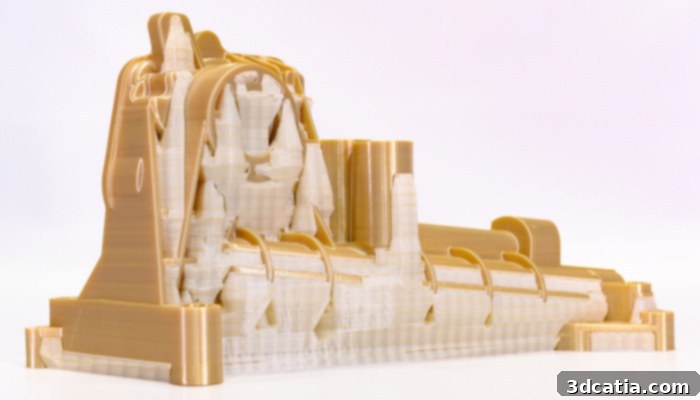
SABIC has developed a 3D printing support for the ULTEM
SABIC stands as the primary and original manufacturer responsible for supplying the raw Polyetherimide (PEI) material used in ULTEM production globally. Historically, SABIC’s proprietary ULTEM filaments for additive manufacturing were exclusively engineered and optimized for compatibility with Stratasys machines, ensuring seamless integration and validated performance within those closed-system ecosystems. However, in recent years, SABIC has strategically expanded its partnerships, recognizing the broader market demand for ULTEM. This expansion includes collaborations with other prominent industrial 3D printer manufacturers like Roboze, which now offers the capability to print ULTEM™ AM9085F filament on their advanced FDM systems. Additionally, the market has seen the emergence of several independent material manufacturers, such as KIMYA, 3DXTech, and 3D4Makers, who develop and offer their own high-quality ULTEM PEI filaments, providing a wider choice for end-users and increasing accessibility to this high-performance material.
A significant innovation from SABIC that greatly enhances the usability of ULTEM in complex 3D printing scenarios is the introduction of a specialized detachable support filament, designated AMS31F. This advanced support material is specifically designed for printing with ULTEM. Its key advantage lies in its ease of removal compared to conventional support options, which often require laborious post-processing steps or chemical dissolution. By using AMS31F, users can significantly streamline their workflow, reduce post-processing time and costs, and critically, preserve the mechanical properties and surface finish of their intricate ULTEM printed parts, which can be sensitive to aggressive removal methods. This innovation makes printing geometrically complex ULTEM components far more practical and efficient.
When considering ULTEM for 3D printing, a crucial factor is its cost-effectiveness in comparison to other high-performance thermoplastics, particularly PEEK (Polyetheretherketone). PEI (ULTEM) offers a more accessible entry point into high-performance additive manufacturing, with filament prices typically around 150 euros per kilogram. In contrast, PEEK filament generally costs significantly more, often at least 300 euros for the same quantity, sometimes even reaching 500-600 euros. While ULTEM boasts the advantage of being certified for various aerospace applications, meeting stringent standardized requirements for FST and mechanical properties, it’s important to acknowledge its limitations. PEI generally exhibits lower impact resistance and, notably, lower continuous operating temperature resistance compared to PEEK. Therefore, the choice between ULTEM and PEEK often comes down to a careful balance of specific application requirements, performance needs, and budget constraints, with ULTEM offering an excellent high-performance solution at a more economical price point.
Do you currently utilize ULTEM as a 3D printing material in your projects? We’d love to hear about your experiences, insights, and the innovative applications you’re developing. Share your thoughts in a comment below or engage with us on our social media platforms: LinkedIn, Facebook, and Twitter! Don’t miss out on the latest advancements and news in the additive manufacturing world; remember to sign up for our free weekly Newsletter here, delivering the freshest 3D printing updates straight to your inbox! You can also explore our comprehensive video library and engaging content on our YouTube channel for further insights.