
3D Printer Emissions: Uncovering the Health Impacts of Carbon Nanotubes and VOCs
The rapid proliferation of 3D printers, from industrial facilities to home offices and educational settings, has undeniably revolutionized manufacturing and design. This innovative technology, also known as additive manufacturing, offers unparalleled flexibility for prototyping, customization, and producing complex geometries. However, as 3D printing becomes increasingly ubiquitous, a critical question emerges regarding its potential impact on human health and indoor air quality. Recognizing this growing concern, the United States Environmental Protection Agency (EPA), in collaboration with the Consumer Products Safety Commission (CPSC), has initiated comprehensive investigations to ascertain whether the widespread use of these devices could lead to unintended adverse health effects.
The emergence of 3D printing is relatively recent when compared to established manufacturing processes, and consequently, the emissions released during operation have not been subjected to extensive, in-depth monitoring. This knowledge gap is particularly concerning given that even a seemingly innocuous desktop machine in a well-ventilated office or home environment could be releasing a complex cocktail of airborne particles and gases. These emissions, primarily consisting of Volatile Organic Compounds (VOCs) and ultrafine particles (UFPs), pose potential risks that users may not fully comprehend or be adequately prepared to mitigate.
Dr. Souhail Al-Abed, a leading EPA scientist spearheading this vital research, articulates the core challenge: “Users may not be aware of chemical emissions during the printing process.” His statement underscores the significant lack of public awareness regarding the invisible airborne contaminants generated by 3D printers, especially the fluctuating levels of volatile organic compounds (VOCs). VOCs are organic chemicals that have a high vapor pressure at ordinary room temperature, meaning they can easily evaporate into the air. They are often associated with various health issues, including respiratory irritation, headaches, and in some cases, more serious long-term health concerns. While there have been some preliminary studies in the past focusing on the general impact of VOCs released from 3D printers on users’ health, these investigations typically overlooked a crucial variable: how these emission profiles can drastically change when certain additives are introduced into the 3D printing filament itself. This oversight highlighted a critical blind spot in understanding the full spectrum of potential health risks.
To address this gap, Dr. Al-Abed’s team embarked on a focused study designed to specifically measure the influence of filament additives on emissions. Their research centered on a commonly available filament type, examining its emission characteristics both with and without the inclusion of carbon nanotubes. Carbon nanotubes were chosen due to their increasing popularity as an additive in advanced composite materials, celebrated for their ability to significantly enhance the mechanical, electrical, and thermal properties of various substances. The objective was clear: to determine precisely whether the presence of these nanoscale inclusions would alter the quantity and type of VOC emissions released during the 3D printing process, thereby potentially introducing new or exacerbated health hazards.
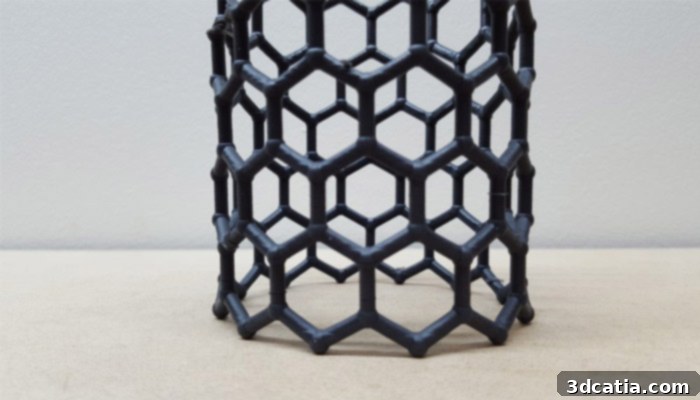
A 3D printed carbon nanotube piece | Credits: Spira3D
Carbon nanotubes (CNTs), much like traditional carbon fibers, are increasingly utilized to enhance the properties of 3D printing filaments. They impart superior strength to printed parts, making them robust yet remarkably lightweight—a critical advantage in sectors ranging from aerospace to automotive. Beyond their mechanical benefits, CNTs possess fascinating electrical and thermal properties, exhibiting excellent conductivity and efficient heat dissipation. These attributes make them ideal candidates for advanced applications, particularly in the electronics industry, where they can be integrated into sensors, flexible circuits, and highly efficient thermal interfaces. However, the rapidly expanding use of these nanomaterials also brings a significant concern: the potential harm to users has not been comprehensively measured or fully understood. The nanoscale size of these particles raises questions about their behavior upon release and their potential interaction with biological systems if inhaled or otherwise absorbed.
To rigorously assess these potential risks, the EPA research team employed a sophisticated methodology. They meticulously monitored the emissions released under a wide variety of precisely controlled conditions, designed to simulate the different heating, melting, and forming phases that plastics undergo during typical 3D printing operations. This involved varying parameters such as print temperature, print speed, nozzle temperature, and even the ambient conditions within the printing environment. To accurately capture and analyze these combustion-related emissions, they utilized a specialized analytical device known as the System for Thermal Diagnostic Studies. This state-of-the-art equipment is specifically engineered for high-precision measurement of gases and particles released during thermal degradation processes, providing the detailed insights necessary to identify and quantify the specific compounds emitted by the 3D printers under investigation.
The findings from their meticulous studies yielded significant and concerning results. The 3D printing filament that incorporated carbon nanotubes was found to emit two entirely *new* volatile organic compounds (VOCs) that were not detected when printing with the filament devoid of these additives. This discovery is crucial because these specific gases could potentially pose a serious inhalation hazard, particularly for users engaged in printing several kilograms of material over extended periods or in poorly ventilated spaces. This highlights a heightened risk associated with specialized filaments designed for enhanced performance. Furthermore, the research pinpointed print temperature as the most critical factor influencing the emission of VOCs. Higher printing temperatures, often required for materials with enhanced properties like those containing carbon nanotubes, led to a proportionally greater release of these hazardous compounds. The duration of heating the filament, or the operational print time, was identified as the second most impactful factor, indicating that longer print jobs inherently contribute to increased emission exposure. Finally, their research also showed that some of the VOCs were not just airborne but were trapped within the particulates of the printed plastic itself. While the team was unable to measure the exact levels of these trapped VOCs, this finding suggests a potential for delayed release or even secondary exposure routes if these particulates are ingested or otherwise handled, adding another layer of complexity to the overall health risk assessment.
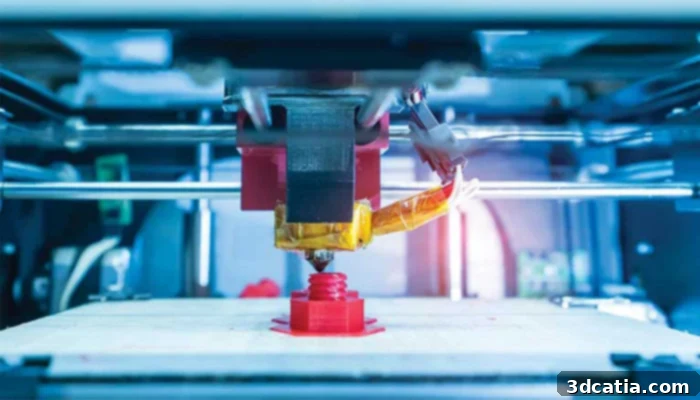
Being exposed to a 3D printer for too long could be harmful | Credits: kynny/iStockphoto
Understanding the intricate relationship between printing parameters, filament composition, and the resulting VOC and UFP emissions will be paramount in the months and years to come. While a general awareness exists among the public that 3D printing emissions are not ideal for a user’s health, specific knowledge about the exact chemical compounds involved, their concentrations, and the precise impact on human physiology remains largely unquantified outside of specialized research circles. This study from the EPA is a crucial step in bridging that knowledge gap, offering concrete data on how certain additives and operational conditions directly influence emission profiles and potential health hazards. It underscores the urgent need for both manufacturers and users to prioritize safety measures and informed practices.
For users, this implies a greater emphasis on adequate ventilation, utilizing printer enclosures with filtration systems, and making educated choices about filament types. For manufacturers, it highlights the responsibility to develop safer materials, provide clearer data on emission characteristics, and design printers with improved emission control features. The regulatory landscape will also need to evolve, with agencies like the EPA and CPSC potentially establishing clearer guidelines and standards for 3D printer operation and material safety. Further research is essential to fully grasp the long-term health effects of chronic exposure, to evaluate the effectiveness of various mitigation strategies, and to explore emission reduction technologies. This ongoing dialogue between scientific inquiry, industry innovation, and public awareness is vital to ensure that the transformative benefits of 3D printing can be enjoyed safely and sustainably by all. You can delve deeper into the specifics of this groundbreaking study by reading the full report HERE.
Were you aware of the potential harm posed by 3D printing emissions, particularly from specialized filaments like those containing carbon nanotubes? We invite you to share your thoughts and experiences in a comment below or join the conversation on our Facebook and Twitter pages! Don’t miss out on the latest advancements and safety recommendations in the world of additive manufacturing. Sign up for our free weekly Newsletter to get all the essential news in 3D printing delivered straight to your inbox!