

Revolutionizing Orthopedic Surgery: 3D-Printable Bioactive Material for Advanced Rotator Cuff Repair
Tendon injuries are notoriously challenging to treat, often leading to prolonged recovery periods and significant pain. Even seemingly minor tears can necessitate up to 12 weeks of healing. However, for severe cases, such as rotator cuff tears, the path to recovery is even more arduous. These debilitating injuries frequently require complex surgical interventions, and even under optimal conditions, a full recovery can take six months or longer. The persistent need for more effective and less invasive treatment options for these common and debilitating injuries has driven innovative research. Addressing this critical demand, a dedicated team of researchers at The Chinese University of Hong Kong (CUHK)’s Faculty of Medicine (CU Medicine) has made a groundbreaking discovery: a novel 3D-printable bioactive material specifically engineered for the robust repair of severe shoulder tendon tears.
The rotator cuff, an intricate network of tendons and ligaments, plays a crucial role in stabilizing the arm at the shoulder joint, enabling a wide range of motion. A tear in this vital structure results in excruciating pain, severely limiting the ability to perform basic daily tasks, even disrupting sleep. In nearly all significant cases, surgical repair becomes unavoidable. The urgency for advanced treatment solutions is underscored by projections indicating a rise in rotator cuff injuries in the coming years, largely due to an aging global population. Current statistics highlight the widespread nature of the problem, with at least 22% of the adult population having already experienced a full-thickness rotator cuff tear. Such prevalence necessitates agile, durable, and highly effective treatment methods. This innovative 3D-printable bioactive material holds immense promise as a transformative solution, offering a new paradigm in orthopedic repair by providing a robust, regenerative, and customizable approach to healing these complex injuries.
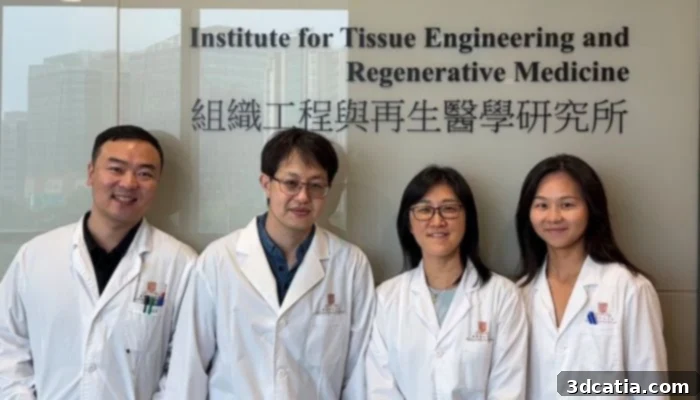
The team developing the materials including (starting from the left) Mr. Wang Chen-yang, Professor Elmer Ker, Dr. Zhang Xu and Dr. Li Ke (photo credits: CUHK)
Unlocking Advanced Tendon Regeneration with a 3D-Printable Bioactive Material
The cornerstone of this remarkable breakthrough by the CUHK team lies in a specially engineered polythiourethane elastomer, aptly named PHT polymer. This revolutionary material is designed to seamlessly integrate into the body, effectively replacing torn tendons and promoting natural healing. The PHT polymer is meticulously crafted using “click chemistry,” a highly efficient and precise method of chemical synthesis known for its ability to join molecular entities with exceptional accuracy. This sophisticated approach enables the creation of biomolecules that are almost exact replicas of their natural counterparts, allowing the PHT polymer to remarkably mimic the intricate structure and function of natural tendon tissue. Beyond its biomimetic capabilities, rigorous testing has demonstrated the material’s extraordinary mechanical robustness. It has proven capable of enduring at least 10,000 stretching cycles without any sign of failure, indicating a durability that far surpasses many existing biomaterials and offers a promising solution for the high mechanical demands placed on shoulder tendons.
The strategic choice to develop this material as 3D-printable was a deliberate and forward-thinking decision by the research team. This approach unlocks unprecedented opportunities for personalization in treatment, allowing surgeons to create custom implants that perfectly match the unique anatomy and specific tear dimensions of each patient. Such tailored solutions can significantly improve surgical outcomes by ensuring a precise fit and optimal integration with surrounding tissues. Furthermore, the CUHK team envisages that leveraging 3D printing for rotator cuff repair will lead to more economical treatment options. The inherent flexibility of on-demand fabrication means that implants can be produced precisely when and where they are needed, potentially reducing waste, storage costs, and supply chain complexities. This not only enhances accessibility to advanced treatments but also streamlines the surgical process, making it more efficient and cost-effective in the long run.
Pioneering Regenerative Success and Future Clinical Applications
The preliminary results from extensive testing of this 3D-printable bioactive material have been overwhelmingly positive and represent a significant leap forward in regenerative medicine. In laboratory studies, the material demonstrated its ability to effectively mimic natural tendons, restoring the shoulder properties of injured rabbits back to healthy, functional levels. This animal model success is a crucial step towards human application, highlighting the material’s biocompatibility and efficacy in a living system. What truly sets this innovation apart, however, is its unprecedented pro-regenerative capability. The material has shown the astonishing potential to deliver bioactive factors that stimulate the regeneration of at least 1 cm of a large tendon injury. For decades, regenerating such a significant length of damaged tendon has been considered virtually impossible with existing treatments, often requiring grafts or extensive rehabilitation with limited success for severe tears. This breakthrough challenges previous biological limitations and opens new avenues for healing complex musculoskeletal injuries that were once deemed irreparable.
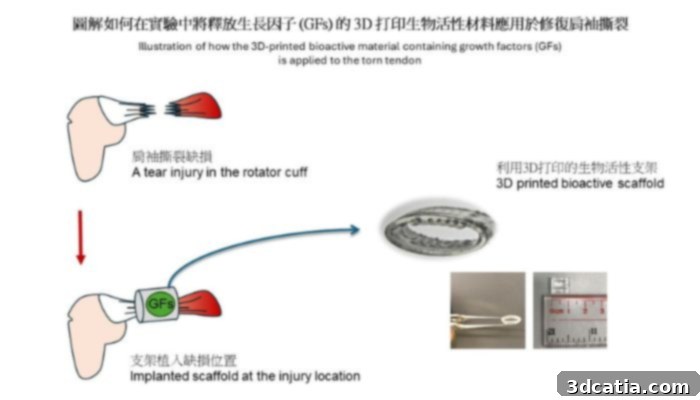
A graphic explaining how the process to heal rotator cuff injuries with the 3D-printable material (photo credits: CUHK)
Professor Elmer Ker, Assistant Professor in the School of Biomedical Sciences at The Chinese University of Hong Kong (CUHK)’s Faculty of Medicine (CU Medicine) and the distinguished leader of this pioneering research, succinctly encapsulates the team’s achievement: “Our work has achieved the goal of developing an easily manufactured, mechanically robust, pro-regenerative tendon biomaterial that addresses mechanical and biological deficits in rotator cuff injuries while avoiding a complex and laborious production process.” He further emphasizes the promising future of this technology, stating, “We will continue to prove the significant potential of this newly developed material for the repair of large-to-massive rotator cuff injuries, as well as other soft tissue injuries, in a clinical setting.” This commitment signals a clear path towards clinical trials, aiming to translate this revolutionary laboratory success into tangible benefits for patients worldwide. The material’s straightforward manufacturing process, coupled with its remarkable ability to provide both structural support and biological cues for regeneration, positions it as a highly adaptable solution for a wide range of orthopedic and soft tissue repair challenges. This research promises to redefine the standards of care for tendon injuries, moving beyond simple repair to true biological regeneration.
The implications of this 3D-printable bioactive material extend far beyond just rotator cuff injuries. Its versatility and regenerative properties suggest immense potential for treating other complex soft tissue damage, including ligament tears, Achilles tendon ruptures, and various muscle injuries. By offering a scaffold that is both mechanically sound and biologically active, this innovation could dramatically reduce recovery times, lower re-injury rates, and significantly improve the long-term quality of life for countless individuals suffering from debilitating musculoskeletal conditions. As the research progresses towards clinical application, it stands to become a cornerstone of future regenerative medicine, providing orthopedic surgeons with a powerful new tool to restore function and promote true healing in ways previously thought impossible. For those interested in delving deeper into the scientific specifics of this breakthrough, the recently published paper can be accessed HERE.
What are your thoughts on the groundbreaking use of a 3D-printable bioactive material for the repair of massive rotator cuff tendon tears and other soft tissue injuries? Share your insights in a comment below or join the conversation on our LinkedIn, Facebook, and Twitter pages! Don’t forget to sign up for our free weekly newsletter here to receive the latest 3D printing news directly in your inbox! You can also explore all our videos and interviews on our dedicated YouTube channel, where we cover the most exciting advancements in additive manufacturing.