
Exploring the Future: Top 5 Essential 3D Printing Videos and Innovations
This week, we delve into the dynamic world of 3D printing and explore how additive manufacturing is fundamentally transforming global production paradigms. This revolutionary technology has successfully permeated a multitude of industrial sectors, demonstrating its remarkable versatility and impact. From critical applications in medical fields to advanced solutions in the automotive industry, 3D printing continues to push boundaries and redefine what’s possible. To keep you abreast of the very latest innovations and breakthroughs, we have curated a selection of the top five most insightful videos of the week. These videos offer a compelling glimpse into the diverse applications and profound benefits of this cutting-edge technology. We invite you to explore this hand-picked collection and witness the exciting advancements shaping the future. For even more engaging content, be sure to visit and subscribe to our dedicated YouTube channel, where a vast library of 3D printing videos awaits. We trust you’ll find these insights valuable and inspiring!
Top 1: Webinar – The Benefits of 3D Printing with Composite ABS Filaments
The landscape of 3D printing materials has witnessed exponential growth over recent years, significantly broadening the scope of applications achievable with additive manufacturing. This expansion is particularly vital for industrial sectors that demand high-performance, technical-grade materials capable of withstanding rigorous conditions and delivering specific functionalities. Indeed, numerous industry studies consistently highlight that the strategic choice of material is not merely a preference but a primary driver for the widespread adoption and successful implementation of additive manufacturing across various industries. Historically, Acrylonitrile Butadiene Styrene, commonly known as ABS, has stood out as one of the most enduringly popular thermoplastic polymers in the 3D printing world. It was among the pioneering materials to gain traction in demanding industrial applications, largely due to its exceptional properties. ABS is renowned for its high impact resistance, making it suitable for parts requiring robustness and durability. Furthermore, its relative ease of use in printing processes has cemented its position as a go-to material for both prototyping and functional parts. On the 26th of May, 3Dnatives hosted an enlightening webinar featuring experts from Kimya and MakerBot. This collaborative session was dedicated to exploring the multifaceted benefits and advanced capabilities offered by composite ABS filaments, specifically tailored for demanding industrial 3D printing applications. The discussion covered how these composite materials enhance the traditional properties of ABS, such as increasing stiffness, improving thermal resistance, and enabling lighter yet stronger parts, thereby unlocking new possibilities for engineering and manufacturing. This webinar provides invaluable insights for anyone looking to leverage the full potential of advanced material science in additive manufacturing.
Top 2: Design Rules for Large Format 3D Printing
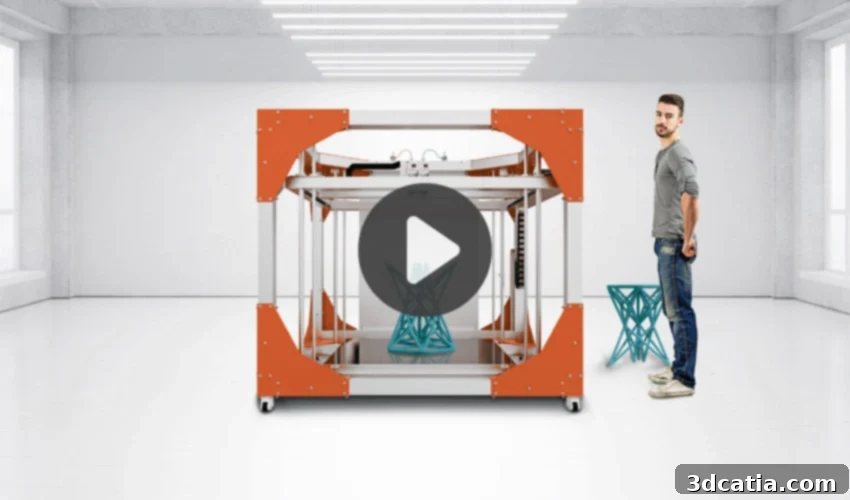
Additive manufacturing, by its very nature, operates under a distinct set of design principles that diverge significantly from those traditionally employed in conventional manufacturing processes. Concepts such as topological optimization, which maximizes material efficiency and structural integrity, sophisticated lattice structures that reduce weight while maintaining strength, and precise part orientation to ensure optimal print quality and mechanical properties, are fundamental to successful 3D printing. While good design is always paramount, its importance is amplified exponentially when transitioning to large-scale 3D printing. Designing for large format additive manufacturing demands an even higher degree of vigilance and precision, as the stakes are considerably higher. A seemingly minor design flaw in a large-scale print can lead to significant and costly consequences. These can include extensive post-processing or complete rework of parts, substantial waste of valuable and often expensive industrial-grade materials, and considerable delays in production timelines. Such errors can impact project budgets and schedules profoundly. To navigate these complexities successfully, manufacturers need expert guidance. Leading large-format 3D printer manufacturer BigRep, a pioneer in this specialized field, offers a comprehensive series of invaluable tips and best practices. These guidelines are specifically tailored to assist engineers and designers in effectively conceptualizing, optimizing, and executing large format industrial parts with additive manufacturing. Their insights cover crucial aspects from initial concept development to final part production, ensuring efficiency, material economy, and structural integrity. Understanding these design rules is crucial for anyone venturing into industrial large-scale 3D printing to minimize risks and maximize output quality.
Top 3: A 3D Printed Dress with Sensors – Fashion Meets Technology
Anouk Wipprecht, an acclaimed Dutch designer, stands at the forefront of combining high fashion with cutting-edge technology, frequently leveraging additive manufacturing to bring her avant-garde creations to life. Her innovative spirit consistently pushes the boundaries of wearable technology and interactive design. Her latest groundbreaking project, aptly named the “Proximity Dress,” is a stunning testament to this fusion. This unique garment is a meticulously 3D printed dress meticulously integrated with a network of sophisticated sensors. The primary function of these sensors is to monitor and respond to the wearer’s immediate surroundings, specifically designed to help maintain social distancing. In a world increasingly conscious of personal space, especially in light of public health concerns like COVID-19, the Proximity Dress offers a truly novel solution. When someone approaches too closely to the person wearing the dress, the garment dynamically responds by stretching or unfolding certain elements, subtly creating an extended personal bubble. This fascinating interaction serves as a visual and tactile cue, encouraging others to maintain a respectful distance. Anouk Wipprecht explains that she precisely fabricated various intricate components of the dress using 3D resin printing, a technique that allows for exceptional detail and structural complexity. This choice of material and method enabled her to achieve both the aesthetic elegance and the functional requirements of her design. The Proximity Dress is far more than just a piece of clothing; it represents a captivating intersection of fashion, technology, and social awareness, showcasing the immense potential of 3D printing to create interactive and responsive wearables that are truly out of the ordinary.
Top 4: Making a Highly Detailed 3D Model of Chicago
Witness the incredible precision and collaborative effort behind the creation of an astonishingly detailed architectural model of Chicago in this captivating video. This ambitious project was born from a unique partnership between the innovative materials manufacturer DSM and the prestigious Chicago Architecture Center. Together, they embarked on a monumental task: to construct a sprawling 3D map of the entire city. This isn’t just a simple representation; it’s a meticulously crafted replica that captures every single monument, iconic building, intricate street layout, and a plethora of minute urban details. The cornerstone of this project’s success was the strategic utilization of advanced 3D resin printers. These high-precision machines were indispensable for accurately reproducing the complex geometries and fine features characteristic of Chicago’s diverse urban landscape. The dedicated teams at DSM took on the crucial responsibility of all the 3D printing operations, leveraging their expertise in material science and additive manufacturing to ensure each printed component met the highest standards of accuracy and quality. Following the extensive printing phase, the skilled teams from the Chicago Architecture Center meticulously undertook the intricate process of assembling the entire model. This highly detailed and labor-intensive assembly required immense patience, precision, and an intimate understanding of the city’s structure. The entire endeavor, from initial printing to final assembly, was completed in a remarkable four days, a testament to the efficiency of modern additive manufacturing combined with expert craftsmanship. This project vividly demonstrates the transformative power of 3D printing in fields such as urban planning, architectural visualization, and educational outreach, allowing for unprecedented levels of detail and immersive representation of complex environments.
Top 5: 3D Printing – The Next Manufacturing Revolution?
The manufacturing industry stands on the precipice of a profound transformation, and 3D printing, or additive manufacturing, is leading this charge. Traditional manufacturing techniques, such as subtractive processes like milling, formative processes like casting, and assembly methods like gluing, which have long been industrial mainstays, are increasingly being challenged by the superior efficiencies and innovative capabilities of 3D printing. This shift promises a future where enormous amounts of material waste are minimized through optimized designs and on-demand production, and energy consumption is significantly reduced compared to energy-intensive conventional methods. Furthermore, 3D printing drastically accelerates lead times, moving from design to finished product with unprecedented speed, and inherently encourages more localized, decentralized production, fostering resilient and agile supply chains. A prime example of this revolution in action is the aerospace giant, Airbus. The company is already reaping substantial benefits from integrating additive manufacturing into its production lines. Commencing this year, the advanced A350 airliner will feature critical components manufactured using 3D printing technology, specifically its door locking shafts. This transition is not merely about using a new technology; it’s about revolutionary efficiency. Where previously ten separate parts had to be individually manufactured, assembled, and installed, 3D printing has enabled the consolidation of these multiple components into a single, optimized part. This remarkable consolidation not only saves numerous manufacturing steps and associated labor but also contributes to overall weight reduction and increased component reliability. This powerful case study from Airbus underscores the profound impact 3D printing is having on complex industrial sectors. In the compelling documentary provided by DW Documentary, viewers can gain even deeper insights into how 3D printing is not just improving individual components but is fundamentally reshaping our entire global supply chains, driving innovation, efficiency, and sustainability across industries worldwide. This truly positions 3D printing as a cornerstone of the next industrial revolution.
We trust you found these curated videos both informative and inspiring, offering a comprehensive look into the diverse applications and revolutionary potential of 3D printing across various sectors. The innovations showcased this week are just a glimpse into the ongoing evolution of additive manufacturing. We’d love to hear your thoughts and insights! Please feel free to share your comments and reactions to these videos below, or join the conversation on our vibrant Facebook and Twitter pages. Your feedback is invaluable to us. Additionally, to ensure you never miss out on the latest advancements, breaking news, and exclusive content in the rapidly evolving 3D printing industry, don’t forget to sign up for our free weekly Newsletter. Delivered straight to your inbox, it’s your essential guide to staying ahead in the world of additive manufacturing!