
Innovations in Additive Manufacturing: From Lunar Rovers to Sustainable Boats and Next-Gen Automotive Parts
This week, we delve into the forefront of additive manufacturing, showcasing groundbreaking applications that are reshaping industries from aerospace to automotive, and even contributing to environmental sustainability. Our compilation begins with Lockheed Martin’s strategic integration of 3D printing for their lunar rover project, demonstrating how advanced technologies like the Makerbot Method X are enhancing agility, efficiency, and accelerating the entire design, development, and testing lifecycle. Beyond the cosmos, we explore how plastic waste is being ingeniously transformed into a functional boat hull and witness the revolutionary impact of additive manufacturing in creating next-generation automotive components. Additionally, we’ll uncover how optimized software solutions are making 3D printing processes more efficient than ever before. Join us as we explore these remarkable advancements!
Top 1: Lockheed Martin & The Power of Makerbot in Space
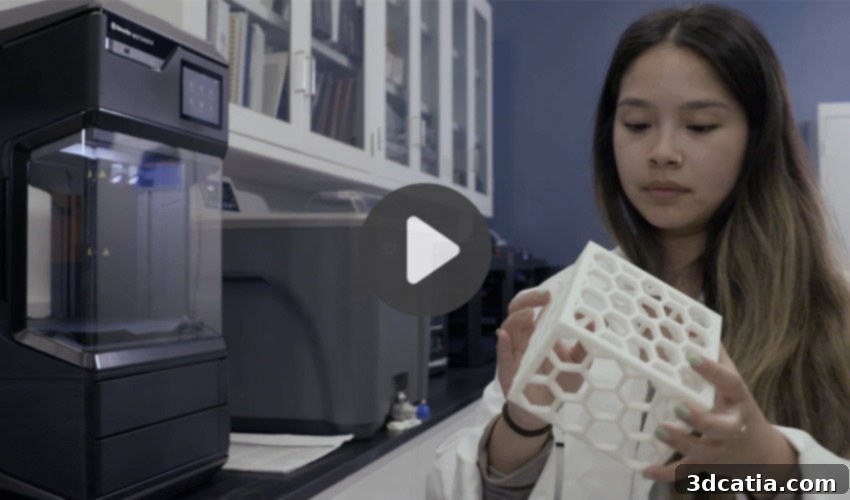
Lockheed Martin, a global leader in security and aerospace, is consistently at the vanguard of technological innovation. In their ambitious autonomous lunar rover project, designed for potential use by NASA, additive manufacturing plays a pivotal role in accelerating the creation of various tools, fixtures, and functional prototypes. The demanding environment of space exploration necessitates rapid iteration and high-performance components, challenges ideally met by advanced 3D printing. Lockheed Martin has strategically invested in a Makerbot Method X 3D printer, an industrial-grade machine renowned for its heated chamber and compatibility with a broad spectrum of engineering thermoplastics, including robust carbon fiber-reinforced nylon. This material is particularly critical for aerospace applications due to its exceptional strength-to-weight ratio and durability.
The integration of the Makerbot Method X allows Lockheed Martin’s engineering teams to drastically improve their design, development, and testing workflows. Traditionally, prototyping complex components for space missions could be a lengthy and costly process, often involving intricate machining or outsourcing. With in-house 3D printing capabilities, engineers can conceptualize, print, and physically test new ideas with unprecedented speed and cost-effectiveness. This agility is crucial for iterating through multiple design variations to optimize functionality, reduce weight, and ensure mission success for the lunar rover. Specific applications include the rapid production of custom sensor supports, protective enclosures for sensitive electronics, and various made-to-measure parts that are integral to the rover’s operation. By reducing lead times and facilitating continuous improvement, additive manufacturing empowers Lockheed Martin to push the boundaries of space exploration with greater efficiency and innovation:
Top 2: Henkel Elastomers Revolutionize Automotive Comfort and Design
The automotive sector has long recognized the transformative potential of additive manufacturing, leveraging it for numerous applications ranging from custom tooling and lightweight components to intricate prototypes and end-use parts. The technology’s ability to produce complex geometries, optimize material usage, and enable rapid design iterations has made it indispensable for modern vehicle development. KTM E-TECHNOLOGIES, a forward-thinking player in the electric vehicle (EV) market, is now taking this a step further by utilizing 3D printing to significantly enhance the interior comfort and design of its new electric vehicle.
Specifically, KTM E-TECHNOLOGIES has adopted Digital Light Processing (DLP) 3D printing technology in conjunction with advanced elastomeric materials developed by Henkel. DLP is a resin-based additive manufacturing process known for its speed and precision, curing liquid photopolymer resins layer by layer using a digital light projector. This method is particularly well-suited for producing intricate, flexible, and detailed parts, making it ideal for creating ergonomically designed components. In this application, they are designing sophisticated pads for car seats, which are crucial for improving driver and passenger comfort, especially during longer journeys.
A key innovation here is the use of lattice structures within these seat pads. These highly engineered, open cellular geometries are impossible to create with traditional manufacturing methods but are easily achievable with additive manufacturing. Lattice structures offer a unique combination of flexibility, breathability, and tunable mechanical properties, allowing engineers to customize stiffness and support levels precisely. This results in superior shock absorption, better air circulation, and a significant reduction in overall component weight compared to solid counterparts. Furthermore, thanks to the generous build volumes of the resin 3D printers employed, these complex lattice parts can be printed in a single, continuous process, streamlining production and ensuring consistency. This marriage of advanced materials and cutting-edge 3D printing is not just about comfort; it represents a paradigm shift in how automotive interiors are designed, offering unparalleled customization and performance:
Top 3: Caracol & The Sustainable Future: A Boat 3D-Printed from Plastic Waste
Caracol, an innovative Italian 3D printing service, stands out for its strong commitment to sustainable development, placing environmental responsibility at the core of its operational philosophy. This dedication has led to a remarkable collaboration with Maire Tecnimont, an international leader in the transformation of natural resources. Together, they are pioneering the characterization and utilization of 3D printable materials derived directly from plastic waste, specifically sourced from Maire Tecnimont’s MyReplast Industries plant.
This partnership addresses a critical global challenge: the escalating problem of plastic waste and the urgent need for circular economy solutions. By transforming discarded plastics into valuable raw materials for additive manufacturing, Caracol and Maire Tecnimont are demonstrating a viable pathway for resource recovery and sustainable production. Caracol leverages its advanced robotic arm 3D printing system, a technology particularly suited for large-format additive manufacturing and working with unconventional materials like recycled plastic pellets. This robotic platform provides the flexibility and scale necessary to produce substantial parts from these regenerated polymers.
The most recent and compelling project to emerge from this collaboration is the creation of a functional boat hull entirely 3D-printed from plastic waste. This initiative is far more than a mere demonstration; it represents a significant leap in sustainable manufacturing. The teams meticulously designed and fabricated a robust, seaworthy part, showcasing that recycled materials can be engineered to meet demanding performance criteria, including buoyancy and structural integrity for marine applications. The ability to take material that would otherwise end up in landfills or oceans and convert it into a tangible, high-value product like a boat hull opens up vast possibilities for various industries seeking to minimize their environmental footprint. This project highlights the potential of large-scale additive manufacturing combined with intelligent material science to drive a truly circular economy, proving that waste can indeed become a valuable resource for future innovation:
Top 4: “Sky is the Limit” with Virgin Orbit’s Hybrid Manufacturing Rockets
Virgin Orbit, a pioneering American company dedicated to the orbital launching of small satellites, embodies the spirit of its mantra, “Sky is the limit,” through continuous innovation in rocket manufacturing. For several years, Virgin Orbit has fostered a strategic partnership with DMG Mori, a leading manufacturer of advanced machine tools. This collaboration has culminated in Virgin Orbit’s significant investment in hybrid manufacturing machines, which seamlessly integrate both additive and subtractive manufacturing processes into a single system.
Hybrid manufacturing offers a revolutionary approach to producing complex components, particularly those for demanding applications like aerospace. It combines the geometric freedom and material efficiency of additive manufacturing (3D printing) with the precision, surface finish, and tight tolerances achievable through subtractive manufacturing (CNC machining). This synergy allows Virgin Orbit to produce superior rocket components that are not only structurally optimized but also boast exceptional quality and reliability. The benefits are profound: production times can be reduced by a factor of ten, while manufacturing costs can be cut by up to five times, dramatically accelerating the pace of rocket development and deployment.
One of the most significant advantages of using DMG Mori’s hybrid machines is the ability to consolidate multiple parts into a single, complex component. This part consolidation intrinsically reduces the overall number of components required for a rocket, thereby increasing its inherent reliability and safety by minimizing potential points of failure. Furthermore, additive manufacturing enables the creation of internal channels and optimized geometries that are impossible with traditional methods, leading to considerable reductions in the weight of critical parts. For space launch, every kilogram saved translates directly into increased payload capacity and reduced fuel consumption, making missions more efficient and cost-effective. Virgin Orbit’s adoption of hybrid manufacturing is a testament to how cutting-edge technology is enabling faster, cheaper, and more reliable access to space, truly making the sky no longer the limit:
Top 5: Sintratec Unveils Next-Gen Nesting for More Efficient 3D Printing
In the realm of additive manufacturing, maximizing efficiency is paramount to achieving cost-effectiveness and increasing throughput. 3D printer manufacturer Sintratec, a specialist in Selective Laser Sintering (SLS) technology, is addressing this critical need by unveiling its advanced nesting solution, designed to significantly improve the efficiency of the entire 3D printing process. Nesting, in the context of 3D printing, refers to the intelligent arrangement of multiple parts within the build volume of a printer to minimize empty space and maximize material utilization.
Sintratec’s new software is built upon a powerful, sophisticated algorithm that automatically determines the optimal arrangement of parts within the build chamber. This intelligent automation eliminates the need for manual, time-consuming, and often sub-optimal placement of objects, which can lead to wasted build volume, increased material consumption, and longer print times. The algorithm considers various factors such as part geometry, orientation, and structural integrity requirements to create the densest and most stable packing configuration possible. This ensures that every available cubic millimeter of the build platform is utilized effectively, leading to substantial material savings and a reduction in post-processing effort.
For users, this nesting solution translates into tangible benefits: enhanced printing efficiency, reduced operational costs, and faster production cycles. By automating the complex task of part arrangement, the software frees engineers and operators from a tedious, error-prone process, allowing them to focus on design and innovation. Moreover, optimal nesting helps prevent potential print failures that can arise from improper part placement, thus improving overall print success rates. This new solution from Sintratec underscores the growing importance of intelligent software in optimizing additive manufacturing workflows, pushing the boundaries of what’s possible in terms of speed, cost-efficiency, and productivity in industrial 3D printing:
What are your thoughts on this week’s inspiring compilation of additive manufacturing innovations? We’d love to hear from you! Share your comments below or engage with us on our Facebook and Twitter pages. To stay updated with all the latest advancements and news in the dynamic world of 3D printing, don’t forget to sign up for our free weekly newsletter, delivered directly to your inbox!