
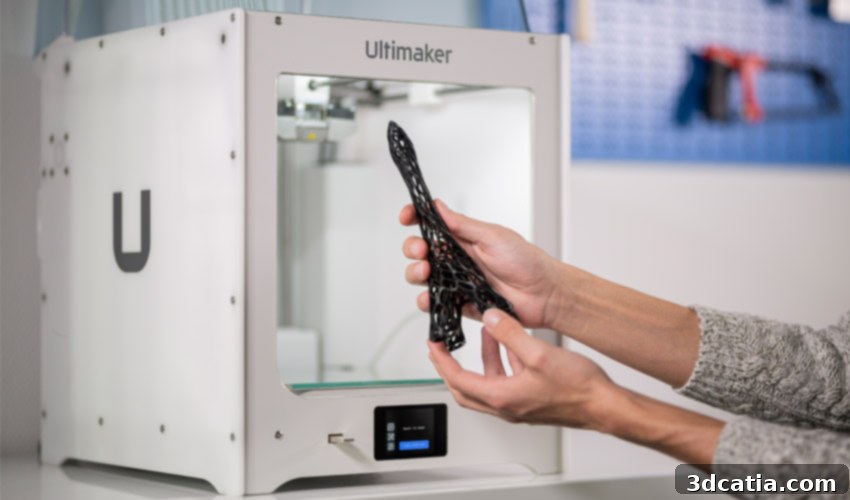
Ultimaker’s 3D Printing Sentiment Index: Unveiling Global Trends and Future Directions in Additive Manufacturing
Every year, Ultimaker, a leading manufacturer in the 3D printing industry, conducts a comprehensive global study to analyze the evolving landscape of additive manufacturing. This insightful report delves into the adoption rates, awareness levels, understanding of the industry, and the various challenges encountered by users of 3D printing technologies worldwide. Known as the 3D Printing Sentiment Index, this study assigns a maturity score to each participating country, reflecting its progress and sophistication in the realm of additive manufacturing. The latest findings from this significant report place the United States at the forefront of 3D printing adoption and maturity, closely followed by the United Kingdom and Germany, solidifying their positions as key players in the global market.
The extensive survey, meticulously carried out by Savanta at the close of 2020, gathered valuable insights from a substantial pool of 2,525 professionals across 12 different countries. A standout revelation from the 2020 Index was the noticeable increase in the global adoption of additive manufacturing compared to the preceding year, 2019. This positive trend was further underscored by a greater number of respondents indicating an enhancement in their skills within the field. This clearly demonstrates a proactive engagement from users who are actively pursuing training and seeking to deepen their expertise, driving the industry forward through continuous learning and development.
The primary objective of Ultimaker’s 3D Printing Sentiment Index study is to provide a clear understanding of how 3D printing is being utilized across the globe, how companies perceive this transformative technology, and the specific benefits they derive from its implementation. The 2020 report notably highlighted the profound impact of the health crisis, which acted as a catalyst, compelling businesses, entrepreneurs, and individual makers to leverage 3D technologies for the rapid creation of critical, often unexpected, parts and components. Many will recall the inspiring instances where 3D printing communities rallied to support healthcare workers during the unprecedented COVID-19 pandemic. A prominent example includes the ingenious adapter for the Decathlon diving mask, which allowed it to be repurposed and transformed into a life-saving respirator, showcasing the agility and adaptability of additive manufacturing in times of urgent need.
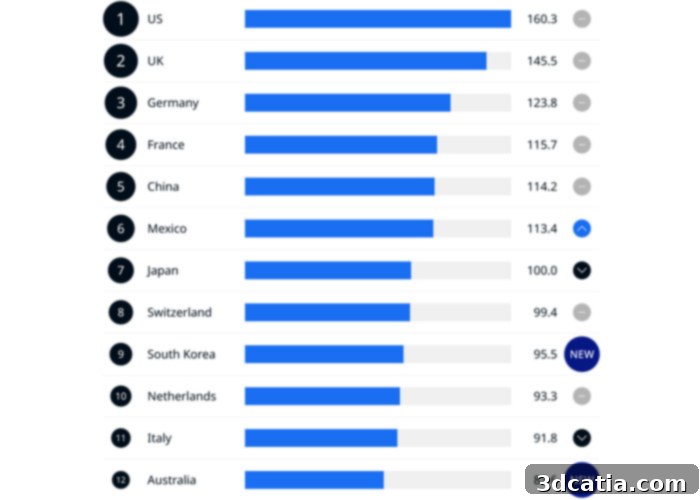
Photo Credits: Ultimaker
Global Awareness and Adoption of 3D Printing Technologies
One of the most compelling aspects of the 3D Printing Sentiment Index is its deep dive into global awareness of 3D printing. The study reveals a significant overall increase in awareness, reaching 71% globally. This figure, however, varied substantially across different countries, pointing to diverse levels of engagement and understanding. China, for instance, demonstrated the highest level of awareness among all surveyed nations, with a remarkable 84% of respondents familiar with 3D printing. This starkly contrasts with other major economies, such as the United States at 76%, the United Kingdom at 73%, and notably, Australia trailing significantly with only 30% awareness. Such disparities highlight potential areas for growth and targeted educational initiatives to foster broader understanding.
Beyond awareness, the adoption of 3D printing technologies also saw a healthy surge, increasing by 4% from the previous year to reach 29% globally. This expansion signifies a growing confidence and integration of additive manufacturing into various industries and business operations. Geographically, the implementation of 3D printing is most pronounced in the United States, the United Kingdom, Germany, and France, reinforcing their positions as the primary drivers of this technological shift. These countries are not only leading in terms of industrial application but also in fostering an environment conducive to the further proliferation of 3D printing solutions.
However, the report authors caution that raw numbers can sometimes be deceptive, necessitating a deeper analysis of the underlying market dynamics. A prime example is the United States, which boasts the largest installed base of 3D printers in the world, with an impressive 422,000 units – a figure considerably higher than any other country. Despite this massive installed capacity, only 38% of US companies surveyed reported having actually adopted 3D printing. This apparent paradox is largely due to the sheer size and breadth of the US market, implying that over 60% of American businesses that could potentially benefit significantly from additive manufacturing have yet to integrate it into their operations. This represents an enormous untapped market potential for future growth.
In contrast, the United Kingdom exhibits a higher adoption rate of 47%, and China leads with an even more impressive 54%. These figures suggest that while the US market has a strong foundation with its large printer base, other countries are demonstrating higher penetration rates within their existing business ecosystems. All three markets – the US, UK, and China – are unequivocally recognized as having incredible potential for 3D printing, with expectations for continued robust growth in the coming years. This indicates a worldwide shift towards embracing additive manufacturing as a cornerstone of modern industrial processes, driven by efficiency, innovation, and localized production capabilities.
When it comes to materials, it is no surprise that plastics and polymers consistently remain the most favored choice across the globe. The survey highlights that 85% of respondents worldwide utilize these versatile materials, underscoring their widespread applicability, cost-effectiveness, and ease of use in diverse 3D printing applications. In comparison, the use of composites stands at 23%, while carbon fiber sees adoption by only 21% of users. Specific material trends also emerged: PETG and related PET filaments experienced a notable 4% increase in usage, while plastics and polymers in general saw a 3% rise across the user base, further cementing their dominance. Composites also demonstrated positive momentum, with a 3% increase in users from the previous year. Carbon fiber, however, observed a minor decrease of just 1%. These trends emphatically confirm that plastics and polymers continue to lead the 3D printing material market, a position they are expected to maintain for the foreseeable future due to their inherent advantages and continuous innovation in material science.

Heineken has integrated 3D printing to design tooling for its assembly lines (photo credits: Ultimaker)
Understanding the Perception of Additive Manufacturing and Overcoming Barriers
A core objective of the 3D Printing Sentiment Index is to gain a deeper understanding of how additive manufacturing technology is perceived by professionals and to identify the persistent barriers that hinder its full-scale adoption. For those closely following the sector, it is well-known that the primary hurdles often revolve around a lack of comprehensive knowledge or the perceived high cost and accessibility challenges associated with certain processes and materials. This sentiment is widely shared among the survey respondents. For instance, in the United States, 35% of professionals expressed concerns about their current lack of skills required to optimally utilize 3D printing. Encouragingly, this figure represents a 5% decrease from the previous year, indicating positive strides in skill development and education within the industry. Conversely, in the UK, 42% of respondents reported a deficit in the necessary skills for effective additive manufacturing use, a figure that unfortunately saw a 1% increase from the prior year, highlighting a regional divergence in skill-building efforts.
As anticipated, prototyping remains a dominant application for 3D printing, with 71% of respondents identifying it as a key use case. However, the dynamics within application trends are clearly shifting. The 71% figure for prototyping marks an 8% decrease from the previous year, suggesting that while it’s still crucial, other applications are rapidly gaining prominence. Prototyping is now only marginally considered more important than tooling as a key application, with tooling garnering 70% recognition. What stands out most remarkably is the significant increase in end-use applications, which surged by 5% from 2019 to reach 55%. The report authors attribute a substantial portion of this transformation to the profound impact of the COVID-19 pandemic. The crisis acted as a powerful catalyst for manufacturers seeking resilient, local production solutions, a necessity born from the widespread breakdown of global supply chains. These crucial findings were consistently reflected in responses from a diverse range of countries, including China, the US, the UK, and Australia, underscoring a global shift towards integrating 3D printing for final parts and local manufacturing.
Among the myriad benefits attributed to 3D printing, bringing concept designs to life continues to be the most widely acknowledged advantage. While still paramount, this benefit saw a slight decrease in recognition from the previous year. The study also highlighted the efficiency of additive manufacturing for specific production needs: 72% of respondents affirmed that 3D printing is the most efficient method for producing finished parts in small batches, a sentiment that remained consistent with 2019 data. Furthermore, a significant 76% believe that 3D printing offers a far more effective approach to creating jigs, tools, and fixtures compared to traditional manufacturing methods, emphasizing its role in optimizing production workflows. Finally, and perhaps most indicative of future confidence, 42% of users globally expressed conviction in the positive impact that 3D technologies will have on their businesses in the coming year. This marks a clear vote of confidence in additive manufacturing, even amidst the ongoing uncertainties of the global economic climate. This particular finding is especially notable as it was the only one among the four core benefits to demonstrate growth, a positive change of 4% from the last year, signalling a growing optimism and strategic investment in 3D printing. For those interested in a comprehensive dive into the data and country-specific indicators, the full report is available on the official Ultimaker website.
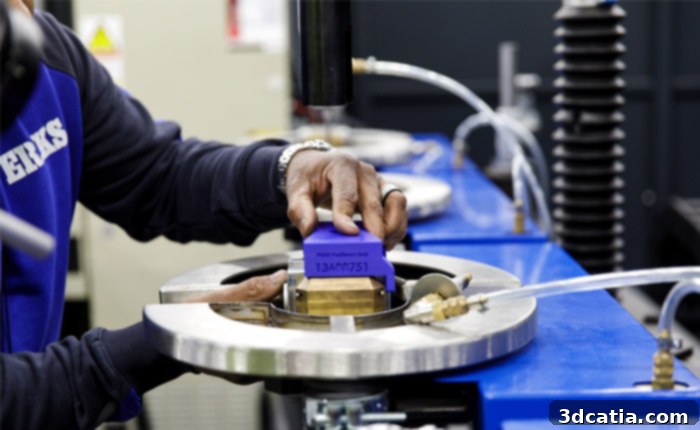
Photo Credits : Ultimaker
What are your thoughts on Ultimaker’s latest 3D Printing Sentiment Index? We encourage you to share your insights in a comment below or join the conversation on our Facebook, Twitter, and LinkedIn pages! To stay informed with the very latest developments in the additive manufacturing world, be sure to sign up for our free weekly Newsletter here, delivering the most important 3D printing news directly to your inbox!