
Formnext 2025: Cutting-Edge 3D Printing Innovations Reshaping Industries
Every year, Formnext serves as a barometer for the additive manufacturing industry, showcasing the latest advancements and trends. Formnext 2025 was no exception. As we navigated the exhibition halls, we encountered a range of applications that were both innovative and thought-provoking. These applications demonstrated the power and potential of 3D printing across various sectors. Here are some of the highlights that captured our attention this year.
Large-Format 3D Printing: Scaling New Heights
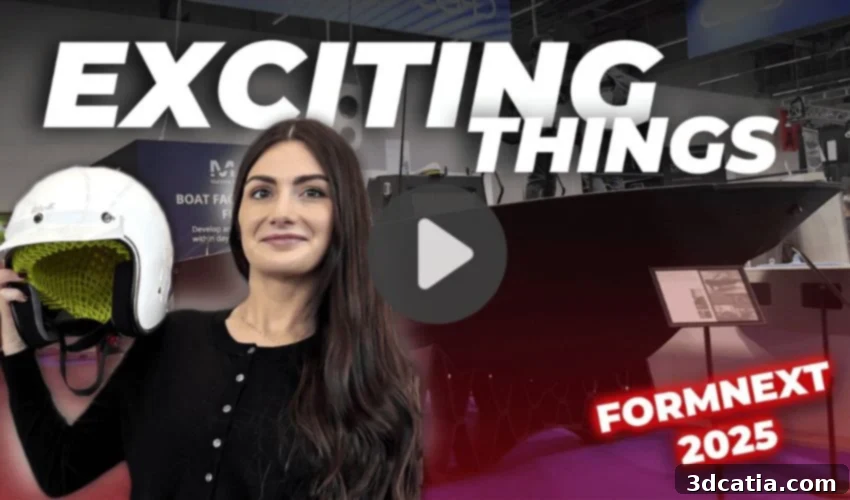
Large-format additive manufacturing (AM) solutions were prominently featured this year, demonstrating significant progress in terms of scale and capabilities. The collaboration between CEAD and Faber Navalis exemplifies this trend. Together, they showcased a fully 3D-printed boat hull produced in a single weekend. This impressive feat was achieved using an automated workflow and CEAD’s HDPro material, resulting in a durable and impact-resistant structure.
The final product was a 5.78-meter fishing vessel that possessed a surprisingly streamlined aesthetic, especially considering its size and rapid production time. This project served as a prime example of the transformative potential of large-scale AM, prompting attendees to reconsider the possibilities of this technology.
Aerospace Advancements: GE Catalyst Engine
The aerospace sector continues to embrace additive manufacturing, and the GE Catalyst turboprop engine served as a compelling case study. Approximately 30 percent of the engine is 3D-printed using Colibrium Additive’s powder bed fusion systems. High-performance alloys, such as nickel alloy 718, are employed to meet the stringent requirements of aerospace applications.
One of the key advantages of using AM in this context is part consolidation. Complex components that previously required multiple parts can now be manufactured as single, optimized structures. These integrated designs are lighter, stronger, and easier to assemble. The GE Catalyst engine benefits significantly from these advancements, achieving an exceptional power-to-weight ratio and demonstrating the maturity of metal AM for flight-ready production.
Fashion Forward: 3D-Printed Footwear by Alexander Wang
Fashion made a surprising and notable appearance at Formnext 2025, particularly with Alexander Wang’s 3D-printed kitten heels. These innovative shoes, produced by Hilos using Carbon’s DLS technology, seamlessly blend engineering and design. The shoes feature a rigid 3D-printed heel paired with a soft, multi-density lattice upper, providing both structure and comfort.
The Alexander Wang kitten heels exemplified the potential for AM to revolutionize the fashion industry. The unexpected comfort and wearable nature of the shoes defied expectations, showcasing the versatility and aesthetic appeal of 3D-printed designs.
Rapid Liquid Print: Revolutionizing Manufacturing Processes
The Rapid Liquid Print booth was a highlight, showcasing their unique gravity-free printing process. This technology stands out from conventional additive manufacturing techniques. Instead of depositing material layer by layer in open air, the printhead operates within a gel-filled reservoir. This allows the creation of complex shapes without the need for support structures.
The gel environment facilitates the curing process, resulting in smooth, flexible, and ready-to-use parts. The Rapid Liquid Print team demonstrated the speed and efficiency of their process by printing a full-scale motorcycle seat in 392 minutes and a helmet liner in 165 minutes. This process is ideal for producing customized, end-use parts that cannot be easily manufactured using traditional extrusion systems.
Bio-Inspired Drones: EOS Takes Flight
The bio-inspired drone developed by EOS was a captivating surprise. Showcased at the EOS booth, this drone is designed to mimic the flight patterns of real birds, making it exceptionally difficult to detect. The entire system is produced on the EOS P 396 using selective laser sintering (SLS).
The drone is printed in just 3 hours and 35 minutes using ALM PA 640 GSL, a reinforced polymer powder that provides the necessary lightweight, stiffness, and high-performance characteristics. This drone is a remarkable illustration of how additive manufacturing can enable stealth-focused UAV design. The drone’s natural and fluid movements highlighted the harmonious intersection of engineering and biology.
The Broader Impact of Additive Manufacturing
Formnext 2025 effectively showcased the convergence of imagination, engineering, and real-world production capabilities. The applications highlighted, spanning mobility, aerospace, fashion, and marine sectors, provided a glimpse into the future of additive manufacturing.
These innovations underscore the transformative potential of 3D printing to reshape industries, enabling faster, more efficient, and more sustainable manufacturing processes. From large-scale boat hulls to intricate aerospace components and customized fashion items, AM is proving its versatility and ability to address a wide range of challenges and opportunities.
Delving Deeper into Additive Manufacturing Applications
Beyond the specific examples already mentioned, Formnext 2025 highlighted several recurring themes that are driving the advancement of additive manufacturing. One key trend is the increasing use of simulation and design optimization tools to enhance part performance and reduce material waste. These tools enable engineers to create more efficient designs that are tailored to the specific requirements of each application.
Another important development is the growing availability of new materials for additive manufacturing. These materials include high-performance polymers, metals, ceramics, and composites, each offering unique properties that can be leveraged to create innovative products. The expansion of the material palette is broadening the range of applications for AM and opening up new possibilities for product development.
Furthermore, there is a growing emphasis on automation and process control in additive manufacturing. Automated systems can improve the efficiency and reliability of the printing process, while advanced sensors and control algorithms can ensure consistent part quality. These advancements are making AM more scalable and cost-effective for production environments.
The integration of additive manufacturing with other technologies, such as artificial intelligence (AI) and machine learning (ML), is also gaining momentum. AI and ML can be used to optimize printing parameters, detect defects, and predict part performance, further enhancing the capabilities of AM.
The Future of Additive Manufacturing
The trends and innovations showcased at Formnext 2025 suggest a bright future for additive manufacturing. As the technology continues to mature and evolve, it is expected to play an increasingly important role in a wide range of industries. AM has the potential to transform manufacturing processes, accelerate product development, and create new business models.
One area where AM is expected to have a significant impact is in the customization and personalization of products. AM enables the creation of bespoke products that are tailored to the specific needs and preferences of individual customers. This capability is particularly valuable in industries such as healthcare, where customized implants and prosthetics can improve patient outcomes.
Another area where AM is likely to make a significant contribution is in the development of sustainable manufacturing practices. AM can reduce material waste, energy consumption, and transportation costs, making it a more environmentally friendly alternative to traditional manufacturing methods. As businesses and consumers become more environmentally conscious, the demand for sustainable manufacturing solutions is expected to grow.
In conclusion, Formnext 2025 provided a comprehensive overview of the latest advancements and trends in additive manufacturing. The innovations showcased at the event highlight the transformative potential of AM to reshape industries and create new opportunities for businesses and individuals. As the technology continues to evolve, it is expected to play an increasingly important role in shaping the future of manufacturing.
To experience these technologies firsthand, be sure to watch our comprehensive video recap.
Which application stood out to you the most? Share your thoughts in the comments below or on our LinkedIn or Facebook pages!
Don’t forget to subscribe to our free weekly Newsletter for the latest 3D printing news delivered directly to your inbox. Explore our video content on our YouTube channel.