
Revolutionizing Metal 3D Printing: The Critical Role of Optimized Metal Powders in Additive Manufacturing
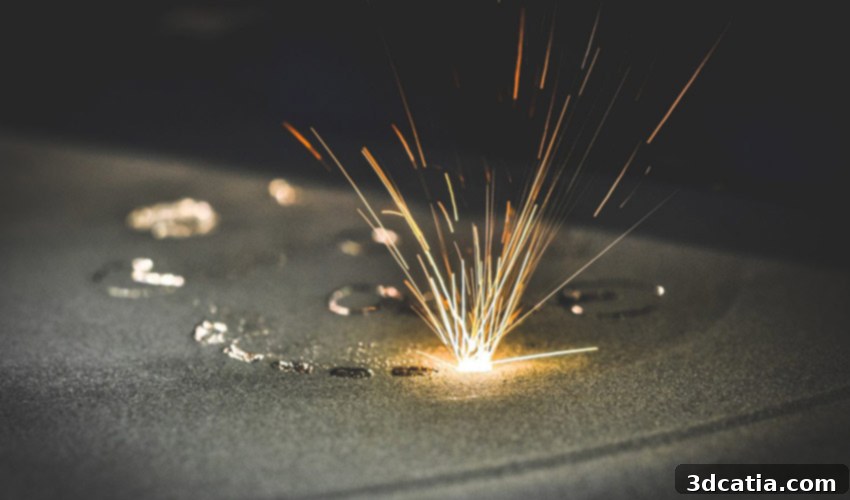
The landscape of metal 3D printing is constantly evolving, promising unparalleled innovation across various industries. At the heart of this transformative technology lies additive manufacturing, a process that builds objects layer by layer from digital designs. Among the most prevalent and powerful techniques is laser powder bed fusion, a method that leverages intense laser energy to selectively melt and fuse metallic powders. While the potential of metal additive manufacturing (AM) is vast, unlocking its full capabilities hinges on overcoming significant material-related challenges. Equispheres, a leading Canadian company specializing in advanced metal powder development, particularly for applications like laser powder bed fusion and cold spray, has shed critical light on these issues.
Drawing on extensive market experience and deep material science expertise, Equispheres recently conducted a comprehensive study to investigate the primary hurdles confronting metal 3D printing and the printers themselves, with a specific focus on the powder bed fusion process. Their findings underscore a fundamental truth: the choice and inherent quality of metal powder are not merely components of the process but are, in fact, the linchpin for success or failure. Suboptimal powder can lead to a cascade of problems, including inconsistent and unreliable mechanical properties in the final parts, significantly reduced production speeds, diminished overall efficiency, and increased operational costs. Equispheres firmly posits that to truly realize the promise of this technology, metal additive manufacturing demands specialized metal powders meticulously engineered for the unique demands of AM processes. Without raw materials that meet stringent, specific criteria, laser powder bed fusion processes will inherently fall short of expectations, pointing to the core problem in advanced metal 3D printing.
The Stagnation of Materials: A Bottleneck for Metal AM Growth
In recent years, much attention has been given to the exponential growth of metal 3D printing. Numerous reports and market analyses have consistently highlighted a surge in the number of manufacturers entering this dynamic space. For instance, the Wohlers 2018 report indicated approximately thirty key players, collectively offering over 125 sophisticated machines. These machines were often marketed with promises of increased productivity and efficiency, aiming to reduce production costs that, for many applications, remained prohibitively high. However, Equispheres’ study suggests that focusing solely on hardware advancements might be missing the bigger picture. The true impediment to widespread adoption and optimal performance of metal 3D printing is not necessarily the printers themselves, but rather a profound lack of development in adapted and truly innovative materials.
This material stagnation becomes particularly evident when contrasted with other segments of the additive manufacturing industry. The polymer market, for example, is a hotbed of innovation, with new solutions and specialized resins appearing almost daily, many explicitly designed to leverage the unique capabilities of polymer additive manufacturing. In stark contrast, the metal materials market has, to a significant extent, remained static. The vast majority of metal powders currently employed in 3D printing are produced using traditional gas atomization methods. While gas atomization is a well-established and cost-effective technique for conventional metallurgy, it is inherently limited in its ability to consistently produce materials with properties specifically optimized for the rigorous and precise requirements of additive manufacturing processes. This traditional production method often fails to deliver powders with sufficiently constant and predictable characteristics from one batch to another, leading to variability in the final printed parts – a critical flaw in high-precision, industrial applications.
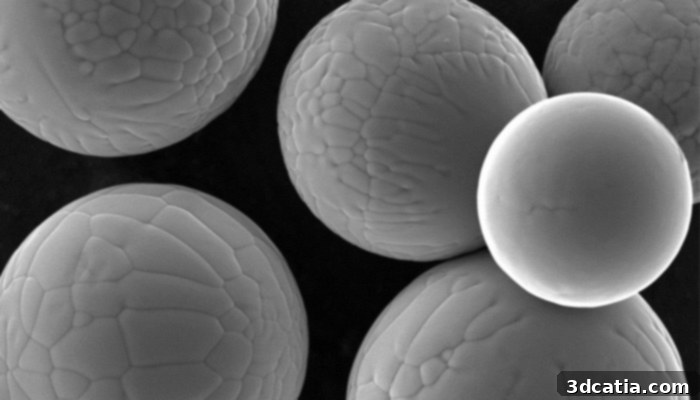
The quality and consistency of powder are one of the principal obstacles to the widespread development and adoption of metal additive manufacturing.
Metal Powders’ Properties: The Core Challenge in Metal Additive Manufacturing
Equispheres’ comprehensive study highlights that metal additive manufacturing frequently encounters significant issues related to process reliability and overall productivity. These challenges, often perceived as machine or process-related, are, in fact, directly attributable to the fundamental properties of the material itself – the metal powder. According to the company’s rigorous analysis, metal powders destined for high-performance AM applications must possess **four essential, interconnected qualities** to ensure optimal printing performance and part integrity:
- High Fluidity: This refers to the powder’s ability to flow smoothly and consistently across the build plate. High fluidity ensures uniform layer deposition, which is crucial for preventing defects like uneven powder beds, streaks, or voids. Poor fluidity leads to inconsistent layer thickness, directly impacting the quality and density of the final part.
- High Distribution Density: An optimally distributed powder bed, characterized by high packing density, is essential for achieving dense parts with minimal porosity. When powder particles pack tightly and uniformly, it allows for more efficient laser absorption and melting, leading to homogeneous microstructure and superior mechanical properties. Low distribution density can result in internal voids and weak points.
- Low Moisture Absorption: Moisture in metal powders is a critical contaminant. During the high-temperature laser melting process, absorbed moisture can vaporize, leading to gas porosity within the printed part. This porosity severely compromises mechanical strength, fatigue resistance, and overall structural integrity. Minimizing moisture absorption is paramount for producing aerospace and medical-grade components.
- High Chemical Stability: The powder must maintain its chemical composition and integrity, particularly when exposed to the intense heat of the laser. Any chemical degradation or undesirable reactions during the melting and solidification phases can introduce impurities, alter alloy properties, and lead to defects such such as cracking or delamination. This stability ensures that the desired material properties are consistently achieved throughout the build.
These four qualities are not isolated; they are intricately linked and directly influence the resulting mechanical properties of the final 3D-printed part. Equispheres elucidates that inconsistent powder properties directly translate into uneven energy absorption by the laser and irregular material flow dynamics during the printing process. This variability inevitably leads to the formation of internal voids, localized inconsistencies in material density, and overall irregular mechanical properties throughout the printed component. Even with advanced control systems integrated into modern additive manufacturing machines, these point-to-point inconsistencies within the powder bed are extremely difficult, if not impossible, to correct in real-time within the printing chamber. Tragically, even the highest quality powders produced using conventional spraying methods often fall short of meeting these stringent requirements. This inherent limitation significantly compromises crucial performance metrics such as build speed, part consistency, and ultimately, the reliability and cost-effectiveness of the entire additive manufacturing workflow.
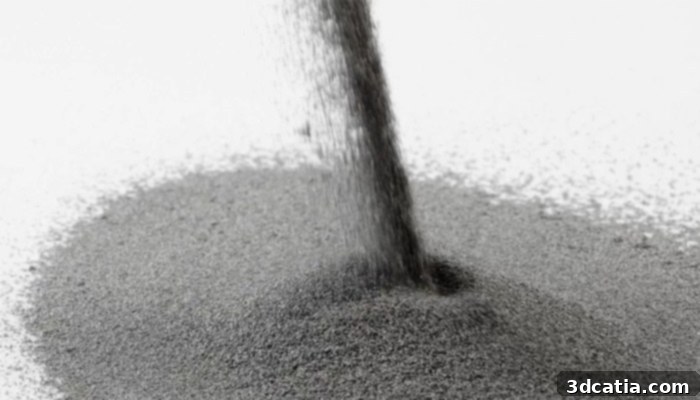
High fluidity, distribution density, low moisture absorption, and chemical stability are four essential qualities for optimal metal powder performance (photo credits: Nanosteel).
Engineering the Ideal Metal Powder: The Five Key Physical Properties
Recognizing these profound limitations, it becomes clear that the metal additive manufacturing market must move beyond conventional powder production and actively embrace the development of its own specialized, purpose-built powders. For a metal powder to consistently exhibit the previously mentioned essential qualities—high fluidity, high distribution density, low moisture absorption, and high chemical stability—the individual granules comprising the powder must possess a specific set of **five key physical properties**. These characteristics are foundational to achieving optimal performance in additive manufacturing:
- Spherical: Perfectly spherical particles are critical for excellent flowability. Their uniform shape reduces inter-particle friction, allowing the powder to spread evenly and consistently across the build plate, ensuring a smooth and dense powder bed.
- Smooth Surface: A smooth surface on each particle further enhances flow characteristics by minimizing surface friction and inter-particle interlocking. This contributes to better packing density and reduces the likelihood of clumping or aggregation, which can lead to defects.
- Equally Sized: A narrow particle size distribution, meaning particles are very close in size, is vital for achieving high and uniform packing density. When particles are largely the same size, they settle and arrange themselves more efficiently, resulting in a denser and more homogeneous powder bed. This consistency prevents segregation during handling and recoating.
- Very Fine: Fine particles enable the creation of highly detailed and intricate geometries with superior surface finish and resolution. Finer powders also promote better laser absorption and faster melting kinetics, which can contribute to increased build speeds and improved metallurgical bonding. However, ‘very fine’ must be balanced with flowability; the ideal is a fine, but still highly flowable powder.
- Low Oxygen Content: Oxygen is a common impurity in metal powders and can significantly degrade the mechanical properties of the final part by forming oxides, leading to embrittlement, reduced ductility, and increased porosity. Maintaining an extremely low oxygen content ensures the purity of the material and helps achieve the desired strength and performance characteristics.
These five meticulously engineered characteristics collectively define an ideal raw material for advanced metal 3D printing. Equispheres’ study provides compelling evidence that parts 3D printed from powders conforming to these rigorous specifications consistently demonstrate superior mechanical properties. These components are not only stronger and more robust but also exhibit significantly greater homogeneity in their microstructure and material characteristics. Furthermore, the optimization of these powder properties directly translates into tangible improvements in manufacturing efficiency: parts can be printed up to an astonishing 50% more quickly without compromising quality or reliability. This acceleration in production speed, coupled with enhanced part performance, represents a monumental leap forward for industrial metal additive manufacturing.
The study meticulously acknowledges and details the impact of each physical property of the powder, empirically demonstrating how each factor contributes to a substantial reduction in printing defects. By controlling these variables, manufacturers can guarantee stable and regulated final mechanical properties, leading to more predictable and reliable part performance. For those eager to delve deeper into these groundbreaking findings and understand the intricate science behind optimized metal powders, the complete study is available for download HERE.
In conclusion, while advancements in metal 3D printer hardware have been remarkable, the true bottleneck and the greatest opportunity for revolutionizing additive manufacturing lies in the development of purpose-built, highly optimized metal powders. Companies like Equispheres are at the forefront of this material science innovation, paving the way for a future where metal 3D printing can consistently deliver on its promise of high-performance, cost-effective, and reliable manufacturing for an ever-expanding range of industrial applications.
Do you agree that powder quality is the primary obstacle to the widespread development and adoption of metal 3D printing? We invite you to share your thoughts and insights in a comment below or join the conversation on our Facebook and Twitter pages! For the very latest news, trends, and innovations in the world of 3D printing, remember to sign up for our free weekly Newsletter here and receive the freshest updates straight to your inbox!