
Industrial Lasers: Powering the Future of 3D Printing and Additive Manufacturing
The landscape of manufacturing is undergoing a profound transformation, largely driven by the advancements in additive manufacturing (AM), commonly known as 3D printing. At the heart of this revolution lies a critical component: industrial lasers. A comprehensive report from the esteemed research firm SmarTech Analysis underscores the monumental economic opportunities that industrial lasers are bringing to the 3D printing and AM market. This in-depth study highlights how the laser industry is not just supporting but actively propelling growth in established additive manufacturing technologies, particularly in Stereolithography (SLA) and Powder Bed Fusion (PBF) machines.
The financial projections paint a vivid picture of this burgeoning sector. By the close of 2019, the AM market was projected to utilize industrial lasers valued at nearly $350 million. Looking ahead, these figures are set to soar, with revenues generated by the AM laser market expected to reach an impressive $870 million within the subsequent five years. The long-term forecast is even more staggering, with predictions indicating that by 2028, this market could surpass a remarkable $1.2 billion, signifying a truly transformative period for both laser technology and additive manufacturing.
The Driving Force: Why Industrial Laser Use is Soaring in Additive Manufacturing
The escalating adoption of industrial lasers within the additive manufacturing industry is multifaceted, rooted in both technological advancements and market demands. SmarTech Analysis’s report meticulously outlines the key areas where these lasers are creating significant opportunities. Beyond the well-established domains of Stereolithography (SLA), Powder Bed Fusion (PBF), and Direct Energy Deposition (DED), lasers are also integral to emerging AM processes still under development in research laboratories. Furthermore, their utility extends beyond the primary printing phase, playing a crucial role in the post-processing of 3D printed objects, where precision and efficiency are paramount.
One of the most significant trends identified is the widespread adoption of multi-laser machines. These advanced systems are fundamentally reshaping the industry by offering enhanced productivity for end-users, drastically reducing build times, and increasing throughput. For manufacturers, the integration of multiple lasers also represents a strategic marketing advantage, allowing them to differentiate their offerings in an increasingly competitive marketplace. For instance, the report forecasts that the proliferation of multi-laser PBF solutions alone will dramatically elevate the demand for lasers in the PBF sector, potentially by as much as 30% within the next decade. This indicates a clear shift towards higher efficiency and greater capacity in industrial 3D printing operations.
Understanding Laser Technologies in 3D Printing Processes
The core functionality of many additive manufacturing processes relies heavily on the precise and controlled interaction of lasers with various materials. From photopolymer resins to metal powders, lasers provide the energy necessary to selectively solidify or fuse material, layer by layer, to create complex three-dimensional objects.
Stereolithography (SLA): Precision Curing with UV Lasers
In Stereolithography (SLA), the oldest commercial 3D printing technology, the role of the laser is foundational. SLA printers utilize the focused UV light from a laser to selectively cure a photosensitive liquid resin. As the laser traces the cross-section of a part on the surface of the resin vat, it causes the resin to solidify, turning it into a hardened polymer. This process is repeated for each layer, gradually building the object from the bottom up. The precision of the laser directly influences the accuracy and surface finish of the final part, making it a critical component for applications requiring high detail and smooth surfaces, such as prototyping, tooling, and dental models.
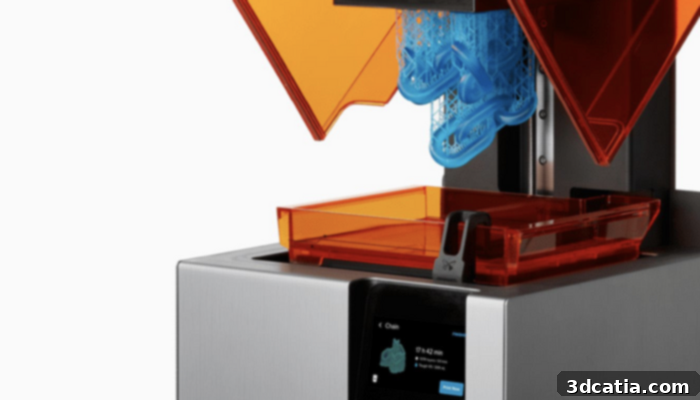
The SLA process uses the UV light from a laser to selectively cure a photosensitive resin, as a result turning it into a solid. Above, the Form 2, a very popular SLA 3D printer from Formlabs | Credits: Formlabs
Powder Bed Fusion (PBF) and Direct Energy Deposition (DED): Shaping Metals and Advanced Materials
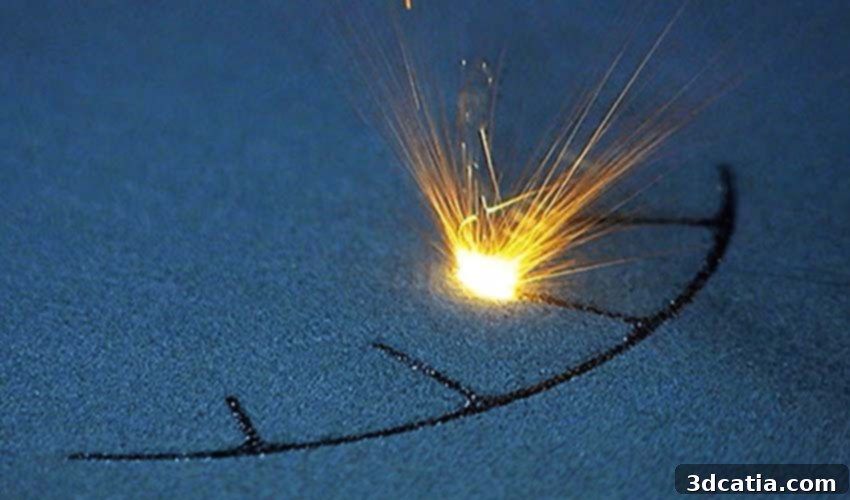
For metal 3D printing, laser technology is even more paramount. In Powder Bed Fusion (PBF) processes, such as Selective Laser Melting (SLM) and Direct Metal Laser Sintering (DMLS), powerful lasers are used to selectively melt or sinter fine metal powders, fusing them together to create dense, robust parts. A thin layer of powder is spread across a build platform, and the laser scans the cross-section of the part, melting the powder. This layer is then lowered, a new layer of powder is applied, and the process repeats. This technique is indispensable for creating complex geometries, lightweight structures, and parts with superior mechanical properties for industries like aerospace, medical, and automotive.
Similarly, in Direct Energy Deposition (DED), lasers are employed to melt material (typically metal powder or wire) as it is simultaneously deposited through a nozzle onto a substrate. The laser creates a molten pool, into which the material is fed and fused, allowing for the repair of existing components, the addition of features to existing parts, or the creation of entirely new, large-scale structures. DED is particularly valuable for repairing high-value components and for building parts with functionally graded materials.
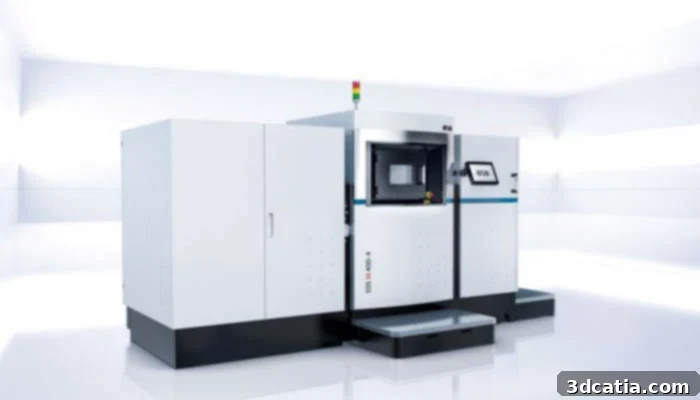
The EOS M 400 is a metal 3D printer, it uses DMLS technology – it is a PBF technique | Credits: EOS
Key Drivers of Laser Adoption and Innovation
The additive manufacturing sector is characterized by continuous improvement in its techniques and machines, and lasers are at the forefront of this evolution, offering distinct advantages and opening new opportunities. Several factors are accelerating the adoption and innovation of laser technology within AM.
The Rise of Multi-Laser Systems: Enhancing Productivity and Competitiveness
The transition to multi-laser machines is perhaps the most prominent trend driving market growth. By integrating multiple lasers that can operate simultaneously on different areas of the build plate, these systems dramatically reduce production times, especially for larger parts or batches of smaller components. This parallel processing capability translates directly into higher throughput and lower per-part costs, making additive manufacturing more competitive for industrial applications. For manufacturers, offering multi-laser configurations is a strategic imperative, demonstrating innovation and delivering tangible economic benefits to their customers. This trend is not merely about increasing speed; it’s about enabling a new scale of production that was previously unattainable with single-laser setups, pushing AM further into mainstream manufacturing.
Advancements in Laser Types and Their Impact
The ongoing development of various laser technologies is also a significant catalyst for growth. Each laser type possesses unique characteristics that make it suitable for specific AM processes and materials, and continuous innovation is broadening their applicability and improving their performance.
From CO2 to Yb-Fiber Lasers: A Paradigm Shift
Historically, CO2 lasers have been a workhorse in many laser-based 3D printers, particularly for polymer Powder Bed Fusion (e.g., Selective Laser Sintering, SLS) and some earlier metal AM systems. Renowned for their high power output and reliability, CO2 lasers have played a crucial role in establishing these technologies. However, the industry is witnessing a significant shift towards Yb-fiber lasers, especially in metal 3D printing applications like DMLS and SLM. Yb-fiber lasers offer several advantages, including superior beam quality, higher efficiency, and a more compact footprint. Their shorter wavelength is also more readily absorbed by many metal powders, leading to more efficient melting and finer resolution. This shift is evident in market projections: shipments of Yb-fiber lasers were expected to reach $80 million in 2019 and are forecasted to grow substantially to $280 million by 2024, highlighting their increasing dominance in the metal AM sector.
Nd:YVO4 Lasers: Versatility Across AM Applications
Nd:YVO4 lasers, another key player, are widely utilized in SLA printers due to their ability to produce focused UV light ideal for curing photosensitive resins with high precision. Their application also extends to certain PBF printers, particularly those working with specific polymers or composites, and they are increasingly found in post-processing equipment where precise material removal or surface finishing is required. Compared to CO2 lasers, Nd:YVO4 lasers offer a larger processing region and boast exceptional longevity, contributing to lower operational costs and increased uptime for industrial users. The market for these versatile lasers is also on an upward trajectory, with expectations for it to reach just under $400 million by 2024, underscoring their integral role across various AM stages.
Diode Laser Arrays: High Efficiency for Future Applications
Diode laser arrays represent another promising frontier in additive manufacturing. These arrays offer distinct advantages in terms of high efficiency and significantly lower maintenance requirements compared to traditional laser sources. While their current integration is limited to a few DED machines and notably one EOS PBF machine, their inherent benefits suggest a strong potential for increased popularity and wider adoption in the future. Their ability to deliver high power output with minimal energy loss makes them an attractive option for improving the performance and sustainability of AM machines, particularly as the industry seeks to optimize energy consumption and reduce operational overheads.
Beyond Printing: Lasers in Post-Processing and Surface Finishing
The utility of industrial lasers in additive manufacturing extends beyond the actual fabrication of parts. Post-processing is a critical stage in the AM workflow, often involving surface finishing, removal of support structures, or improving mechanical properties. Lasers are increasingly being employed in these post-build operations for their precision and ability to automate tasks that would otherwise be labor-intensive or difficult to achieve manually. For instance, lasers can be used for precise cutting, drilling, and ablation to remove intricate support structures from delicate parts without damaging the main component. They can also be utilized for laser polishing, selectively melting the surface of a metal part to reduce roughness and improve aesthetic quality and performance. This expansion into post-processing further solidifies the economic opportunities for laser manufacturers within the broader AM ecosystem.
Market Outlook: A Billion-Dollar Industry on the Horizon
The comprehensive findings from SmarTech Analysis paint a compelling picture of sustained and robust growth for industrial lasers in the additive manufacturing market. The convergence of technological innovation, increasing industrial adoption, and the undeniable advantages offered by laser-based AM processes are collectively driving this expansion. As manufacturers continue to push the boundaries of materials science and design complexity, the demand for more powerful, precise, and efficient laser systems will only intensify. The projected market value of $1.2 billion by 2028 is a testament to the essential and evolving role of lasers, not merely as components, but as critical enablers of the next generation of manufacturing. This growth trajectory signals a fertile ground for investment, research, and development, promising continuous innovation that will further integrate 3D printing into mainstream industrial production.
For those interested in delving deeper into the specifics of this market, the full report is available on SmarTech’s website HERE.
What are your thoughts on this latest report regarding industrial lasers for additive manufacturing? We invite you to share your insights in a comment below or connect with us on our Facebook and Twitter pages! Don’t miss out on the latest 3D printing news and trends; sign up for our free weekly Newsletter here, delivered straight to your inbox!