
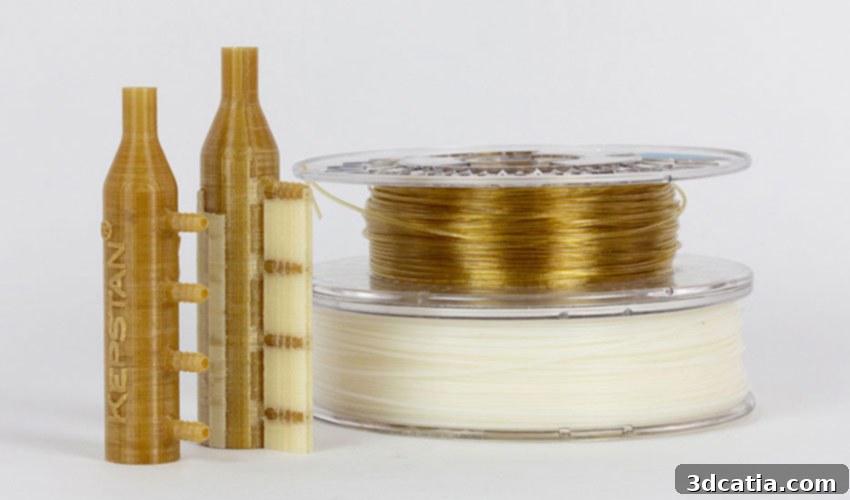
Exploring PEKK in Additive Manufacturing: A Comprehensive Guide to this High-Performance Polymer
Polyetherketoneketone, widely known by its versatile acronym PEKK, stands as a semi-crystalline thermoplastic that is rapidly gaining prominence and market share within the competitive and innovative additive manufacturing industry. Frequently drawn into comparisons with its close relative PEEK, PEKK proudly belongs to the same esteemed family of polymers – the PAEK (Polyaryletherketone) family. This distinguished group is celebrated globally for its exceptional blend of mechanical strength, thermal stability, and remarkable chemical resistance, making its members indispensable in demanding applications. What sets PEKK apart, particularly in the realm of 3D printing, is its superior printability compared to PEEK. This ease of processing is largely attributed to its unique molecular structure, which facilitates a lower and more controlled crystallization rate, reducing common printing challenges like warping. As a result, PEKK is predominantly available as a high-performance filament, catering to a wide array of FDM/FFF 3D printers, but it can also be found in powder form, supporting a select number of SLS 3D printers for specialized applications.
The journey of PEKK began in 1988, when it was first conceptualized, developed, and subsequently brought to market by the pioneering company Dupont. Initially, its advanced properties were harnessed for the rigorous demands of the aerospace sector, where lightweight yet incredibly strong materials are paramount. The early 2000s marked a significant evolutionary step for PEKK, as its chemical composition and performance characteristics were further enhanced and refined by Oxford Performance Materials. This company, recognized for its expertise in high-performance polymers, was later acquired by Arkema in 2009, a leading global chemical company that has since become a major player in the PEKK market. The fundamental composition of PEKK closely mirrors that of PEEK, primarily comprising ketone and ether linkages. However, subtle yet critical differences in the arrangement and proportion of these molecular bonds impart PEKK with its distinct advantages and processing characteristics. This comprehensive guide delves deep into the world of PEKK, exploring its applications, manufacturing processes, key characteristics, and the leading producers shaping its future in additive manufacturing.
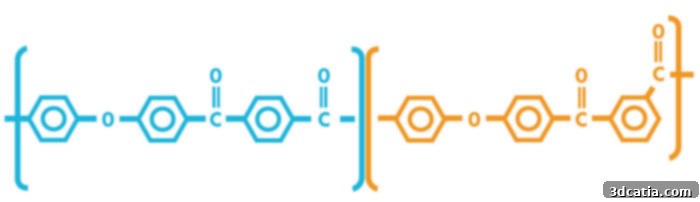
The position of the ketone bonds in the polymer chain can be precisely modified, influencing PEKK’s properties (photo credits: Arkema)
Unveiling the Production and Unique Characteristics of PEKK
As previously highlighted, PEKK shares a strong molecular kinship with PEEK, both being esteemed members of the PAEK polymer group. Their similarity extends beyond just their names, reaching into their core chemical components, notably the presence of both ketone and ether functional groups. However, the true distinction and the source of PEKK’s unique attributes lie in the subtle yet impactful variations in the ether-to-ketone ratio within its polymer backbone. PEKK is characterized by a higher proportion of ketone bonds compared to PEEK. These ketone bonds are inherently more flexible than ether bonds, a characteristic that fundamentally influences the polymer’s overall properties. This increased flexibility within the polymer chains results in a polymer with enhanced rigidity at higher temperatures, consequently raising both its glass transition temperature (Tg) – the point at which the polymer transitions from a rigid, glassy state to a softer, rubbery state – and its melting temperature (Tm). These elevated thermal properties make PEKK an excellent candidate for applications requiring superior performance under extreme heat.
Beyond the ether/ketone ratio, another critical factor differentiating PEKK and allowing for tailored properties is the ability to strategically modify the position of the ketone bonds within its aromatic ring structures. This precise molecular engineering provides manufacturers with an opportunity to fine-tune PEKK’s thermal profile, allowing for adjustments in its melting temperature and, significantly, its crystallization rate. This control over crystallization is paramount for additive manufacturing. More specifically, PEKK exhibits a lower degree and slower rate of crystallization compared to PEEK, which allows it to be processed in a manner akin to an amorphous polymer under certain conditions. This reduced tendency to crystallize rapidly is a key advantage during 3D printing, as it minimizes internal stresses that can lead to warping and part distortion, thereby improving print success rates and overall part quality. This makes PEKK a more forgiving material to print, especially for intricate geometries.
Key Performance Attributes of PEKK
The intrinsic chemical structure of PEKK bestows upon it a suite of exceptional characteristics that make it suitable for the most demanding engineering applications:
- Outstanding Wear and Chemical Resistance: PEKK demonstrates remarkable resilience against wear and abrasion, making it ideal for components subjected to friction or repetitive motion. Furthermore, its chemical resistance is incredibly robust; only a select few aggressive liquids, such as highly concentrated benzene or certain strong alcohols, are capable of degrading its structure. This property ensures its integrity in harsh chemical environments, including exposure to acids, bases, and a wide range of industrial solvents.
- Superior Dielectric Resistance and Insulating Properties: In the electronics sector, PEKK’s excellent dielectric strength and insulating capabilities are highly advantageous. It effectively prevents electrical conductivity, safeguarding sensitive electronic components and systems from short circuits and electrical interference. This makes it a preferred material for connectors, insulators, and housings in high-performance electronic devices and aerospace systems.
- Exceptional Thermal Stability: With its high glass transition and melting temperatures, PEKK maintains its mechanical properties and structural integrity at elevated operating temperatures. This thermal stability is critical for components used in hot zones of engines, industrial machinery, and other high-temperature applications.
- Inherent Flame Retardancy and Low Smoke Toxicity: Safety is a paramount concern in many industries, particularly aerospace and public transportation. PEKK is inherently flame retardant, meaning it resists ignition and self-extinguishes, without the need for additional flame-retardant additives. Crucially, when subjected to extreme heat, it emits very low levels of smoke and toxic fumes, significantly enhancing safety margins in confined or sensitive environments.
- High Strength-to-Weight Ratio: Similar to other high-performance polymers, PEKK offers an impressive strength-to-weight ratio. This characteristic is vital for applications where reducing mass is critical without compromising structural integrity, such as in aerospace components, where every gram saved can translate to significant fuel efficiency improvements.
- Hydrolytic Stability: PEKK exhibits excellent resistance to hydrolysis, meaning it performs reliably even when exposed to hot water or steam, making it suitable for marine, oil and gas, and medical applications where fluid exposure is common.
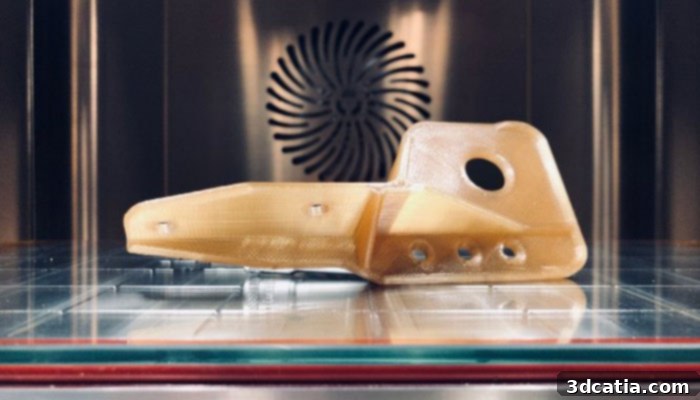
PEKK’s Transformative Role in 3D Printing
In the realm of additive manufacturing, PEKK emerges as a significantly more accessible and forgiving material to print compared to its counterpart, PEEK. This ease of processing is a major differentiator and a primary driver of its increasing adoption. The unique molecular architecture of PEKK means it is considerably less susceptible to the adverse effects of rapid cooling, which is a common challenge in FDM/FFF 3D printing. This reduced sensitivity to cooling gradients translates directly into superior adhesion to the print bed and, crucially, a dramatic reduction in warping effects. Warping, caused by uneven cooling and differential shrinkage within the printed part, can lead to failed prints and poor dimensional accuracy, especially with high-temperature materials. PEKK’s inherent properties help mitigate these issues, leading to more reliable and successful prints.
Beyond its superior printability, PEKK also contributes to a higher quality visual appearance of finished parts, often exhibiting a smoother surface finish and better aesthetic appeal. Moreover, this advanced thermoplastic offers enhanced wear and friction properties directly from the 3D printer, allowing for the creation of functional components that can withstand demanding operational conditions. From a technical printing perspective, PEKK typically requires an extrusion temperature ranging between 340°C and 360°C. To achieve optimal results and maintain dimensional stability, it also necessitates the use of a heated build plate, often operating at temperatures between 100°C and 150°C, and a precisely controlled, enclosed print chamber. This enclosed environment ensures a consistent temperature around the printing area, further minimizing temperature gradients and preventing premature cooling. While these requirements are indicative of a high-performance material, they are largely similar to those for PEEK, with the notable advantage that PEKK often allows for a slightly lower extruder temperature and less stringent chamber temperature control, making it marginally easier to integrate into existing high-temperature 3D printing workflows.
The ability to 3D print PEKK effectively opens up new possibilities for creating highly complex geometries and customized parts that would be challenging or impossible to produce with traditional manufacturing methods. This includes intricate internal structures, lightweight lattice designs, and consolidated assemblies, all while retaining the exceptional performance characteristics inherent to PEKK. This technological synergy between an advanced material and cutting-edge manufacturing processes positions PEKK as a cornerstone for future innovations in diverse engineering fields.
Diverse Application Sectors Leveraging PEKK’s Capabilities
Given its outstanding array of properties, PEKK has become an incredibly sought-after material across a multitude of high-stakes industries. Its ability to perform reliably under extreme conditions makes it a critical material for innovation. Here are some of the primary sectors where PEKK is making a significant impact:
- Aerospace Industry: PEKK is exceptionally popular in the aerospace sector, where the constant drive for weight reduction without compromising structural integrity is paramount. Its high weight-to-strength ratio makes it an ideal solution for manufacturing strategic, lightweight components such as brackets, air ducts, fairings, structural elements, and interior cabin parts. These applications benefit from PEKK’s high temperature resistance, flame retardancy, and low smoke emission, all crucial for aircraft safety and performance. The ability to 3D print complex geometries further allows for part consolidation and optimized designs, leading to more efficient and lighter aircraft.
- Automotive Industry: In the automotive world, PEKK’s resistance to high temperatures, chemicals, and wear makes it suitable for “under-the-hood” components. These include parts for engine compartments, intake manifolds, fluid systems, and structural elements that require durability and heat resistance beyond what standard plastics can offer. Its use contributes to vehicle lightweighting and enhanced performance, especially in high-performance and electric vehicles.
- Oil and Gas Industry: The harsh operating conditions of the oil and gas sector – characterized by extreme pressures, corrosive chemicals, and high temperatures – find an ideal partner in PEKK. It is extensively used for manufacturing seals, valves, connectors, downhole tools, and other critical components that must withstand aggressive environments and prevent material degradation, ensuring operational safety and efficiency.
- Medical and Healthcare: PEKK’s biocompatibility, sterilizability, and excellent mechanical properties have positioned it as a revolutionary material in medicine. It is increasingly employed in the creation of patient-specific medical devices and implants, such as custom cranial plates, spinal fusion cages, and dental prosthetics. The ability to tailor implants precisely to individual patient anatomy through 3D printing significantly improves surgical outcomes and patient recovery. Its inert nature means it does not react adversely with bodily tissues, making it safe for long-term implantation.
- Industrial and Chemical Processing: For environments demanding resistance to aggressive chemicals, high temperatures, and abrasive conditions, PEKK is an excellent choice. It is used in components for pumps, valves, filters, and chemical processing equipment, offering a durable and reliable alternative to traditional materials.
- Metal Replacement: Across various industries, PEKK is frequently utilized as a high-performance substitute for metals. Its superior strength-to-weight ratio, coupled with its resistance to corrosion and wear, allows engineers to design lighter, more durable, and often more cost-effective parts. This transition from metal to advanced polymer components also opens up new design freedoms not possible with conventional metal manufacturing, such as intricate internal cooling channels or complex lattice structures.
Leading Manufacturers and Market Pricing of PEKK Materials
The landscape of PEKK production for additive manufacturing is dominated by a few key players, each contributing to the material’s increasing availability and innovation. Currently, the French chemical giant Arkema stands out as one of the largest and most influential producers of PEKK. Arkema offers its proprietary Kepstan® PEKK series, which is highly regarded in the industry and primarily available as high-performance filaments tailored for FDM/FFF 3D printing technologies. Their commitment to research and development has led to PEKK variants that optimize printability and performance for diverse applications.
Another significant contributor to the PEKK market is the German group Lehvoss, which has developed its LUVOCOM 3F PEKK filaments. Lehvoss distinguishes itself by offering specialized formulations, including options reinforced with carbon fiber and glass fiber. These composite filaments significantly enhance the mechanical properties of PEKK, such as stiffness, tensile strength, and impact resistance, making them suitable for even more demanding structural applications where maximum performance is required. A growing number of other reputable manufacturers in the 3D printing materials sector also supply high-performance PEKK filaments. These include the French company KIMYA, known for its PEKK-A and PEKK Carbon variants, as well as Nanovia, 3DXTech, and 3D4Makers, all of whom contribute to a broader range of available PEKK products, sometimes with specific enhancements for particular applications or printer types.
The price of PEKK reflects its status as a high-performance engineering polymer. A typical 500-gram spool of PEKK filament can range significantly, usually oscillating between €400 and €500. Variants reinforced with carbon fiber or glass fiber tend to fall into the higher end of this price spectrum, or even exceed it, due to the added cost and complexity of the reinforcing materials and the specialized compounding processes. This pricing places PEKK firmly in the category of premium materials, reserved for applications where its unparalleled properties justify the investment. While the initial material cost is higher than that of commodity plastics, the performance benefits, longevity, and potential for part consolidation and weight savings often result in a lower total cost of ownership for critical applications.
When it comes to PEKK in powder form for selective laser sintering (SLS) 3D printing, the market is more niche. Currently, EOS, with its advanced EOS P 810 system, is recognized as the leading SLS printer manufacturer that officially supports and optimizes for PEKK powder. This makes EOS a crucial enabler for industrial applications requiring the design freedom and material properties offered by PEKK in powder bed fusion processes.
PEKK’s unique blend of thermal, mechanical, and chemical resistance, coupled with its improved printability over other high-performance PAEKs, solidifies its position as an indispensable material in the advanced additive manufacturing landscape. As research and development continue, and more manufacturers adopt and refine its use, PEKK is poised to unlock even greater potential across critical industries, driving innovation and enabling the creation of components that push the boundaries of performance.
What are your thoughts on the future of PEKK in additive manufacturing? We invite you to share your insights in a comment below or connect with us on ourLinkedIn,Facebook, andTwitter pages! Don’t forget to sign up for our free weeklyNewsletter here to receive the latest 3D printing news straight to your inbox! You can also find all our compelling videos and industry updates on ourYouTube channel.
*Cover photo credits: 3DGence