
Termite-Inspired 3D Printed Buildings: Revolutionizing Energy-Efficient Architecture
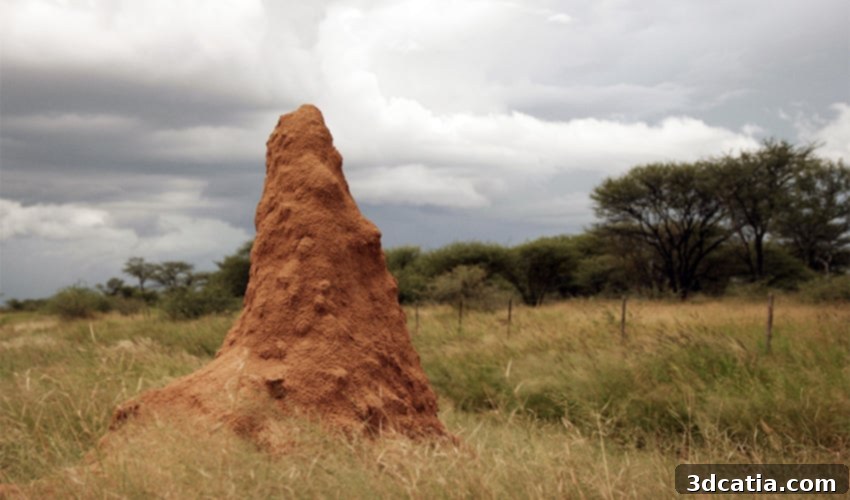
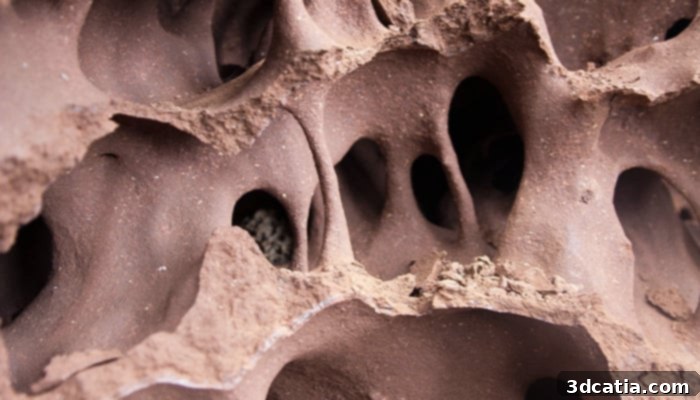
Imagine a future where our buildings effortlessly maintain a comfortable indoor climate, consuming minimal energy, much like the intricate dwellings found in nature. This vision is rapidly becoming a tangible reality, thanks to groundbreaking research exploring the architectural genius of termites. Scientists at Lund University in Sweden and Nottingham Trent University in England have uncovered fascinating insights from studying the termite mounds of *Macrotermes michaelseni*, a species indigenous to Namibia. Their discoveries reveal that these remarkable insects construct sophisticated dwellings that achieve optimal indoor comfort without relying on external energy sources. This natural engineering marvel is accomplished through an elaborate network of lattice-like tunnels, typically between 3 and 5 mm wide, strategically designed to intercept prevailing winds around the mound. This ingenious system powers a highly efficient passive ventilation mechanism, meticulously regulating the internal environment of the colony.
The research team delved deep into the mechanics of these termite mounds, uncovering not only their ventilation prowess but also their ability to actively manage internal atmospheric conditions. They found that the same wind currents that drive ventilation also play a crucial role in expelling excess moisture and respiratory gases, ensuring a healthy and stable environment for the termite colony. Dr. David Andréen, a senior lecturer at Lund University’s bioDigital Matter research group and the study’s lead author, articulated the significance of these findings: “Here we show that the ‘egress complex’, an intricate network of interconnected tunnels found in termite mounds, can be used to promote flows of air, heat, and moisture in novel ways in human architecture.” This profound understanding of nature’s engineering principles has opened up exciting possibilities for the project leaders, allowing them to conceptualize how these extraordinary structures could be replicated and integrated into man-made buildings, ushering in a new era of sustainable construction.
Termite-made mound in Namibia (photo credits: D. Andréen)
Biomimicry in Action: Leveraging Termite Wisdom for Sustainable Construction
The concept of designing buildings inspired by natural processes, often referred to as biomimicry, is gaining significant traction in architecture and engineering. Termite mounds, particularly those of *Macrotermes michaelseni*, stand as prime examples of sophisticated natural engineering, offering invaluable lessons for creating truly sustainable and energy-efficient structures. These intricate natural systems demonstrate an unparalleled ability to maintain stable internal temperatures and humidity levels, regardless of harsh external conditions. The “egress complex” within these mounds is a testament to natural selection’s power, fine-tuning a passive ventilation system over millions of years to achieve optimal comfort with zero energy input. By carefully studying the size, orientation, and interconnectedness of these tiny tunnels, researchers are uncovering the algorithms that govern such efficient environmental control. This deeper understanding is crucial for translating biological blueprints into viable architectural solutions.
The implications of this research extend far beyond mere curiosity; they offer a practical pathway to dramatically reduce the energy consumption of buildings globally. Traditional buildings often rely heavily on energy-intensive heating, ventilation, and air conditioning (HVAC) systems to regulate indoor climates. This dependence contributes significantly to global carbon emissions and places a substantial burden on energy grids. A termite-inspired approach, however, promises a paradigm shift. By designing buildings that can naturally ventilate, cool, and even regulate humidity through their inherent structure, we could drastically cut down the need for active climate control. This would not only lead to significant energy savings but also reduce operational costs for building owners and occupiers, making sustainable living more accessible and economically attractive.
The Pivotal Role of 3D Printing in Reproducing Nature’s Complexity
Translating the complex, organic geometries of termite mounds into human-built structures presents a formidable challenge for conventional construction methods. This is where emerging technologies, particularly advanced 3D printing, become indispensable. While the idea might sound like something from a science fiction novel, the practical application of nature-inspired design in construction is now within reach, largely due to the capabilities of additive manufacturing. Powder-based 3D printing technologies, in particular, are uniquely suited to create the intricate, lattice-like networks and precise channel dimensions required to mimic the termite’s “egress complex.” Unlike traditional building techniques that are often limited to straight lines and simple forms, 3D printing offers unparalleled design freedom, allowing architects and engineers to fabricate highly complex, optimized structures layer by layer.
The ability of 3D printing to produce bespoke components with internal geometries previously impossible to achieve opens up a new realm of architectural possibilities. Imagine walls that are not solid barriers but rather porous membranes, engineered with internal channels designed to passively regulate airflow and temperature. This natural ventilation mechanism has the potential to revolutionize the entire construction industry. By creating more comfortable and inherently energy-efficient homes and commercial buildings, we can significantly reduce the environmental footprint associated with the built environment. This, in turn, would lead to a substantial decrease in CO2 emissions, especially those resulting from the excessive use of air conditioning during warmer months and heating during colder ones. Furthermore, by integrating advanced 3D printing technology with intelligent building management systems, these bio-inspired structures can be further optimized in real-time to respond to changing environmental conditions, maximizing their efficiency and minimizing their overall ecological impact.
The Vision for “Living, Breathing Buildings”
The transformative potential of this research is eloquently captured by Dr. Rupert Soar, Associate Professor in the School of Architecture, Design and the Built Environment at Nottingham Trent University. He emphasizes that the true advancement in construction will come from our ability to emulate nature’s intricate designs: “Construction-scale 3D printing will only be possible when we can design structures as complex as in nature.” He further elaborates on the multi-faceted benefits of adopting such bio-inspired solutions: “The egress complex is an example of a complicated structure that could solve multiple problems simultaneously: keeping comfort inside our homes, while regulating the flow of respiratory gases and moisture through the building envelope.” This holistic approach to building design—where the structure itself acts as an intelligent, responsive system—represents a profound departure from conventional methods.
Dr. Soar’s concluding remark paints a vivid picture of the future: “We are on the brink of the transition towards nature-like construction: for the first time, it may be possible to design a true living, breathing building.” This vision goes beyond mere energy efficiency; it speaks to buildings that are intimately connected with their environment, adapting and responding much like living organisms. Imagine a building whose walls can “breathe,” exchanging air and moisture in a controlled manner, preventing stuffiness, mold, and unhealthy indoor air quality, all without the hum of an air conditioner or the blast of a heater. This not only promises greater comfort for occupants but also a healthier living and working environment. The integration of structural design with environmental regulation implies a future where buildings actively contribute to the well-being of their inhabitants and the planet, rather than being passive consumers of resources. This research, detailed in full HERE, marks a significant step towards realizing such a future.
Beyond Energy: The Broader Impact of Bio-Inspired 3D Printed Architecture
The implications of this termite-inspired design paradigm, facilitated by advanced 3D printing, extend far beyond just energy savings. It heralds a shift towards a more sustainable and resilient built environment. By reducing reliance on mechanical systems, these buildings inherently become more robust and less susceptible to system failures, particularly in areas prone to extreme weather or limited access to electricity. Furthermore, the ability to print complex, optimized geometries on demand can lead to significant material efficiency, reducing waste generated during construction. Materials can be strategically placed only where needed for structural integrity and environmental control, leading to lighter, yet stronger structures. This approach could also enable the use of more sustainable, locally sourced, or recycled materials in 3D printing, further reducing the carbon footprint of construction. The flexibility of 3D printing also allows for greater customization, meaning buildings can be tailored to specific local climates and environmental conditions, maximizing their passive performance.
This research not only provides a blueprint for individual structures but also offers a scalable model for urban development. Imagine entire communities where buildings are designed as interconnected, energy-efficient ecosystems, inspired by the collective intelligence of termite colonies. Such an approach could lead to the development of “smart cities” where infrastructure harmonizes with nature, providing unprecedented levels of comfort, sustainability, and quality of life. The challenge now lies in scaling these laboratory findings to real-world applications, developing suitable construction-grade materials for 3D printing these intricate designs, and educating architects and builders in this new multidisciplinary approach. However, the promise of true living, breathing buildings that are inherently energy-efficient and environmentally responsible makes this endeavor incredibly worthwhile and a critical step towards a sustainable future.