
Mitsubishi Electric Unveils Dot Forming: Revolutionizing Metal 3D Printing with Advanced DED Technology
Mitsubishi Electric Corporation, a globally recognized Japanese powerhouse known for its extensive range of electrical equipment and its significant role as one of the world’s largest producers of photovoltaic panels, is making substantial strides in the additive manufacturing sector. Building on its prior achievements, which include the development of an innovative hybrid machine capable of combining metal sintering and milling, the company has now unveiled a groundbreaking new metal 3D printing technology. This innovative process, dubbed “Dot Forming,” represents a sophisticated method for creating metallic components through the precise formation of individual points. It draws significant inspiration from the established principles of Directed Energy Deposition (DED) technology, a method widely recognized for its ability to melt and fuse materials upon deposition using a concentrated energy source. The machine at the heart of Mitsubishi Electric’s Dot Forming technology is engineered to integrate laser, Computer Numerical Control (CNC), and Computer-Aided Manufacturing (CAM) capabilities, promising the production of high-quality parts with unparalleled precision and efficiency.
This strategic move firmly establishes Mitsubishi Electric’s position on the growing list of metal 3D printer manufacturers, a testament to the dynamic expansion of the additive manufacturing industry. The vigorous growth in this sector is well-documented; for instance, the authoritative Wohlers Report 2018 highlighted an impressive 21% increase in the metal 3D printing segment in the preceding year, a trend that continues with sustained momentum. This booming market offers fertile ground for manufacturers, attracting significant investments and innovations. A prime example of this industry-wide growth is HP’s recent announcement at IMTS in Chicago, where the company introduced its HP Metal Jet, a new system that leverages a binder jetting technique inspired by Metal Injection Molding (MIM). In contrast to such powder-bed-based or binder-jetting approaches, the Japanese manufacturing giant, Mitsubishi Electric, has chosen a distinct path, refining and advancing a method rooted in DED technology. This choice underscores a commitment to exploring and perfecting additive manufacturing processes that offer unique advantages in material deposition and structural integrity, setting the stage for significant advancements in industrial production.
The Evolution of Metal Additive Manufacturing: Why Dot Forming Matters
The landscape of metal additive manufacturing (AM) is diverse and rapidly evolving, driven by the increasing demand for complex geometries, lightweight components, and on-demand production across various industries. Traditional manufacturing processes often face limitations in creating intricate internal structures or repairing high-value components efficiently. Metal AM technologies, including Powder Bed Fusion (PBF), Binder Jetting, and Directed Energy Deposition (DED), have emerged as powerful alternatives, each with its unique strengths and applications. PBF processes, like Selective Laser Melting (SLM) and Electron Beam Melting (EBM), are renowned for producing highly dense parts with excellent mechanical properties, often used for complex designs in aerospace and medical implants. Binder Jetting, exemplified by HP’s Metal Jet, offers high productivity and cost-effectiveness for mass production, although parts typically require post-sintering. DED technology, which forms the foundation for Mitsubishi Electric’s Dot Forming, distinguishes itself through its ability to repair and enhance existing parts, build large structures, and utilize wire feedstock, which can offer significant economic and safety advantages over powder.
The continuous growth observed in the metal AM market is fueled by several factors. Industries such as aerospace, automotive, medical, and energy are increasingly adopting AM for prototyping, tooling, and end-use part production. The ability to create parts with optimized designs, reduced material waste, and shortened lead times provides a compelling case for AM integration. Furthermore, advancements in materials science, machine design, and software control are continuously pushing the boundaries of what is possible with metal 3D printing. Against this backdrop, Mitsubishi Electric’s introduction of Dot Forming is particularly significant. It represents not just an incremental improvement but a focused effort to address specific challenges and enhance capabilities within the DED family of technologies. By emphasizing precision, material efficiency, and cost-effectiveness, Dot Forming aims to carve out a distinct niche, offering solutions that cater to the evolving needs of advanced manufacturing sectors and contributing to the broader maturation of the additive manufacturing ecosystem.
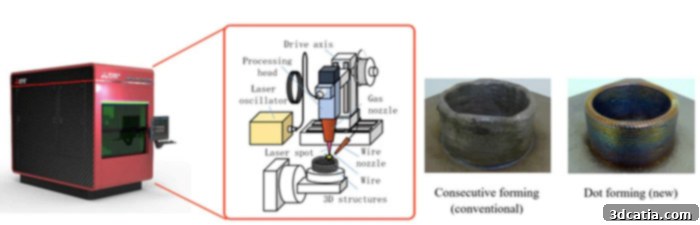
The operation of the Mitsubishi process and printing samples showcasing its capability.
Mitsubishi Electric’s Dot Forming Technology: A Deep Dive into Precision
Directed Energy Deposition (DED) processes are widely recognized for their versatility, commonly employed in applications ranging from the repair and maintenance of high-value structural components to the creation of complex hollow or overhanging geometries. Mitsubishi Electric’s Dot Forming technology, while inspired by DED, introduces a critical distinction: its unique method utilizes a laser-welding wire as the primary feedstock, rather than the more conventional metal powder. This seemingly subtle difference has profound implications for cost-efficiency and material handling. Laser-welding wire is considerably more economical than the specialized metal powders often used in DED and PBF processes. The production of wire is generally less complex and energy-intensive than atomizing metal into fine powders, and wire feedstock typically involves less waste during the process, contributing to overall material savings. Furthermore, wire is safer to handle, posing fewer risks related to dust exposure and explosion hazards compared to fine metal powders, simplifying industrial integration and operational safety protocols.
The true innovation of Dot Forming lies in its meticulous control mechanism. Mitsubishi Electric explains that the technology operates by synchronously controlling several key parameters: the pulsed laser irradiation, the wire feed rate, the shielding gas flow, and the precise shaping position of the deposition head. This highly synchronized approach allows for the repetitive, precise formation of individual “dots” of molten metal. Unlike continuous deposition methods, this point-by-point formation, governed by real-time feedback and sophisticated algorithms, enables an unprecedented level of control over the molten pool dynamics and solidification process. By fine-tuning each pulse of the laser and the exact moment of wire delivery, the system can deposit material with exceptional accuracy. This sophisticated control over the localized thermal input minimizes heat-affected zones and allows for better microstructural control within the deposited material. The shielding gas plays a crucial role in preventing oxidation during deposition, a common challenge in metal AM that can compromise material properties and structural integrity. Through this intricate interplay of parameters, Dot Forming aims to achieve superior material properties and geometric precision.
The benefits derived from this precise, synchronous control are compelling. Mitsubishi Electric asserts that its Dot Forming technology achieves a shape accuracy that is 60% higher than other conventional metal additive manufacturing processes. This significant improvement in accuracy directly translates into several advantages: reduced need for post-processing and machining, tighter tolerances for functional parts, and the ability to produce near-net-shape components with minimal material removal. For industries where precision is paramount, such as aerospace and medical device manufacturing, this level of accuracy can drastically cut down on manufacturing time and costs. Furthermore, the localized and concentrated nature of the high temperatures during the Dot Forming process, focusing only on a small number of points at any given moment, significantly reduces overall thermal exposure for the part. This optimized thermal management leads to a remarkable 20% reduction in oxidation. Minimizing oxidation is critical for maintaining the mechanical properties, corrosion resistance, and overall integrity of metal components, particularly those made from reactive alloys. This enhanced control over both geometric accuracy and material quality positions Dot Forming as a highly promising technology for demanding industrial applications.
Applications and Future Impact of Dot Forming Technology
Mitsubishi Electric harbors high expectations for its new Dot Forming technology, anticipating that it will significantly boost productivity across a diverse spectrum of applications, particularly in industries requiring high-performance metal components. The primary target areas include the critical fields of aircraft and automotive part repair, as well as the efficient production of near-finished parts for these sectors. In the aerospace industry, the ability to precisely repair damaged turbine blades, engine components, or structural elements can dramatically reduce maintenance costs, extend the lifespan of expensive parts, and minimize aircraft downtime. Dot Forming’s high accuracy and reduced oxidation make it ideally suited for these demanding repairs, ensuring that the restored components meet stringent safety and performance standards. For automotive manufacturing, the technology offers potential for creating lightweight custom components, complex prototypes, and specialized tooling with enhanced properties, supporting the industry’s push towards electric vehicles and personalized mobility solutions. The capability to produce “near-finished parts” also implies a reduction in post-processing steps such as extensive machining or grinding, thereby accelerating production cycles and lowering manufacturing costs.
Beyond repair and part production, Dot Forming’s advantages in precision and material efficiency open doors to other promising applications. It could be instrumental in fabricating complex geometries that are difficult or impossible to achieve with traditional methods, leading to designs optimized for performance and weight reduction. Consider lattice structures or internal cooling channels for heat exchangers, which can significantly enhance efficiency in power generation or electronic cooling systems. The cost-effectiveness of using wire feedstock further expands its appeal for a broader range of industrial uses, potentially democratizing access to advanced metal additive manufacturing for small to medium-sized enterprises (SMEs) that might otherwise be deterred by the high cost of metal powders. Mitsubishi Electric’s integrated approach, combining laser technology with CNC and CAM systems, ensures that Dot Forming machines are not just isolated 3D printers but integrated manufacturing solutions, capable of seamlessly fitting into existing production lines and enabling automated, high-precision fabrication processes.
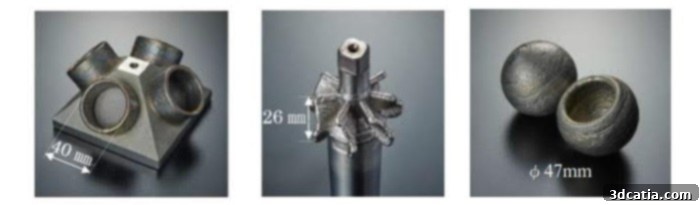
Parts created by Mitsubishi technology demonstrating complex geometries and surface finish.
Mitsubishi Electric’s Vision for the Future of Manufacturing
The introduction of Dot Forming underscores Mitsubishi Electric’s long-term vision for advancing manufacturing capabilities globally. By developing a technology that offers enhanced precision, material cost-efficiency, and reduced oxidation, the company is positioning itself at the forefront of the next generation of industrial production. This commitment to innovation was showcased to the world at the prestigious International Machine Tool Exhibition in Tokyo at the beginning of November, where the new machine was presented to a global audience of industry experts and potential adopters. The exhibition served as a crucial platform to demonstrate the capabilities of Dot Forming, generating considerable interest among manufacturers seeking more efficient and cost-effective ways to produce and repair metal components. While the technology is already making waves, the first commercial deliveries of Dot Forming machines are slated for 2021. This phased rollout allows for further refinement, comprehensive testing, and the establishment of robust support infrastructure to ensure a successful integration into various industrial environments. For those eager to delve deeper into the technical specifications and strategic implications of this groundbreaking development, more comprehensive information can be found in the official press release HERE.
The strategic implications of Dot Forming extend beyond individual applications; they point towards a broader shift in manufacturing paradigms. Mitsubishi Electric’s emphasis on integrating laser, CNC, and CAM within a single system highlights a trend towards smarter, more automated, and digitally driven production processes. This level of integration is essential for achieving the high levels of repeatability and reliability required in industrial settings, ultimately contributing to the realization of Industry 4.0 principles. As industries continue to seek ways to optimize their supply chains, reduce waste, and respond quickly to market demands, technologies like Dot Forming will become increasingly vital. They offer the flexibility to produce custom parts on demand, the capability to repair rather than replace expensive components, and the potential to unlock new design freedoms that were previously unachievable. Mitsubishi Electric’s entry with such a refined DED-inspired process signifies not only a major technological leap for the company but also a significant contribution to the ongoing evolution of metal additive manufacturing, promising a future where high-precision metal parts can be fabricated with unprecedented efficiency and quality.
What are your thoughts on Mitsubishi Electric’s innovative Dot Forming process? How do you envision this technology impacting the future of metal additive manufacturing and industrial repair? We invite you to share your insights and comments below, or join the conversation on our Facebook and Twitter pages! Don’t miss out on the latest advancements and news in the rapidly evolving world of 3D printing; remember to sign up for our free weekly Newsletter, delivering all the essential updates directly to your inbox!