
Revolutionizing Affordable Housing: World Housing & TAM Pioneer Canada’s First 3D Printed Village
In a world grappling with a pervasive housing crisis, marked by escalating costs and a growing population experiencing homelessness, innovative solutions are more critical than ever. Since 2013, World Housing has been at the forefront of this battle, driven by a steadfast commitment to ensuring that every individual has access to a safe and secure roof over their head. Their mission transcends mere shelter provision; it focuses on creating sustainable, viable, and dignified housing options for vulnerable communities globally. This long-standing commitment has now culminated in a groundbreaking partnership with Twente Additive Manufacturing (TAM), a visionary Dutch manufacturer specializing in advanced 3D concrete printing technologies.
This collaborative effort marks a pivotal moment in the quest for affordable housing. Together, World Housing and TAM are embarking on an ambitious project: to construct an entire 3D printed village. This pioneering community is planned for a region of significant housing need in British Columbia, Canada, an area where the demand for accessible and cost-effective living spaces is particularly acute. If successful, this venture will not only provide much-needed homes but also establish North America’s very first fully 3D printed housing development, setting a new benchmark for sustainable and rapid construction practices.
The Transformative Power of Additive Manufacturing in Construction
Additive manufacturing, more commonly known as 3D printing, has been steadily revolutionizing various industries, and its application in construction is proving to be particularly impactful. For several years now, this technology has been harnessed to design and fabricate structural elements, most notably the walls of future homes. While many initiatives remain in their developmental or pilot phases, the prospects offered by 3D printing in construction are immense. This innovation promises significant advancements across architecture, material science, and, critically, sustainability, reshaping how we conceive and build our living environments.
One of the most compelling advantages of turning to 3D printing for construction lies in its remarkable environmental benefits. This method allows for a drastic reduction in material waste by precisely depositing only the concrete needed for a structure, a stark contrast to traditional construction’s extensive material offcuts and disposal challenges. Furthermore, by enabling local construction, 3D printing minimizes the carbon footprint associated with transporting materials over long distances. It also opens avenues for utilizing recycled or locally sourced aggregates, thereby further enhancing the ecological profile of construction projects and fostering a more sustainable building ecosystem.
Beyond its environmental credentials, additive manufacturing significantly enhances efficiency and speed on the construction site. The automated nature of 3D printing allows for rapid fabrication of structural components, substantially accelerating the overall construction timeline. This increased pace translates directly into the ability to deliver more housing units within a shorter period, a critical factor in addressing urgent housing shortages. By streamlining the construction process and reducing reliance on labor-intensive traditional methods, 3D printing offers a powerful tool for scaling up housing provision effectively and affordably. Recognizing these multifaceted advantages of concrete 3D printing, World Housing strategically partnered with TAM to realize their vision of an affordable, 3D printed housing community in Canada.
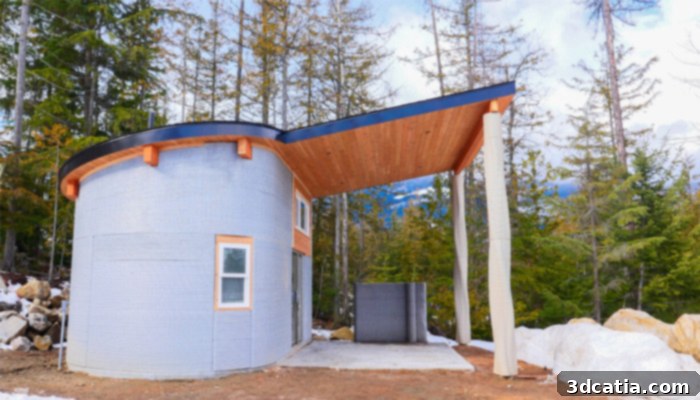
Twente Additive Manufacturing has developed an advanced method to 3D print concrete structures efficiently and sustainably (photo credits: Twente Additive Manufacturing)
Why World Housing is Relying on Additive Manufacturing to Combat Homelessness
For World Housing, the decision to embrace 3D printing technologies stems primarily from their potential to deliver significantly more affordable housing solutions. This core advantage aligns perfectly with the organization’s mission to tackle homelessness and provide secure living environments for those in need. Don McQuaid, Managing Director of World Housing, articulates this strategic shift: “We need a radical re-thinking in the way that we approach solving complex issues in our society like homelessness. 3D technology can advance the goal of providing safe affordable housing and preventing the slide of the most vulnerable into homelessness.” He further emphasizes the organization’s enthusiasm, stating, “World Housing is excited to partner with Twente Additive Manufacturing to help revolutionize the way we provide housing.” This partnership represents a forward-thinking approach to social challenges, leveraging cutting-edge technology for profound humanitarian impact.
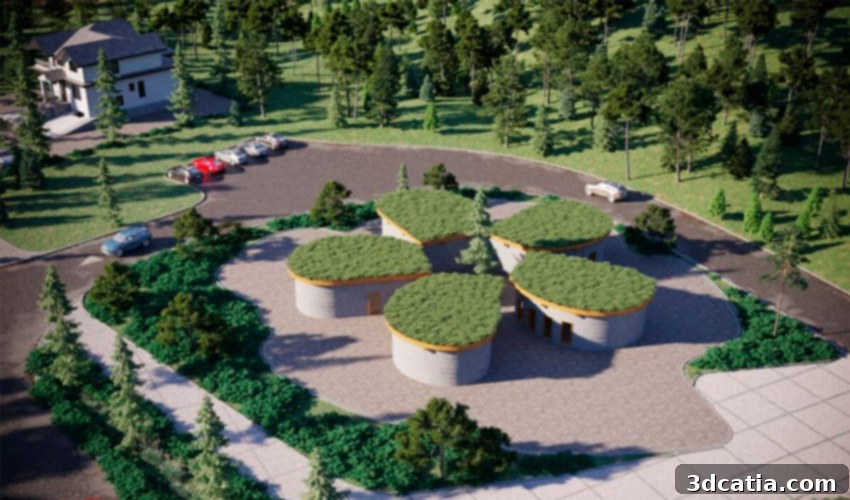
The collaborative vision for the Canadian village extends beyond mere structural integrity. The manufacturer TAM collaborated closely with Alterativ Design to conceive a community that harmoniously integrates into the unique Canadian landscape. This intricate design process thoughtfully incorporated feedback from local indigenous communities, ensuring that the structures are not only functional but also culturally sensitive and respectful of their surroundings. Each individual house within the village measures approximately 65 square meters (700 square feet), offering a comfortable layout with two bedrooms. A distinctive feature of these homes is their roofs, which will be covered with greenery, contributing to both insulation and local biodiversity. Furthermore, the entire community is designed with a strong emphasis on communal living, featuring shared gardens that foster a sense of belonging and interaction among residents.
The construction methodology itself is a testament to efficiency. Once the initial 3D printing of the structural walls is completed – a process that significantly reduces the time typically spent on conventional framing – only a few additional days will be required for the finishing touches. This final phase includes the installation of the green roofs, doors, windows, and the crucial connections for water and electricity. This hybrid approach, combining the speed and precision of 3D printing for the core structure with traditional methods for internal fittings and utilities, allows for rapid deployment of move-in ready homes, further underscoring the project’s efficiency and practicality.

An artist’s rendering of the future Canadian 3D printed community, blending modern architecture with natural elements (photo credits: World Housing)
Unlocking Key Advantages: Accessibility, Affordability, and Advanced Design
The technology proposed and implemented by Twente Additive Manufacturing offers three paramount advantages that are crucial for addressing the global housing crisis. First and foremost is better accessibility. The inherent mobility and on-site printing capabilities of TAM’s machines mean that construction can occur directly at the desired location, even in remote or challenging terrains. This significantly reduces logistical complexities and costs associated with transporting pre-fabricated components or extensive building materials, making it feasible to establish housing in areas that would otherwise be economically or logistically prohibitive for traditional construction methods. This on-demand, localized production model opens up vast possibilities for providing housing where it is most needed, without being constrained by infrastructure limitations.
Secondly, the project promises significantly reduced construction costs. This cost-efficiency is a direct result of several factors inherent to 3D concrete printing. Material waste is minimized through precise deposition, labor requirements are substantially lower due to automation, and the speed of construction reduces overall project timelines and associated overheads. These combined savings translate into lower per-unit housing costs, directly fulfilling World Housing’s core objective of making homes genuinely affordable for vulnerable populations. By slashing the financial barriers to homeownership or stable tenancy, this technology becomes a powerful tool in breaking cycles of poverty and homelessness.
Finally, the approach ensures a better design of the houses, encompassing cultural, ecological, and structural considerations. Culturally, the integration of feedback from indigenous communities ensures that the homes are not only functional but also resonate with local heritage and aesthetics. Ecologically, features like green roofs contribute to environmental sustainability, while the precise material usage minimizes the overall ecological footprint. Structurally, TAM leverages advanced topological optimization software. This innovative design approach allows for the creation of structurally sound yet materially efficient designs, often with organic shapes that optimize load distribution. Furthermore, this method can eliminate destructive processes common in traditional construction, such as extensive excavation, thereby minimizing site disruption and preserving the natural landscape more effectively. For a deeper dive into the specifics, additional information can be found HERE.
A Blueprint for the Future of Housing and Community Development
The ambitious project by World Housing and Twente Additive Manufacturing in British Columbia is far more than just a single housing development; it serves as a powerful proof-of-concept and a scalable blueprint for the future of affordable housing globally. By demonstrating the viability and extensive benefits of 3D printed villages, this initiative holds the potential to inspire and inform similar projects in diverse geographical and socio-economic contexts. The lessons learned from design, material optimization, construction process, and community integration will be invaluable for future endeavors aiming to address housing shortages with speed, efficiency, and sustainability.
This pioneering approach challenges conventional construction paradigms and offers a compelling vision for how technology can be harnessed to solve some of humanity’s most pressing social issues. It underscores a shift towards more resilient, responsive, and environmentally conscious building practices that prioritize human dignity and community well-being. As the world continues to urbanize and demand for housing intensifies, the model presented by World Housing and TAM could become a cornerstone of future urban planning and humanitarian efforts, transforming barren landscapes into vibrant, sustainable communities.
What do you think of the idea of a 3D printed village as a solution to housing challenges? We invite you to share your thoughts and perspectives in a comment below or join the discussion on our Facebook, Twitter and LinkedIn pages! Don’t miss out on the latest advancements and news in additive manufacturing; sign up for our free weekly Newsletter here, delivering the most current 3D printing news straight to your inbox!