
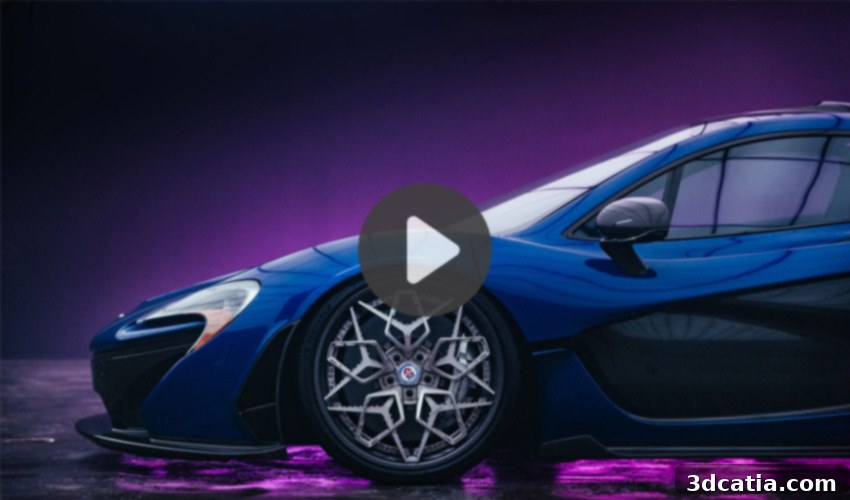
Unveiling the Future: Top 5 Revolutionary 3D Printing Innovations This Week
Welcome to our exclusive weekly roundup, where we delve into the most captivating advancements in additive manufacturing and explore how this groundbreaking technology is profoundly shaping our modern society. From the intricate demands of the medical sector to the boundless frontiers of space exploration, 3D printing continues to infiltrate and redefine countless industries, pushing the boundaries of what’s possible. This week, we’ve curated a selection of five extraordinary videos that highlight cutting-edge developments, including a groundbreaking collaboration between HRE and GE Additive for custom wheels, the unveiling of the world’s first 3D printed diamond composite at RAPID + TCT, and much more. Each innovation showcases the immense potential of 3D printing to revolutionize design, production, and everyday life. Join us as we explore these exciting breakthroughs, offering a glimpse into a future where custom solutions and complex geometries are not just feasible, but commonplace. For even more insightful videos and the latest trends, be sure to visit and subscribe to our official YouTube channel. We hope you enjoy this inspiring collection and have a fantastic week ahead!
Top 1: Revolutionizing Automotive Design with 3D Printed Custom Wheels
Last November, the automotive and additive manufacturing communities were abuzz with the news of HRE Performance Wheels developing the world’s first 3D printed titanium rim. This pioneering project was a testament to the power of collaboration, undertaken in partnership with industry giant GE Additive. The resulting rim boasts an incredibly complex, intricate design that would be nearly impossible to achieve with traditional manufacturing methods. Beyond its aesthetic appeal, this innovation delivers significant functional benefits, primarily a substantial reduction in weight compared to conventionally manufactured rims. This lightweighting is crucial for enhancing vehicle performance, improving fuel efficiency, and reducing overall emissions – factors that are increasingly vital in the modern automotive landscape.
The advanced capabilities of metal additive manufacturing were key to this achievement. Technologies such as Electron Beam Melting (EBM) and Direct Metal Laser Sintering (DMLS) allowed HRE and GE Additive to precisely control the material deposition, creating internal lattice structures and topology-optimized geometries that maximize strength while minimizing material usage. This not only results in a lighter product but also leads to significant material savings during the production process, contributing to reduced manufacturing costs and a more sustainable approach. In the featured video, representatives from both HRE and GE Additive provide a deeper insight into their collaborative journey, elaborating on the technical challenges overcome, the innovative solutions implemented, and the profound advantages that such a production method brings to the high-performance automotive sector. This partnership exemplifies how 3D printing is not just an alternative manufacturing method, but a transformative force enabling a new era of design freedom and functional excellence in specialized automotive components.
Top 2: Sandvik Pioneers World’s First 3D Printed Diamond Composite
Diamond, renowned as the hardest natural material on Earth, boasts an astonishing strength that is 58 times greater than any other naturally occurring substance. Its unparalleled resistance and hardness make it exceptionally durable, but these very qualities also present immense challenges when it comes to machining and forming complex shapes using conventional methods. The inherent difficulty in processing diamond has historically limited its application to relatively simple geometries, often requiring painstaking and expensive techniques.
Recognizing this significant bottleneck, the innovative teams at Sandvik embarked on a mission to leverage additive manufacturing to unlock new possibilities for this extraordinary material. Their breakthrough involved mixing fine diamond powder with a polymer base, carefully formulating a unique photopolymerizable resin. This ingenious composite material could then be processed using stereolithography (SLA) technology, a high-precision 3D printing method known for its ability to create intricate designs with smooth finishes. At RAPID + TCT 2019, Sandvik proudly unveiled their success: they had managed to 3D print complex geometries from this novel diamond composite, objects that exhibited the exact same exceptional properties as natural diamond. This revolutionary development opens up a vast array of potential applications across numerous industries. Imagine cutting tools with unprecedented geometries, advanced wear parts for demanding industrial machinery, or even specialized medical instruments that benefit from diamond’s superior hardness and resistance. This innovation is not merely an incremental improvement; it has the potential to fundamentally transform various sectors, enabling previously unimaginable designs and functionalities for components requiring extreme durability and precision.
Top 3: NASA’s Vision for Exploration with 3D Printed Soft Robots
NASA has long been at the forefront of adopting and advancing 3D printing technology, recognizing its unparalleled potential for space applications. The agency has extensively utilized additive manufacturing for creating highly complex, lightweight components for its satellites and spacecraft, and even for 3D printing essential tools and spare parts directly in orbit aboard the International Space Station. These applications underscore the technology’s critical role in reducing launch mass, enabling on-demand repairs, and facilitating rapid prototyping in the challenging environment of space.
Now, NASA is pushing the boundaries further by employing additive manufacturing in a new, exciting frontier: the development of soft robots designed for extraterrestrial exploration. Recognizing the limitations of rigid robotic systems on unpredictable planetary surfaces, NASA’s teams are actively engaged in creating flexible silicone robots that possess the agility and adaptability required to traverse diverse and often unforgiving terrains, such as the dusty lunar surface or the rocky landscape of Mars. These innovative robots are not simply molded; they are intricately designed and produced using complex 3D printed molds. The precision offered by additive manufacturing allows researchers to embed sophisticated pneumatic networks directly within the silicone structure. These internal channels can be inflated and deflated to mimic biological muscles, enabling the robots to bend, grip, and move with remarkable dexterity and control. This design approach facilitates the rapid iteration and testing of various properties, allowing NASA scientists to optimize the robots’ movement capabilities, their interaction with delicate samples, and their resilience to harsh environments. Such soft robotics hold immense promise for future missions, offering a gentler touch for scientific exploration and potentially expanding humanity’s reach across the cosmos.
Top 4: KALLISTA Redefines Luxury Faucets with Metal Additive Manufacturing
In the realm of luxury product design, the pursuit of unparalleled aesthetics, bespoke customization, and superior functionality is paramount. KALLISTA, a brand synonymous with exquisite bathroom and kitchen fixtures, has embraced metal additive manufacturing to craft a first-of-its-kind luxury faucet, pushing the boundaries of what is traditionally achievable in this highly refined market. This groundbreaking endeavor was made possible through the advanced metal 3D printing technologies and robust stainless steel materials provided by 3D Systems, a leader in additive manufacturing solutions.
The project highlights a crucial distinction, as eloquently explained by the Lead Industrial Designer at KALLISTA in the accompanying video: the difference between an artist and a designer. While an artist often creates without immediate consideration for production methods, a designer must meticulously consider the manufacturing process even before the design truly takes shape. This iterative design-for-manufacturing approach is where metal additive manufacturing truly shines. Traditional metal fabrication techniques, such as casting or machining, impose significant constraints on geometric complexity, often limiting designers to simpler forms. However, with metal additive manufacturing, these limitations are dramatically reduced, opening up a universe of new possibilities. Designers can now conceptualize and produce intricate internal channels, complex lattice structures, and organic shapes that would be impossible or prohibitively expensive to create otherwise. This freedom allows KALLISTA to design faucets that are not only visually stunning and uniquely sculptural but also functionally optimized for water flow and durability. By embracing this advanced manufacturing method, KALLISTA is not just producing fixtures; they are crafting works of art that set new benchmarks for innovation and exclusivity in luxury design, offering customers products that are truly unique and reflective of a bespoke lifestyle.
Top 5: Heineken Taps into Efficiency with Industrial 3D Printing
The transformative impact of 3D printing extends far beyond high-tech industries and into the everyday operational efficiency of manufacturing plants, even those in unexpected sectors like brewing. At the bustling Heineken factory in Seville, Spain, a fleet of Ultimaker 3D printers is actively at work, demonstrating how additive manufacturing can optimize production on a large scale. This facility, which impressively produces 500 million liters of beer annually, relies on these machines to print a diverse range of tools, jigs, fixtures, and spare parts directly on-site.
The implementation of 3D printing at Heineken exemplifies the practical, tangible benefits of integrating this technology into an industrial environment. Instead of waiting for external suppliers to deliver specialized tools or custom spare parts, which can lead to costly downtime and production delays, the factory’s teams can design and print them on demand. This agility allows for immediate solutions to operational challenges. For instance, additive manufacturing enables the design and creation of more effective safety devices, ergonomic tools tailored for specific tasks, and brilliantly engineered spare parts that often surpass the performance and longevity of their traditionally manufactured counterparts. This direct access to rapid prototyping and production also fosters a culture of innovation among the engineering teams, empowering them to continuously improve processes and optimize machinery. The result is a significant boost in operational efficiency, a reduction in maintenance costs, and ultimately, a more streamlined and productive brewing operation, proving that 3D printing is a valuable asset even in traditional manufacturing settings.
What are your thoughts on this week’s inspiring selection of 3D printing videos? The breadth of applications, from cutting-edge automotive components and revolutionary material science to advanced robotics and industrial optimization, truly highlights the dynamic and far-reaching influence of additive manufacturing across global industries. We’d love to hear your insights and predictions for the future of this technology. Drop a comment below or join the conversation on our Facebook and Twitter pages! To ensure you never miss out on the latest news, innovations, and trends transforming the 3D printing industry, be sure to sign up for our free weekly Newsletter, delivered straight to your inbox.