
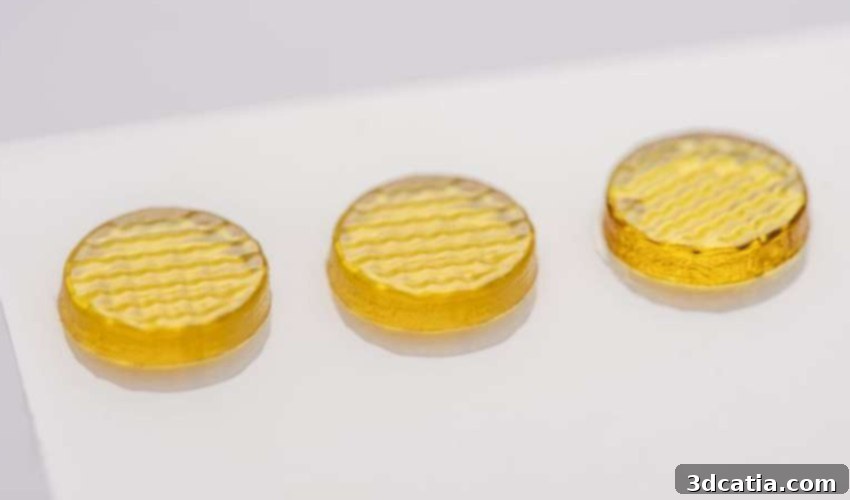
Revolutionizing Personalized Medicine: University of Nottingham Pioneers 3D Printed Multi-Drug Tablets for Precision Delivery
In a groundbreaking advancement set to redefine pharmaceutical innovation, researchers at the University of Nottingham’s Centre for Additive Manufacturing have achieved a significant breakthrough in personalized healthcare. This innovative development leverages a novel 3D printing technology known as multi-material inkjet 3D printing (MM-IJ3DP). This remarkable achievement enables the precise creation of individualized tablets, each capable of containing multiple distinct drugs, meticulously programmed for release at specific, predetermined times. This paradigm-shifting advancement, spearheaded by Dr. Yinfeng He from the esteemed Centre for Additive Manufacturing and Professor Felicity Rose from the renowned School of Pharmacy, holds immense promise to profoundly revolutionize the entire pharmaceutical landscape. It paves the way for the development of highly customized and incredibly precise drug delivery systems, promising unparalleled improvements in how medication is managed, administered, and ultimately, how patients experience their treatment regimens.
At the heart of this transformative innovation lies poly-ACMO, a sophisticated and newly developed soluble polymer ink specifically engineered for demanding pharmaceutical applications. This unique and groundbreaking material is ingeniously composed of light-sensitive molecules, endowing it with a remarkable property: it rapidly solidifies when exposed to ultraviolet light. This solidification process allows it to form a stable, yet water-soluble framework that constitutes the intricate internal structure of the tablet. Scientists have not only successfully synthesized this novel polymer but have also masterfully leveraged the advanced capabilities of multi-material inkjet 3D printing to harness poly-ACMO’s unique properties. This synergy enables them to engineer tablets with precisely tailored drug release rates and meticulously controlled spatial distribution of active pharmaceutical ingredients. This unprecedented level of control ushers in an era of personalized medication, allowing healthcare providers to address the unique physiological needs and treatment requirements of each individual patient with far greater efficacy, ensuring medication is administered at the most opportune and controlled rate for optimal therapeutic outcomes.
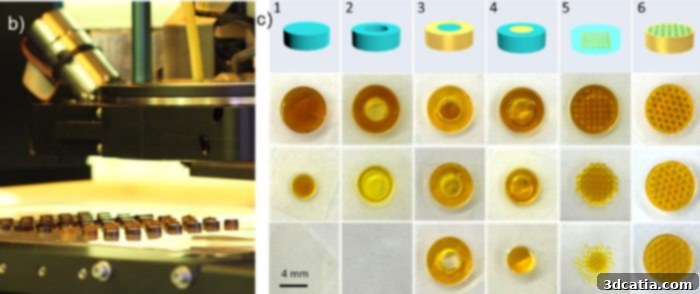
Illustrative designs of personalized tablets produced by MM-IJ3DP technology.
This advanced approach offers a multitude of additional, compelling benefits that extend far beyond simple drug encapsulation. The tablet’s sophisticated and unique interior structure is not merely a mechanism for controlling the drug release rate with enhanced accuracy; it also possesses the remarkable capability to facilitate the simultaneous printing of multiple distinct drugs within the confines of a single tablet. This groundbreaking feature significantly simplifies what were once complex and often confusing medication regimens, consolidating multiple doses into a single, easy-to-manage pill. This technology is particularly advantageous for patient populations burdened with intricate or extensive medication schedules, such as the elderly, individuals managing multiple chronic conditions, or those undergoing polypharmacy treatments. Traditionally, navigating multiple medications can be an overwhelming and challenging task for patients, often requiring them to meticulously track and take several different pills at various, specific times throughout the day. MM-IJ3DP elegantly streamlines this process by seamlessly combining these various drugs into a single, intelligently designed tablet, engineered to precisely release each active component at its predetermined, therapeutically optimal moment. This not only enhances patient convenience but also drastically improves adherence to prescribed treatments, leading to better health outcomes and a higher quality of life for patients.
Reflecting on the transformative potential and myriad benefits of this pioneering work, Dr. Yinfeng He, Assistant Professor in the Faculty of Engineering’s Centre for Additive Manufacturing, shared his enthusiasm. He emphasized, “This represents an incredibly exciting and pivotal step forward in our journey towards developing truly personalized medication. The implications of this breakthrough are far-reaching; it not only powerfully highlights the immense potential of advanced 3D printing technologies in revolutionizing the fundamental principles of drug delivery but also unequivocally opens up entirely new and promising avenues for the accelerated development of next-generation personalized medicines. We are moving towards an era where medication is no longer a one-size-fits-all solution but a bespoke treatment tailored precisely to individual patient needs, optimizing efficacy and minimizing side effects.” This sentiment underscores the profound shift from conventional pharmaceutical manufacturing to a more agile, patient-centric approach enabled by additive manufacturing.
While the immense potential of MM-IJ3DP in revolutionizing personalized healthcare is undeniably vast and transformative, the research team acknowledges that there are still critical challenges to diligently overcome before widespread clinical application. The current primary focus of their dedicated research efforts is centered on developing a broader and more diverse array of innovative ink formulations. This expansion is crucial to accommodate an ever-wider range of medications, each with unique chemical properties and therapeutic requirements. Fortunately, the pioneering research team remains highly confident and optimistic that the application and capabilities of this groundbreaking technology will rapidly expand and significantly improve in the coming years. As a testament to its current sophistication, MM-IJ3DP already boasts the remarkable capacity to allow for up to 56 different medications to be printed simultaneously within a single, complex dosage form. This extraordinary ability to precisely create highly individualized pharmaceutical solutions, meticulously tailored to the specific needs of each patient, is poised to profoundly drive forward a new and exciting era in healthcare. In this future, treatments will truly be as unique and distinct as the patients they are meticulously designed to serve, moving beyond standardized approaches to deliver unparalleled precision and efficacy in patient care. Echoing this hopeful and forward-looking sentiment, Professor Felicity Rose, a distinguished expert at the University of Nottingham’s School of Pharmacy, further elaborated on the vital importance of this personalized approach:
“The future of prescribed medication unequivocally lies in a personalized approach, deeply rooted in an understanding of individual patient needs. We are keenly aware that, staggeringly, up to 50% of people in the UK alone do not take their medicines correctly or consistently. This widespread issue has a tangible and detrimental impact on health outcomes, leading to conditions not being adequately controlled or properly treated, which can result in significant patient suffering and increased healthcare burdens. Our research indicates that a single-pill approach, where multiple necessary medications are combined into one intelligent dosage form, would profoundly simplify the often-complex task of taking multiple medications at different times throughout the day. This innovative research, therefore, represents an incredibly exciting and significant step towards realizing that much-needed future of streamlined, effective, and patient-centric medication management.” This emphasizes the critical role of MM-IJ3DP in improving patient adherence and the overall effectiveness of pharmaceutical interventions.
The profound implications of MM-IJ3DP’s ability to significantly enhance personalized healthcare are truly immense, promising a future where medication is precisely tailored, leading to superior patient outcomes and a more efficient healthcare system. What are your thoughts on how this innovative 3D printing technology could reshape the pharmaceutical industry and patient care? We invite you to share your perspectives and engage in the conversation by leaving a comment below or by connecting with us on our LinkedIn, Facebook, and Twitter pages! Don’t miss out on the latest advancements and breaking news in additive manufacturing; remember to sign up for our free weekly newsletter here to receive the most current 3D printing news directly to your inbox! Additionally, for a comprehensive visual experience and deeper insights, you can find all our engaging videos on our dedicated YouTube channel. Join our community and stay informed about the future of personalized medicine and 3D printing innovation.
*All Photo Credits: University of Nottingham