
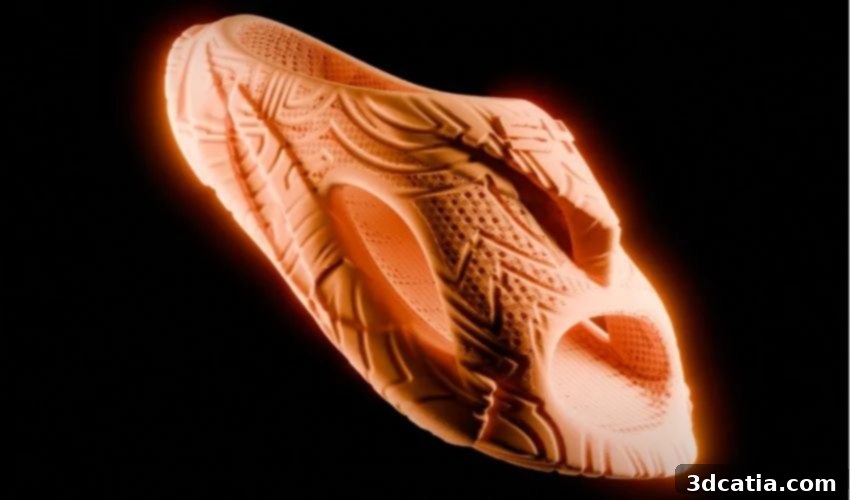
Syntilay: Pioneering the Future of Footwear with AI-Driven Design and On-Demand 3D Printing
For many years, the intersection of 3D printing and footwear has captured the imagination of designers and innovators alike. We’ve witnessed a steady rise in the integration of additive manufacturing into shoe production, particularly with performance sports shoes featuring complex 3D-printed midsoles designed for optimal cushioning and support. Similarly, elements of fashion footwear have embraced 3D-printed components, adding unique aesthetic details and structural innovation. However, the vision of complete, commercially viable footwear produced entirely by 3D printers has remained largely elusive. While pioneering companies like Zellerfeld, known for its collaborations with luxury brands, designers, and celebrities to create avant-garde, wild designs, or ELASTIUM with its distinctively futuristic sneakers, have pushed the boundaries, their offerings often remain in the realm of high-concept design specimens or cater to niche markets. These innovative products, while groundbreaking, haven’t always met the aesthetic tastes or commercial scalability required for widespread mass adoption.
Enter Syntilay, a dynamic startup poised to redefine these boundaries. Syntilay is on a mission to bring fully 3D-printed shoes to the commercial market, making them accessible, desirable, and wearable for anyone. What sets Syntilay apart even further is its revolutionary development process: a significant portion of its footwear design was spearheaded by artificial intelligence (AI). This strategic embrace of AI, combined with the power of 3D printing, positions Syntilay at the forefront of a new era of footwear innovation, promising not just novel products but a fundamentally new approach to design, manufacturing, and consumer experience.
Syntilay’s journey began with its visionary 25-year-old founder, Ben Weiss. Under his leadership, the startup rapidly advanced, benefiting from the guidance and expertise of an extensive team of advisors. Among these esteemed figures is Joe Foster, a co-founder of Reebok in 1958, whose invaluable industry insight and unwavering support have significantly shaped Syntilay’s direction. The company’s name itself, “Syntilay,” is derived from the word “scintillate,” meaning to flash light or sparkle. This linguistic inspiration perfectly encapsulates the startup’s grand objective: to empower individuals to express their unique personalities and “bring out the sparkle and shine” in themselves through fashion. By offering personalized, favorite creations, Syntilay aims to provide a platform for self-expression that goes beyond conventional footwear. Furthermore, Syntilay has an explicit focus on the evolving landscape of digital influence. It aims to enable influencers to transcend the typical merchandise of private label T-shirts and hats, offering them a unique opportunity to distribute bespoke footwear through the Syntilay platform, thereby deepening their brand connection with their audience. Syntilay’s keen awareness of contemporary trends is evident not only in its innovative marketing strategies but also profoundly in its technological foundation. The very shoes that represent the future of footwear were meticulously developed using advanced AI and brought to life through sophisticated 3D printing techniques, seamlessly merging cutting-edge technology with modern consumer engagement.
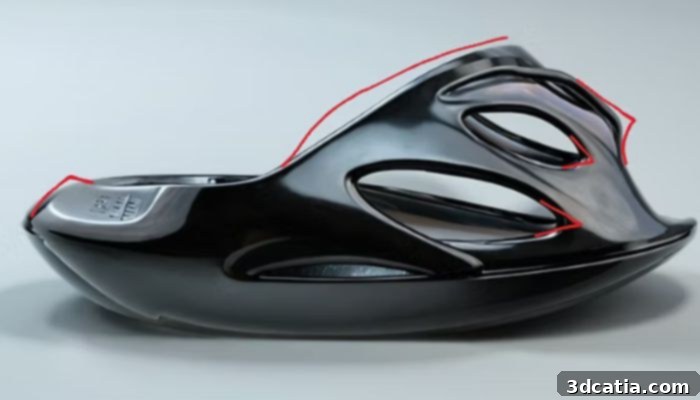
The initial design concept for the Syntilay shoe was generated with the assistance of artificial intelligence.
Syntilay Relies on AI-Supported Design for Revolutionary Footwear
The design process for Syntilay’s distinctive, Croc-like slide shoes stands as a testament to the transformative power of artificial intelligence, with human oversight guiding every step. This innovative approach began with AI tools, specifically MidJourney, taking the initial conceptual lead. MidJourney was tasked with generating a plethora of diverse concepts for the shoe’s overall shape, form, and aesthetic design, exploring a wide range of creative possibilities that might have taken a human designer significantly longer to conceptualize. This AI-driven ideation phase provided a rich foundation of inspiration, from which designer Kedar Benjamin, a human expert, then extracted the most promising elements. He meticulously translated these AI-generated concepts into a refined, standardized sketch of the shoe, ensuring that the creative vision was both cohesive and technically feasible for manufacturing.
Following Benjamin’s precise sketching, the Vizcom tool entered the scene, utilizing these sketches to rapidly create a detailed 3D model. This swift translation from 2D to 3D significantly accelerated the prototyping phase. To further enhance and refine the visual and tactile qualities of the shoe, another generative AI was deployed. This advanced AI specialized in developing intricate patterns and textures, adding layers of complexity and aesthetic appeal to the 3D model. The result is a truly distinctive final design that captivates with its interesting surface patterns, unique lettering emblazoned on the sole, and strategically incorporated mesh layers that contribute to both style and functionality. Comfort, a paramount consideration for any footwear, is assured by the shoe’s ergonomically shaped design. This thoughtful contouring provides essential support for the foot while simultaneously promoting optimal ventilation, ensuring a pleasant wearing experience even over extended periods.
Syntilay firmly asserts that the integration of artificial intelligence has dramatically enhanced the efficiency of their design process. This AI-powered acceleration has not only streamlined creative workflows but has also yielded substantial environmental advantages, primarily through a significant reduction in material waste that typically accompanies traditional prototyping. Economically, the speed-up in the design and development cycle translates into considerable savings and a quicker time-to-market. Syntilay proudly highlights on its website that the entire idea-to-market process for their innovative footwear could be accelerated by an impressive factor of nine, a feat largely attributed to AI’s central role. Joe Foster, a titan in the footwear industry and a key advisor to Syntilay, emphatically underscores this point: “AI is unlocking incredible capabilities for design in software, yet physical products haven’t benefited. It is time for that to change with our slide shoe!” His statement captures the essence of Syntilay’s groundbreaking approach, marking a pivotal shift where the theoretical potential of AI in design is finally realized in tangible, physical products.
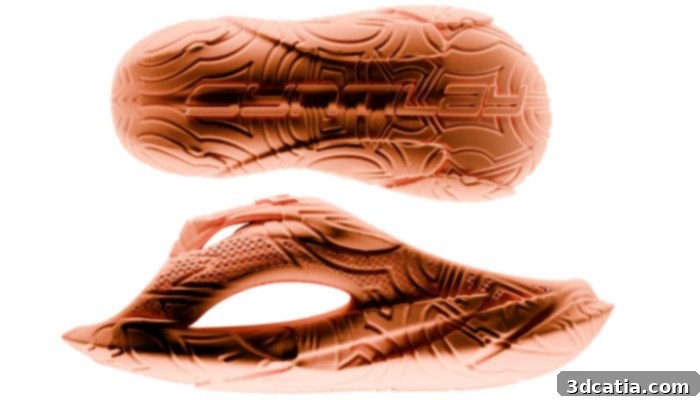
Generative AI was instrumental in creating the unique, intricate patterns seen on the final Syntilay shoe design.
3D Printing for Customized Shoes: The Syntilay-Zellerfeld Partnership
Syntilay’s innovative footwear is now readily available for order directly from their website, offering consumers a truly personalized shopping experience. The slide shoes come in a vibrant palette of five distinct colors – classic red, versatile beige, energetic orange, serene blue, and sleek black – catering to a wide range of individual styles. Customers can select between men’s or women’s models, each priced at an accessible $149.99. What truly sets Syntilay apart is its commitment to personalization and on-demand production. Every single pair of shoes is printed specifically for the customer, ensuring a unique product tailored to their needs.
The ordering process is meticulously designed for convenience and precision. The customer first selects their preferred model and color, indicating a reference shoe size. This initial step then seamlessly transitions into a crucial phase of customization. Customers are redirected to Syntilay’s esteemed partner company, Zellerfeld, a pioneer in the field of 3D-printed footwear, which handles the intricate manufacturing process. Before printing commences, Zellerfeld leverages cutting-edge technology to achieve an unparalleled level of fit. Customers simply use their smartphone camera to scan their feet, a process that takes mere minutes to complete. This data, capturing the exact contours and dimensions of their feet, is then uploaded to Zellerfeld’s system. With this precise biometric information, Zellerfeld proceeds to 3D print each pair of shoes from high-quality thermoplastic polyurethane (TPU). This material choice is significant, as TPU offers an ideal combination of flexibility, durability, and comfort, making it perfectly suited for wearable, long-lasting footwear. The result is a shoe that is not just 3D printed but custom-fitted to the individual’s foot, promising an unprecedented level of comfort and support that traditional mass-produced footwear cannot match.
Looking ahead, Syntilay is actively planning to expand its groundbreaking business model, capitalizing on the clear resonance its approach has found within the market. This innovative method of combining AI-driven design with personalized 3D printing has evidently struck a chord with industry experts and consumers alike. Cornelius Schmitt, the highly respected CEO of Zellerfeld, wholeheartedly concurs with the synergistic potential of these technologies, stating: “AI unlocks never-before-seen design capabilities that our 3D printers are uniquely equipped to produce. We empower brands like Syntilay to design and market groundbreaking footwear. It’s a new age.” His words highlight the profound impact this partnership has on accelerating innovation and delivering truly novel products to the market. Syntilay’s success is a testament to a future where footwear is not just manufactured but intelligently crafted and personally tailored, ushering in an exciting era of bespoke fashion and sustainable production. For those eager to delve deeper into Syntilay’s vision and offerings, further information can be found HERE.
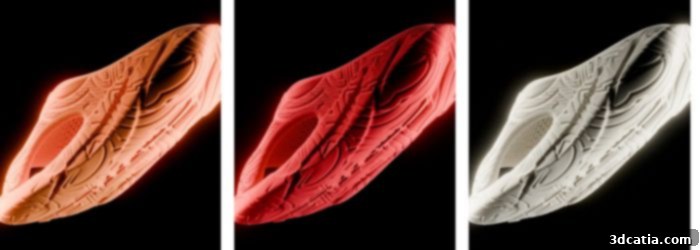
The Syntilay shoe is available in five distinct and appealing colors, catering to diverse preferences.
What are your thoughts on Syntilay’s pioneering use of AI for footwear design and its innovative 3D printing approach? Do you believe this represents the future of custom shoes? Share your insights and opinions in a comment below or engage with us on our LinkedIn, Facebook, and Twitter pages! Don’t forget to sign up for our free weekly Newsletter here to receive the latest 3D printing news directly in your inbox! You can also find all our compelling videos and interviews on our dedicated YouTube channel, where we explore the most exciting developments in the world of additive manufacturing.
*All Photo Credits: Syntilay