
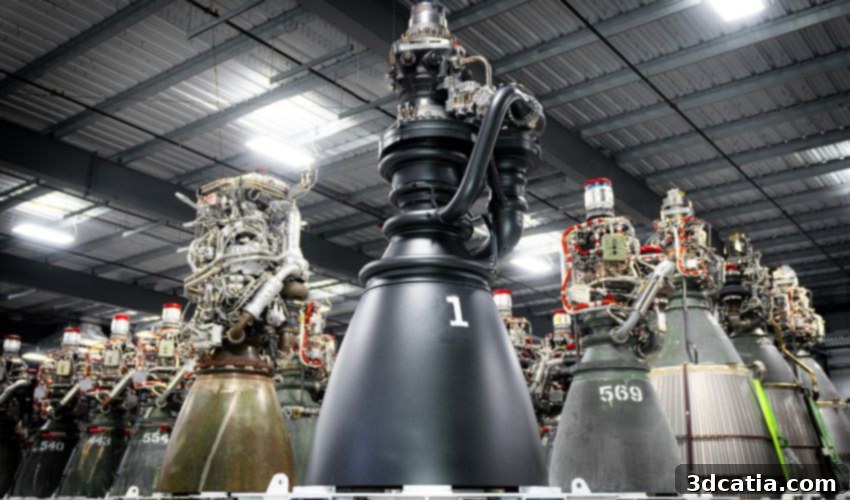
SpaceX’s Raptor 3 Engine: A Quantum Leap in Rocket Propulsion with Advanced Metal 3D Printing and DfAM
In a landscape buzzing with Elon Musk’s diverse endeavors, from his outspoken views on social issues to his growing political endorsements, one particular announcement from SpaceX, his Hawthorne, California-based aerospace company, has captured the attention of the engineering and space communities alike: the unveiling of the Raptor 3 engine. This latest iteration of the formidable rocket engine represents a significant stride forward, largely attributed to the innovative application of metal 3D printing and advanced Design for Additive Manufacturing (DfAM) principles. These technologies have not just refined the engine but have fundamentally reshaped its design and capabilities, promising to push the boundaries of space exploration even further.
The Genesis and Evolution of the Raptor Engine: Powering Starship’s Ambitions
For those unfamiliar with the cutting edge of the commercial space race, SpaceX is meticulously developing the Raptor rocket engine as the powerhouse for its ambitious Starship mission – a fully reusable transportation system designed to carry both crew and cargo to Earth orbit, the Moon, Mars, and beyond. What makes the Raptor engine particularly revolutionary is its use of a full-flow staged combustion cycle. This advanced propulsion system is incredibly complex but offers unparalleled efficiency and thrust. In this cycle, both the fuel and oxidizer are fully vaporized before combustion, significantly increasing efficiency and reducing maintenance requirements, which is critical for reusability.
SpaceX has iteratively refined the Raptor engine through several versions. The initial Raptor 1 showcased the feasibility of the full-flow staged combustion cycle. Raptor 2 built upon this foundation, introducing design improvements for increased thrust and simplified manufacturing. However, the latest version, Raptor 3, stands out as a true testament to engineering ingenuity, distinguished by its radically slimmed-down design, enhanced reliability, and superior performance characteristics. This progression underscores SpaceX’s philosophy of rapid iteration and continuous improvement, where each engine version brings them closer to the ultimate goal of interplanetary travel.

Raptor 3 boasts a simplified and optimized design, significantly enhanced by advanced additive manufacturing and DfAM techniques.
Unlocking Potential: DfAM and Metal Additive Manufacturing in Raptor 3
The key to Raptor 3’s dramatic improvements lies in the synergy between Design for Additive Manufacturing (DfAM) and sophisticated metal 3D printing techniques. SpaceX engineers have brilliantly leveraged DfAM to fundamentally rethink the engine’s architecture. Traditional manufacturing methods impose severe limitations on design complexity, often requiring components to be made separately and then assembled using bolts, welds, or other fasteners. This process adds weight, introduces potential points of failure, and complicates assembly.
With DfAM, designers can create highly complex geometries and integrate multiple functions into a single, consolidated part. For Raptor 3, this meant integrating cooling channels and secondary flow circuits directly into the engine’s structure. Crucially, many components that were previously external, requiring cumbersome bolted connections and protective heat shields, have now been internalized. This strategic relocation and integration have resulted in a vastly simplified and streamlined engine. The elimination of numerous bolted joints not only shaves off significant weight but also enhances the engine’s structural integrity and reliability, as fewer interfaces mean fewer potential points of failure under extreme operational conditions. Furthermore, the aesthetic appeal of the engine is also enhanced, reflecting a sleek, optimized form that is a direct consequence of its advanced internal design.
The benefits extend beyond weight and aesthetics. By reducing the number of individual parts, SpaceX can significantly decrease manufacturing time, simplify supply chains, and reduce the labor required for assembly. This holistic approach, enabled by DfAM, allows for a level of design optimization that was previously unimaginable with conventional manufacturing processes, making the Raptor 3 not just a more powerful engine, but a more efficient and robust one.
SpaceX’s Proprietary Metal 3D Printing: A Glimpse into the Future
Elon Musk’s bold claim that SpaceX possesses “the most advanced 3D metal printing technology in the world” sparks considerable interest and speculation. While he remains intentionally vague about the exact processes employed, the implications are clear: proprietary innovation is at the heart of their manufacturing success. In the realm of metal additive manufacturing, Laser Powder Bed Fusion (L-PBF) and Directed Energy Deposition (DED) are widely recognized as powerful methods capable of producing high-performance, complex metal parts. These techniques are generally known to be used by SpaceX for various components due to their ability to work with advanced alloys and create intricate internal structures.
L-PBF, for instance, builds parts layer by layer from metal powder using a laser, ideal for intricate geometries and fine details. DED, on the other hand, involves melting metal wire or powder with a laser or electron beam as it’s deposited, suitable for larger structures and repair. Musk’s statement, however, suggests that SpaceX might not just be using off-the-shelf solutions. They could be employing highly customized versions of these technologies, perhaps optimized for specific aerospace-grade alloys or configured for unique production scales and part sizes. This could involve in-house developed machinery, specialized material formulations, or a synergistic combination with established 3D printing solution providers. The ability to iterate quickly on design and manufacturing processes, inherent to their approach, allows them to push the boundaries of what’s possible, creating components with superior strength-to-weight ratios and thermal management capabilities essential for extreme environments like rocket combustion chambers.
Pushing the Limits of Physics: Raptor 3’s Unprecedented Performance
The impact of these advanced manufacturing techniques on the Raptor 3’s performance is profound. Musk’s enthusiastic commentary underscores the significant gains achieved: “It’s important to note that while the induced mass (…) of Raptor 3 is much better than Raptor 2, there is still a lot of room for improvement. The thrust on Raptor 3.x will be over 300 tons (thrust/mass>200), allowing for a thrust of 10,000 tons at launch. (…) We are approaching the limit of known physics.”
A thrust-to-mass ratio exceeding 200 for an engine of this scale is truly exceptional and speaks volumes about the efficiency of its design and the robustness of its materials. This metric is a critical indicator of a rocket engine’s performance, representing how much thrust an engine produces relative to its own weight. A higher ratio means more propellant can be carried, or more payload delivered, for the same amount of engine mass. Achieving over 300 tons of thrust per engine for a Starship stack of potentially 33 Raptor engines would indeed yield an astonishing 10,000 tons of thrust at launch, offering unprecedented power for heavy lift and deep space missions. This level of performance is vital for making Starship fully reusable and enabling ambitious missions to Mars and beyond, where every kilogram of payload capacity and every percentage point of efficiency counts. Musk’s reference to “approaching the limit of known physics” highlights the relentless pursuit of optimal design and material science that characterizes SpaceX’s engineering philosophy.
The Future of Rocketry: Raptor 4 and Beyond with Additive Manufacturing
Despite the impressive advancements seen in Raptor 3, SpaceX maintains its philosophy of continuous iteration and improvement. The Raptor 3 will not be the final version, with Raptor 4 already anticipated to bring additional refinements and enhancements. This iterative development cycle is a hallmark of SpaceX’s rapid engineering, allowing them to learn quickly from tests and implement improvements at an accelerated pace. Given the success and strategic advantages gleaned from Raptor 3, it is highly probable that SpaceX will deepen its reliance on metal 3D printing and advanced DfAM principles for all future engine iterations.
The ability to rapidly prototype, optimize designs for specific performance metrics, and consolidate complex parts into single, robust structures offers an unparalleled advantage in the competitive and demanding field of aerospace engineering. As SpaceX continues to push towards more ambitious goals, such as sustained human presence on other planets, the efficiency, reliability, and manufacturability offered by additive manufacturing will become even more crucial. These technologies are not merely tools; they are foundational to SpaceX’s vision of making humanity a multi-planetary species, transforming not just how engines are built, but what rockets can achieve.
What are your thoughts on the revolutionary new Raptor 3 engine and the role of additive manufacturing in shaping the future of space exploration? Let us know in a comment below or connect with us on our LinkedIn, Facebook, and Twitter pages! Don’t forget to sign up for our free weekly newsletter here for the latest 3D printing news straight to your inbox! You can also find all our videos on our YouTube channel.
*Cover Photo Credits: SpaceX