
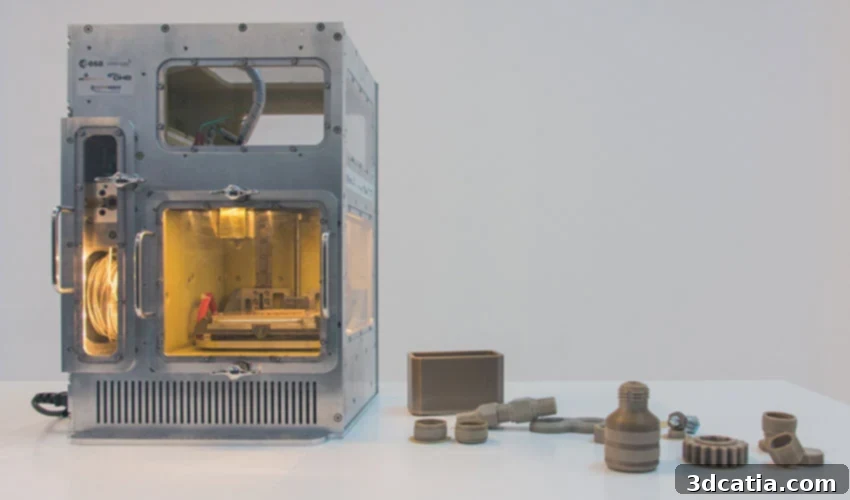
Pioneering In-Space Manufacturing: ESA’s MELT Project Tests Advanced Zero-Gravity 3D Printer for Astronauts
The European Space Agency (ESA) is at the forefront of a technological revolution, actively testing a groundbreaking 3D printer specifically engineered for the unique challenges of operating in zero gravity. Developed through a collaborative effort involving various international partners, this innovative device is designed to process technical polymers renowned for their exceptional mechanical and thermal properties. While still in its prototype phase, this printer holds immense promise, potentially empowering astronauts to fabricate a wide array of essential parts and tools directly in space, ushering in a new era of self-sufficiency for extraterrestrial missions.
The concept of 3D printing in space has long captivated the imagination of both the European Space Agency and the International Space Station (ISS). The ISS has already made significant strides in this area, notably through its partnership with Made In Space, which resulted in the deployment of the first operational 3D printer capable of functioning effectively in a microgravity environment. Building upon these foundational efforts, the ESA launched a public tender to further advance in-space manufacturing capabilities. This tender was successfully secured by a distinguished consortium comprising the Portuguese manufacturer BEEVERYCREATIVE, Germany’s SONACA Space and OHB-System, alongside Active Space Technologies. Together, they embarked on the ambitious MELT project.
The core objective of the MELT project is to meticulously develop and rigorously test a state-of-the-art 3D printer that can reliably operate onboard the ISS. This initiative represents a critical step towards establishing robust in-space manufacturing infrastructure. The ability to print complex parts and tools on-demand could dramatically reduce mission costs, enhance operational flexibility, and significantly improve crew safety and efficiency. Such advancements are not just theoretical; they are rapidly becoming tangible realities, positioning the MELT project to undoubtedly feature prominently in future discussions and rankings of 3D printing applications in space. It underscores a global commitment to pushing the boundaries of what is possible beyond Earth’s atmosphere, transforming the logistical paradigms of space exploration.
An earlier generation 3D printer, developed by Made In Space, capable of printing in zero gravity.
Empowering Astronauts: On-Demand Manufacturing in Space
After two years of intensive research and development, the combined expertise of the four project stakeholders culminated in the successful delivery of their prototype 3D printer to the ESA for a comprehensive testing phase. This printer is designed to be compatible with a range of industrial-grade polymers, poised to become an indispensable manufacturing tool for astronauts. While specific details regarding the underlying technology remain somewhat proprietary, it is understood that the system bears a strong resemblance to Fused Deposition Modeling (FDM). This popular additive manufacturing method involves extruding thermoplastic material layer by layer to build a three-dimensional object.
The profound implications of this technology for future space missions cannot be overstated. Currently, every single item required for an astronaut’s mission, from spare parts to specialized tools, must be meticulously packed and launched from Earth. This process is incredibly expensive, logistically complex, and highly restrictive in terms of what can be carried. A reliable 3D printer onboard the ISS or future lunar and Martian habitats would fundamentally alter this dynamic. Astronauts could, for instance, print a replacement component for a piece of equipment that malfunctions, design and fabricate custom tools for unexpected tasks, or even create medical devices in an emergency. This capability not only enhances mission flexibility and resilience but also dramatically reduces dependence on Earth-based supply chains, making longer-duration and more distant explorations far more feasible.
The Challenges and Triumphs of Space-Based Additive Manufacturing
Developing a 3D printer capable of operating in space presents a myriad of unique engineering challenges. On Earth, gravity plays a crucial role in material extrusion, ensuring molten plastic adheres and solidifies in a predictable manner. In a microgravity environment, however, this natural force is absent, necessitating innovative approaches to material handling, deposition, and cooling. Furthermore, the printer must withstand the harsh conditions of space, including radiation exposure, extreme temperature fluctuations, and the vacuum of space, all while maintaining precise operational stability. The MELT project addresses these hurdles head-on, focusing on robust design, material science, and rigorous testing in simulated space environments to ensure reliability and performance.
The selection of technical polymers with high mechanical and thermal properties is paramount. Unlike conventional plastics used in consumer 3D printers, space applications demand materials that can endure extreme stresses, temperatures, and radiation without degrading. Polymers such as PEEK (Polyether Ether Ketone) and ULTEM (Polyetherimide) are ideal candidates due to their exceptional strength-to-weight ratio, heat resistance, and chemical inertness. The ability to print with such advanced materials ensures that the parts fabricated in space are not merely prototypes but fully functional, durable components critical for mission success. This focus on high-performance materials distinguishes the MELT project from earlier space 3D printing initiatives, pushing the boundaries of what additive manufacturing can achieve beyond our planet.
BEEVERYCREATIVE’s Vision: From Orbit to Industry
The Portuguese manufacturer BEEVERYCREATIVE, a key partner in the MELT project, views this space-oriented endeavor as a powerful springboard for its terrestrial ambitions. The company is actively leveraging the insights and technologies developed for the zero-gravity printer to inform the design of a new generation of industrial 3D printers for rapid prototyping on Earth. These printers are being developed to handle much more technical materials than conventional plastics, including high-performance polymers like PEEK and ULTEM, which are in high demand across various advanced industries.
BEEVERYCREATIVE’s strategic focus targets sectors such as automotive, electronics, and footwear. These industries are characterized by their diverse material requirements and a constant need for flexibility in product design and rapid iteration cycles. The manufacturer’s core ambition is to drastically reduce production lead times for its future customers, moving away from protracted traditional manufacturing processes. Simultaneously, it aims to significantly increase the quality and performance of their finished products, ensuring they meet the stringent demands of modern industrial applications. This dual objective of speed and quality is a major undertaking for any 3D printing startup, and BEEVERYCREATIVE’s journey, fueled by its pioneering work in space, will undoubtedly be one to watch closely in the months and years to come.
The transfer of technology and expertise from space exploration back to Earth-based industries is a common and highly beneficial cycle. Innovations driven by the extreme demands of space often find valuable applications in solving complex problems on Earth. BEEVERYCREATIVE’s strategy exemplifies this perfectly, demonstrating how the pursuit of extraterrestrial manufacturing capabilities can catalyze advancements in terrestrial industrial processes, leading to more efficient, cost-effective, and high-quality production across diverse sectors. For those interested in learning more about their work, further information is available on their official website.
The MELT project and its associated terrestrial spin-offs underscore the critical role that international collaboration and cutting-edge technology play in shaping the future. By enabling astronauts to become makers rather than just consumers of supplies, this initiative promises to unlock unprecedented levels of autonomy and adaptability for space missions. The ability to print tools, spare parts, and even habitats from raw materials will be indispensable for establishing sustainable presences on the Moon, Mars, and beyond, paving the way for humanity’s long-term expansion into the solar system. This era of on-demand manufacturing in space is not just about convenience; it’s about enabling discovery, reducing risk, and making the impossible within reach.
Join the Conversation on Space 3D Printing
What are your thoughts on this exciting new 3D printer and its potential to revolutionize space exploration and industrial manufacturing? We invite you to share your perspectives and insights in the comment section below. You can also engage with us and join the ongoing discussions on our Facebook and Twitter pages. Don’t miss out on the latest advancements and breaking news in the additive manufacturing world; make sure to sign up for our free weekly Newsletter, delivered straight to your inbox with all the crucial updates in 3D printing!