
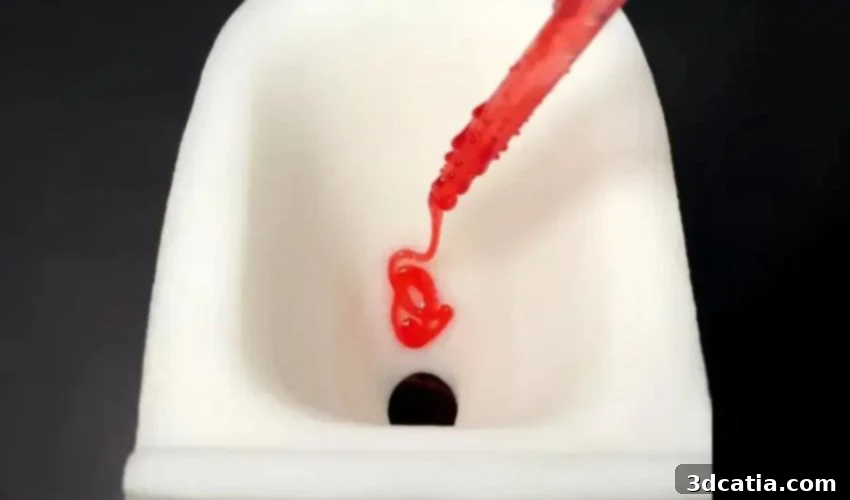
Sustainable Plumbing: How 3D Printing Creates an Ultra-Slippery, Water-Saving Toilet
As global environmental concerns intensify, underscored by July 2023 marking the hottest month on Earth since records began, the urgency for innovative climate solutions has never been greater. Among these critical challenges, water conservation stands out as paramount. Freshwater resources are increasingly strained, and the looming threat of water shortages compels us to re-evaluate our daily practices, even in areas we might not typically consider significant contributors to water waste. One such area is our household plumbing, specifically the seemingly innocuous act of flushing a toilet. Estimates suggest that the advent of the flushing toilet has dramatically escalated human water consumption for sanitation purposes, potentially by up to 20-fold. This staggering figure highlights the profound environmental impact of conventional toilet systems and underscores the need for effective, yet often elusive, ecological solutions. Traditional approaches to reduce flushing often falter due to issues of efficacy and user acceptance, leading to a cycle of inefficiency and continued water wastage. However, a groundbreaking development from researchers at Huazhong University of Science and Technology offers a beacon of hope: a revolutionary 3D printed toilet designed with an extraordinarily slippery surface, preventing anything from adhering to it. This innovation represents a potentially monumental leap forward in our collective efforts towards water conservation and sustainable living.
The innovative concept behind this 3D printed toilet, as initially highlighted by New Scientist, goes beyond mere slipperiness. Its design incorporates robust resistance against abrasion, a crucial feature that addresses the inherent limitations of previous attempts at creating water-saving toilets. The idea of a slippery toilet surface to minimize waste adhesion and thereby reduce the need for multiple flushes is not entirely new. Various projects have explored slippery coatings, such as Teflon-coated toilet bowls, with the aim of decreasing water consumption. While these early concepts showed promise, they were plagued by a significant drawback: the coatings tended to wear off over time. This degradation necessitated either frequent reapplication of the coating or, more commonly, the complete replacement of the toilet bowl, rendering them impractical and ultimately unsustainable. The new toilet from Huazhong University, however, is engineered to overcome this fundamental challenge, promising enduring slipperiness and long-term durability, thereby positioning it as a truly transformative solution.
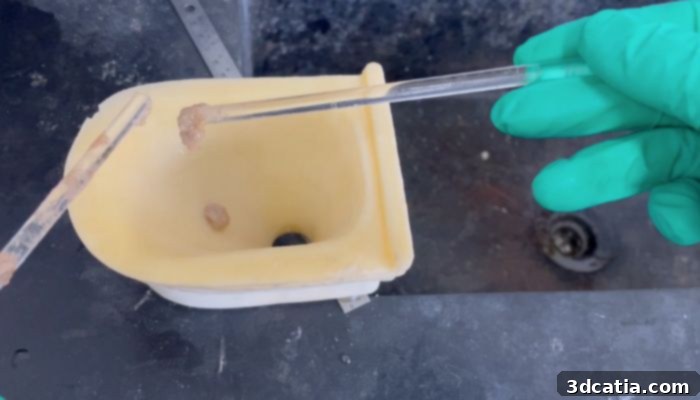
Researchers test the slippery surface of the 3D printed toilet (photo credits: Yike Li et al.)
The Science Behind the Slippery Surface: How the ARSFT is Made
The creation of this pioneering 3D printed toilet involved sophisticated additive manufacturing techniques, spearheaded by lead researcher Yike Li and his team. They leveraged selective laser sintering (SLS), a powerful 3D printing technology renowned for its ability to produce complex geometries with high precision. The innovative device has been fittingly named the Abrasion-Resistant Super-Slippery Flush Toilet (ARSFT). Initially, the team focused on developing scaled-down models, approximately one-tenth the size of a standard toilet, to thoroughly test and refine their design. The choice of material was critical to achieving both slipperiness and durability. Researchers meticulously developed a unique composite mixture consisting of plastic polymers combined with hydrophobic sand grains. These materials were then precisely fused together layer by layer using a high-powered laser, a hallmark of the SLS process, to construct an intricate, self-supporting 3D structure. What truly sets this design apart is its inherent porosity. The complex internal architecture of the ARSFT is engineered to accommodate and retain lubricants, such as silicon oil, within its structure. This novel approach ensures that the super-slippery surface is not merely a coating that can degrade or wear off but an intrinsic and perpetually renewed property, offering an unprecedented level of abrasion resistance and lasting performance.
Rigorous Testing and Unparalleled Durability
To rigorously validate the efficacy of the 3D printed toilet, extensive testing was conducted using a diverse range of challenging liquids and viscous substances. The researchers aimed to simulate the real-world conditions and demonstrate the ARSFT’s exceptional resistance to adhesion. The test substances included everyday liquids like milk and yogurt, highly viscous substances such as honey, and even complex starch-based mixtures like congee. In every scenario, the 3D printed toilet maintained its super-slippery characteristics, preventing any significant adherence. Most notably, the research team reported that the surface exhibited an exceptionally high resistance to sticky synthetic feces, a crucial benchmark for any toilet designed to minimize flushing. This particular finding is immensely promising, as one of the primary objectives of the ARSFT is to drastically reduce water consumption by eliminating the need for multiple flushes to clear residual substances from the toilet bowl. The successful performance against synthetic feces directly validates its potential to achieve significant water savings in practical applications.
Beyond its impressive slipperiness, the ARSFT’s abrasion resistance is equally remarkable. Conventional slippery coatings are notorious for their susceptibility to wear and tear from cleaning, friction, and daily use. However, the 3D printed toilet proved to be incredibly robust. Researchers subjected the surface to an intensive abrasion test involving 1000 cycles of aggressive rubbing with sandpaper. Astonishingly, even after enduring such extreme mechanical stress, the 3D printed toilet retained its full super-slippery capabilities. This unprecedented level of durability is a game-changer, addressing the critical flaw that plagued earlier slippery toilet designs. The ability of the ARSFT to maintain its performance over extended periods, even under harsh conditions, positions it as a practical and long-lasting solution for water conservation in plumbing systems.
The Broader Impact: Environmental and Economic Benefits of Sustainable Plumbing
The implications of a widely adopted super-slippery, 3D printed toilet extend far beyond individual household water savings. On a larger scale, such an innovation could profoundly impact municipal water infrastructure and environmental sustainability. Reduced flushing volumes translate directly into less wastewater needing to be collected, transported, and treated by municipal facilities. This, in turn, leads to significant energy savings, as less water needs to be pumped through extensive sewer networks and processed in energy-intensive treatment plants. The entire lifecycle of water usage, from extraction and purification to distribution, consumption, and wastewater management, is resource-intensive. By dramatically cutting down on water used for flushing, the ARSFT could contribute to a substantial reduction in the overall environmental footprint of urban living. Furthermore, as lead researcher Yike Li points out, “The reduced flushing volume would result in less wasted water during transportation to the processing facilities, thereby saving transportation costs.” This highlights an often-overlooked economic benefit: lower operational costs for water utilities, which could ultimately lead to cost savings for consumers and more efficient public services.
Moreover, the concept introduces a paradigm shift in our perception of plumbing efficiency. Instead of relying on brute force (high water volume) to clean, this technology leverages advanced material science and design principles. This aligns with broader trends in sustainable engineering, where smart, efficient designs replace wasteful, resource-heavy approaches. The long-term durability of the ARSFT also means less frequent replacement of units, reducing manufacturing waste and resource consumption associated with production and disposal. It signifies a move towards truly sustainable plumbing solutions that benefit both the environment and the economy.
Challenges and Future Prospects for 3D Printed Toilets
While the initial results for the Abrasion-Resistant Super-Slippery Flush Toilet are immensely promising, the technology is still in its nascent stages. Currently, testing has primarily been conducted with small-scale models, which, while effective for proving the concept, are not representative of full-sized consumer products. Furthermore, Selective Laser Sintering (SLS), the 3D printing method employed, is known for its incredible precision and material versatility but typically comes with limitations regarding build volume and production speed, especially for large objects. Scaling up production from small prototypes to full-sized toilets presents significant engineering and manufacturing challenges. The cost-effectiveness of producing large components using SLS at a consumer price point also needs to be carefully evaluated and optimized. Li acknowledges these hurdles, stating, “But first the process needs to be adapted for full-size toilets and made cheaper.” This indicates that significant research and development efforts are still required to transition this innovative laboratory concept into a mass-market product. Future work will undoubtedly focus on optimizing the SLS process for larger builds, exploring alternative and more cost-efficient additive manufacturing techniques that can produce the porous, lubricant-infused structure, and streamlining the supply chain for materials. The potential for widespread adoption hinges on achieving a balance between revolutionary performance and economic viability. Despite these challenges, the foundational research lays a robust groundwork for a future where our toilets are not just functional but also profoundly sustainable and efficient.
This remarkable research, detailing the fabrication and performance of the ARSFT, is a testament to the ingenuity of modern materials science and additive manufacturing. For those interested in delving deeper into the technical specifications and comprehensive testing methodology, the full research paper is available HERE.
The development of this 3D printed, ultra-slippery toilet represents a significant milestone in sustainable plumbing and demonstrates the transformative power of additive manufacturing in addressing critical environmental challenges. It pushes the boundaries of what’s possible in daily utilities, offering a glimpse into a future where efficiency and ecological responsibility go hand-in-hand. This innovation is not just about saving water; it’s about rethinking design, materials, and processes to create a more sustainable world for everyone. It serves as a compelling example of how advanced technologies can be harnessed to deliver practical, eco-friendly solutions to global problems.
What are your thoughts on this revolutionary 3D printed, ultra-slippery toilet and its potential to reshape water conservation efforts? Share your insights and opinions in a comment below, or connect with us on our LinkedIn, Facebook, and Twitter pages! Don’t forget to sign up for our free weekly Newsletter here to receive the latest 3D printing news directly in your inbox. You can also explore all our fascinating videos on our dedicated YouTube channel for more additive manufacturing insights.
*Cover Photo Credits: Yike Li et al.