
Revolutionizing Thermal Insulation: EMPA Pioneers 3D Printing of Stable Silica Aerogel Microstructures
The world of 3D printing materials is constantly evolving, pushing the boundaries of what’s possible in additive manufacturing. Among the most exciting recent developments is the successful 3D printing of silica aerogel, widely recognized as the most insulating material known to humanity. This groundbreaking achievement by a team of researchers at EMPA in Switzerland promises to unlock unprecedented applications for this remarkable substance, particularly in areas requiring extreme thermal efficiency and lightweight design.
Silica aerogel has long been a material of immense scientific interest due to its extraordinary properties. Often dubbed “frozen smoke” or “solid air,” it is an incredibly light, porous foam that boasts exceptional thermal insulation capabilities—considered the best available on the market today. Its structure is composed of a very light amorphous silica network, with an astounding 95% or more of its volume made up of air trapped within its nanopores. This unique composition gives it an unparalleled lightness and an incredibly low thermal conductivity, making it an ideal candidate for applications where heat transfer needs to be minimized.
However, despite these attractive characteristics, silica aerogel presents significant challenges for fabrication, especially in intricate designs. It is notoriously brittle, a property that has historically limited its use in small-scale applications. Traditionally, silica aerogel has been reinforced with fibers and employed in larger-scale insulation projects, where its fragility is less of an impediment. Manufacturing small, complex parts from aerogel has been difficult, as any attempt to cut, mill, or even conventional 3D print small structures often results in breakage. The risk of failure for miniature components was simply too high, confining its use to bulk applications or those where mechanical stress was minimal.
This long-standing limitation has now been elegantly overcome. A dedicated team at EMPA, the Swiss Federal Laboratories for Materials Science and Technology, led by Shanyu Zhao, Gilberto Siqueira, Wim Malfait, and Matthias Koebel, has achieved a remarkable feat. They have successfully developed a method to produce stable microstructures from silica aerogel using a 3D printer. This breakthrough signifies a paradigm shift, transforming silica aerogel from a difficult-to-handle bulk material into a versatile substance capable of forming delicate, precise, and stable geometries at a micro-scale.
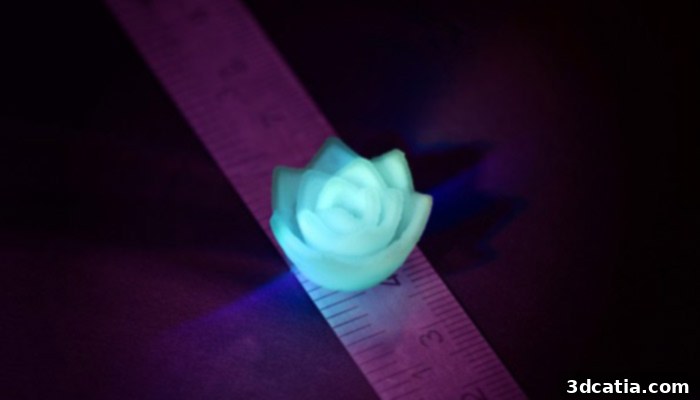
Fine miniature pieces 3D printed with aerogel. (Image credits: EMPA)
The Innovative 3D Printing Process Behind Stable Aerogel Structures
While the EMPA team has maintained a degree of discretion regarding the proprietary details of their innovative printing process, they have shared key insights into their methodology. They revealed that the technique involves using a specialized silica ink, from which the final aerogel structure is meticulously created. This description suggests a sophisticated approach reminiscent of extrusion-based additive manufacturing processes, such as those employed in advanced bio-printing. In such methods, a viscous “ink”—be it bio-ink containing living cells or, in this case, silica ink—is precisely deposited layer by layer through a nozzle, gradually building up the desired three-dimensional object.
The critical difference here lies in the material and its subsequent transformation. Instead of cells, the EMPA process utilizes a silica-based ink designed to solidify into an aerogel. This innovative method, which is currently patent pending, allows for unprecedented control over several crucial parameters. The researchers can precisely adjust the flow characteristics of the ink during extrusion, ensuring smooth deposition and intricate detail. Furthermore, the solidification properties of the ink can be finely tuned, enabling the creation of self-supporting structures without the need for additional support materials, as well as exceptionally thin membranes that were previously impossible to achieve with aerogel. This level of control is fundamental to overcoming the material’s inherent brittleness and enabling the fabrication of complex, delicate geometries.
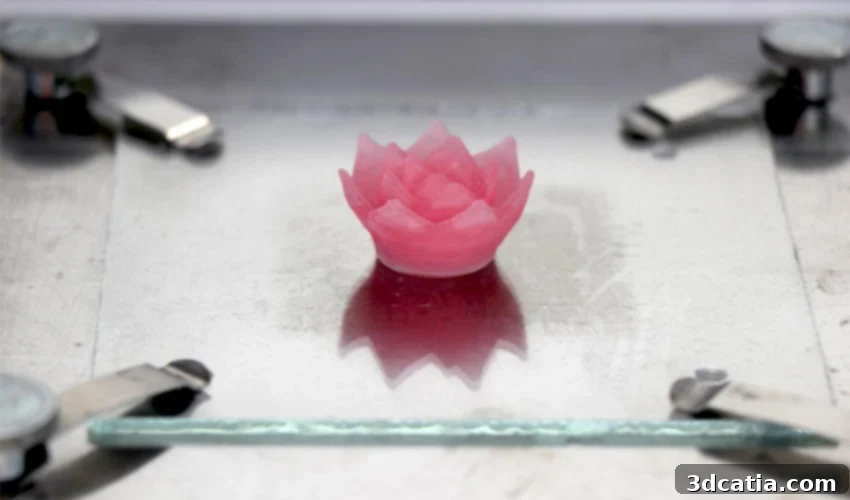
To rigorously test and validate their pioneering printing method, the Swiss researchers embarked on a compelling demonstration: they additively manufactured a miniature lotus flower. This particular choice was not arbitrary; the lotus flower is renowned for its natural hydrophobic properties (it repels water) and its low density, allowing it to float effortlessly on the surface of water. The successful 3D printing of such an intricate and delicate structure, which then demonstrated these intrinsic properties, served as powerful evidence of the technology’s capability to produce functional, stable, and highly detailed aerogel objects. This achievement highlights the potential for creating lightweight, water-repellent, and highly insulating components for a diverse range of future applications.
Revolutionary Potential: Applications of 3D Printed Silica Aerogel
The implications of EMPA’s breakthrough extend far beyond mere miniaturization. The team emphatically states, “3D printed silica aerogel has better mechanical properties and can even be drilled and milled. This opens up completely new possibilities for the post-processing of 3D-printed aerogel casts.” This newfound robustness, allowing for traditional machining operations on 3D printed aerogel, dramatically expands its utility. Previously, handling aerogel parts after fabrication was a delicate task, often leading to damage. Now, the ability to refine and integrate these components with greater ease paves the way for their incorporation into sophisticated systems across numerous industries.
For the researchers, this discovery holds the potential for a significant and transformative impact across a multitude of applications, particularly in the realm of thermal insulation and high-performance engineering. One of the most immediate and impactful areas is in microelectronics. Imagine the ability to thermally insulate even the smallest electronic components from each other within a compact device. This precision insulation could prevent heat buildup, improve component longevity, and enhance the overall performance and reliability of microchips, sensors, and miniature circuits. The 3D printed silica aerogel would be of immense interest to the high-tech industry, providing crucial thermal management solutions in cutting-edge fields such as microelectronics, advanced robotics, sophisticated biotechnology instruments, and highly sensitive sensor technology.
Beyond electronics, the material presents vital solutions for medical technology. Researchers specifically explain that 3D printed aerogel can be used to effectively shield heat sources located inside medical implants. For instance, an active implant that generates even a small amount of heat must ensure that its surface temperature does not exceed 37 degrees Celsius (98.6 degrees Fahrenheit) to protect surrounding body tissue from thermal damage. The exceptional insulating properties of 3D printed silica aerogel can provide this critical thermal barrier, ensuring patient safety and expanding the capabilities of next-generation medical devices, from pacemakers to advanced diagnostic tools and drug delivery systems.
Expanding Horizons: Beyond Current Applications
The potential applications for 3D printed silica aerogel stretch even further, reaching into sectors that demand lightweight, high-performance insulation. Consider the aerospace industry, where every gram saved translates into significant fuel efficiency and payload capacity. Components for satellites, spacecraft, and aircraft could benefit immensely from ultra-light, highly insulating aerogel parts, protecting sensitive instruments from extreme temperature fluctuations in space or reducing thermal loads on critical systems. Similarly, in the automotive sector, particularly with the rise of electric vehicles, thermal management of batteries and electronic systems is paramount. 3D printed aerogel could offer bespoke insulation solutions that are both lightweight and highly effective, contributing to increased range and safety.
The construction industry could also see benefits, especially for specialized insulation needs in high-performance buildings or historical renovations where traditional materials might be too bulky or heavy. The ability to print complex shapes allows for custom-fit insulation in challenging architectural spaces, improving energy efficiency and comfort. Furthermore, researchers are exploring its use in specialized filtration systems, catalysis, and even acoustic dampening, leveraging its porous structure and unique physical properties. The precise control offered by 3D printing means that these structures can be optimized for specific functions, opening up entirely new avenues for material engineering.
Future Collaborations and the Path Forward
The EMPA researchers are not resting on their laurels; they are actively seeking forward-thinking industrial partners. Their goal is to collaborate with companies eager to integrate these novel 3D printed aerogel structures into new, high-tech applications. Such partnerships are crucial for translating this scientific breakthrough from the laboratory into commercially viable products and solutions that can address real-world challenges. The synergy between EMPA’s material science expertise and industry’s manufacturing and market insights will undoubtedly accelerate the adoption and innovation of this technology.
The successful 3D printing of stable silica aerogel microstructures represents a significant leap forward in additive manufacturing and materials science. It redefines the possibilities for the most insulating material on Earth, transforming it from a fragile curiosity into a robust, customizable, and highly versatile component for the future. This innovation is poised to drive advancements in countless sectors, promising more efficient, lighter, and more capable devices and systems.
For those interested in delving deeper into EMPA’s cutting-edge research and the broader scope of their innovative projects, more detailed information can be found on the official EMPA website.
What are your thoughts on the revolutionary potential of 3D printed silica aerogel, particularly for intricate and demanding applications? We invite you to share your insights and predictions in a comment down below or join the conversation on our Facebook and Twitter pages! Don’t forget to sign up for our free weekly Newsletter, ensuring you stay up-to-date with all the latest news, breakthroughs, and trends in the dynamic world of 3D printing, delivered straight to your inbox every week!