
Siemens’ Vision: Revolutionizing Global Manufacturing with an On-Demand 3D Printing Platform
The landscape of global manufacturing is undergoing a profound transformation, with additive manufacturing, commonly known as 3D printing, emerging as a pivotal technology. This innovative process is rapidly becoming the preferred method for design, prototyping, and production across numerous industries worldwide. In this dynamic environment, a significant announcement came from the renowned Germany-based industrial powerhouse, Siemens, at Hannover Messe 2017. Siemens unveiled ambitious plans to develop an interactive, web-based platform specifically engineered to globalize on-demand product design and 3D printing production, aiming to redefine how products are conceived, manufactured, and delivered.
This initiative represents a strategic leap for Siemens, solidifying its position at the forefront of the industrial digital revolution. The proposed platform is designed to serve as a central hub, connecting diverse stakeholders within the additive manufacturing ecosystem. Tony Hemmelgarnd, President and CEO of Siemens PLM Software, eloquently articulated the company’s comprehensive approach, stating, “Siemens is one of the only companies addressing the diverse needs of all additive manufacturing market participants – from designers and engineers, to manufacturers, 3D printing machine OEMs, material vendors and software providers – with a comprehensive set of seamless technology solutions for distributed industrial additive manufacturing and co-innovation.” This statement underscores Siemens’ commitment to building a truly integrated and inclusive system that supports the entire lifecycle of additive manufacturing, from initial concept to final production.
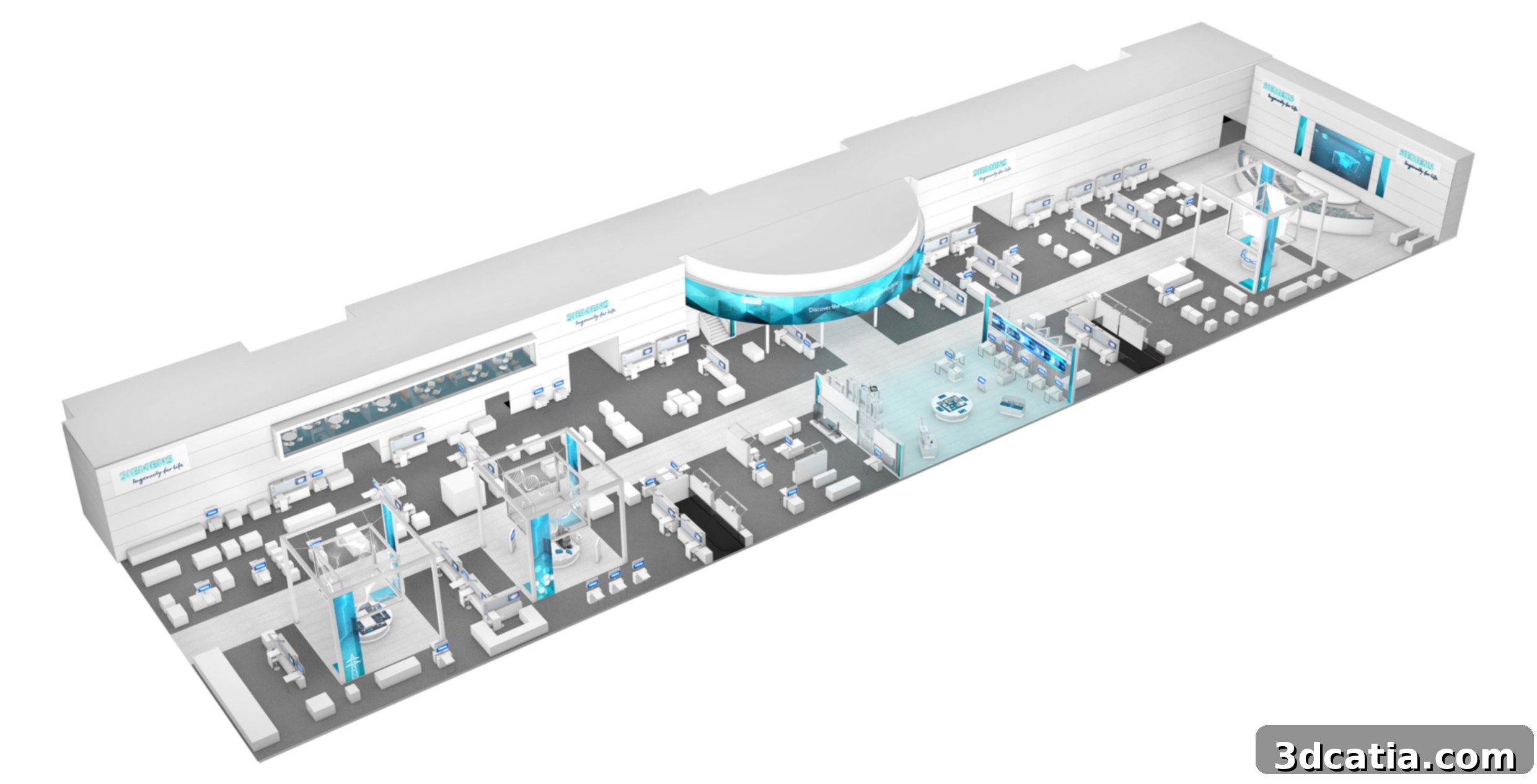
A map of the Siemens exhibit in Hall 9 at Hannover Messe 2017. This year, Siemens’ focus was on “Digital Enterprise”. // Siemens
The growing global demand for on-demand access to advanced additive manufacturing technology is undeniable. Siemens’ new platform aims to meet this critical need by fostering an “online ecosystem” that transcends geographical boundaries and traditional industrial silos. This ecosystem is envisioned as a collaborative space where members from different sectors—such as automotive, aerospace, medical, and consumer goods—can interact, co-innovate, and streamline their production processes. The ultimate goal is to create an environment that not only facilitates the rapid co-innovation of novel products but also significantly boosts productivity and propels additive manufacturing to unprecedented levels of industrial adoption and sophistication.
The platform is expected to democratize access to high-end manufacturing capabilities, enabling small and medium-sized enterprises (SMEs) to leverage sophisticated 3D printing technologies previously reserved for larger corporations. By connecting designers with manufacturers, and material suppliers with machine operators, Siemens seeks to create a seamless workflow that reduces barriers to entry and accelerates innovation cycles. This holistic approach aligns perfectly with the principles of Industry 4.0, emphasizing connectivity, data exchange, and automation to create smart factories and intelligent supply chains.
While specific details of this groundbreaking part-manufacturing platform were still under wraps at the time of the announcement, Siemens provided an eagerly anticipated launch date of mid-2018. The company also outlined several compelling benefits and innovative ways they believe this program will enhance additive manufacturing, bringing unparalleled ease and efficiency to the industry. These anticipated advantages include the ability to quickly identify and engage with qualified manufacturing services, a significant reduction in the time and effort required to obtain desired production quantities through sophisticated job scheduling and optimization tools, and vast opportunities for businesses to expand their market reach and service offerings globally.
The platform’s potential impact extends beyond mere logistical improvements. For designers and engineers, it promises enhanced collaboration tools, allowing them to iterate designs more rapidly and gain immediate access to manufacturing feedback. This shortens development cycles and fosters a more agile design process. For manufacturers, it opens up new revenue streams by connecting them with a broader base of clients seeking on-demand production. It also allows them to optimize their machine utilization, minimizing downtime and maximizing output. Material vendors will benefit from clearer insights into market demand, enabling more efficient inventory management and targeted product development. The entire ecosystem is poised for a leap in efficiency, sustainability, and adaptability.
Siemens’ commitment to “Digital Enterprise,” a central theme at Hannover Messe 2017, is deeply embedded in this platform’s vision. It represents a holistic approach to integrating software, automation, and electrical technology across the entire value chain. By leveraging its extensive expertise in product lifecycle management (PLM) software, manufacturing operations management (MOM), and industrial automation, Siemens is uniquely positioned to build a platform that is not only technologically robust but also deeply integrated into existing industrial processes. Solutions like Siemens NX for design and engineering, Solid Edge for CAD, and MindSphere for industrial IoT connectivity will likely form the backbone of this digital ecosystem, ensuring seamless data flow and process control.
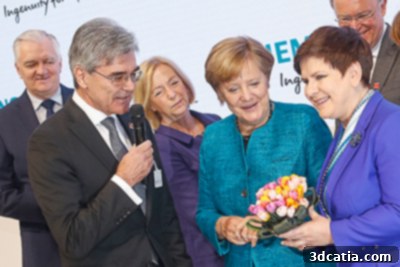
Siemens CEO Joe Kaeser giving a 3D printed bouquet of flowers to Polish Prime Minister Beata Szydło during her visit at the Siemens booth with Chancellor Angela Merkel and Johanna Wanka. // Siemens
The implications of such a platform for supply chains are particularly transformative. Traditional supply chains are often linear and geographically constrained. An on-demand 3D printing platform introduces a decentralized, distributed manufacturing model. This means parts can be produced closer to the point of need, reducing shipping costs, lead times, and environmental impact. It also enhances supply chain resilience, allowing for quicker responses to disruptions and localized production during crises. Mass customization, once a niche market, becomes a scalable reality, enabling businesses to offer highly personalized products efficiently and cost-effectively.
Moreover, the platform’s focus on “co-innovation” highlights a shift towards collaborative development. Instead of companies operating in isolation, the platform will facilitate shared knowledge, resources, and expertise. This open innovation model can accelerate the development of new materials, printing techniques, and application areas for additive manufacturing, pushing the boundaries of what is currently possible. It creates a network effect, where the value of the platform grows exponentially with each new participant and collaboration.
While the platform offers immense promise, considerations such as data security, intellectual property protection, and quality assurance will be paramount. Siemens, with its long-standing reputation for industrial reliability and robust security protocols, is expected to address these challenges head-on, building a trusted environment for sensitive design data and production processes. The successful implementation of such a platform would not only cement Siemens’ leadership in industrial digitization but also fundamentally reshape the global manufacturing paradigm, making 3D printing a truly accessible and integral part of mainstream production.
For those interested in delving deeper into this revolutionary online platform and its potential to reshape the future of industrial production, additional information can be found in Siemens’ official press release here.
What are your thoughts on this innovative online platform? Do you envision this as the definitive future for 3D printing technologies and global manufacturing? We encourage you to share your insights and predictions in a comment below, or join the conversation on our Facebook and Twitter pages!