
3D Printed Metamaterials: A Breakthrough in Magnetically Controlled Sound and Vibration
In a significant leap forward for material science and engineering, a dedicated team of researchers from the Viterbi School of Engineering at the University of Southern California (USC) in Los Angeles has unveiled a groundbreaking method to precisely control sound waves and mechanical vibrations. Their innovative approach leverages the power of 3D printing to create sophisticated metamaterials that can actively block these disturbances from a distance, all through the manipulation of a magnetic field. This development marks a pivotal moment in the quest for adaptive and intelligent materials capable of responding dynamically to their environment, opening up a myriad of possibilities across various industries.
The field of 3D printing materials is experiencing rapid acceleration, driven by diverse and ambitious goals. Researchers are constantly striving to engineer materials that are exceptionally lightweight yet robust, capable of forming intricate solid structures, or designed to significantly enhance the speed and efficiency of the additive manufacturing process itself. Among these fascinating avenues of research, metamaterials stand out as particularly promising. Unlike conventional materials, metamaterials are artificial composite structures, meticulously engineered to possess extraordinary electromagnetic properties that are simply not found in any naturally occurring substances. Traditionally, these materials have been constructed with fixed, unalterable geometries, meaning their unique properties were static and could not be changed once fabricated. However, this inherent limitation has now been ingeniously overcome by the American research team from USC, thanks to their innovative use of 3D printing combined with magnetic actuation.
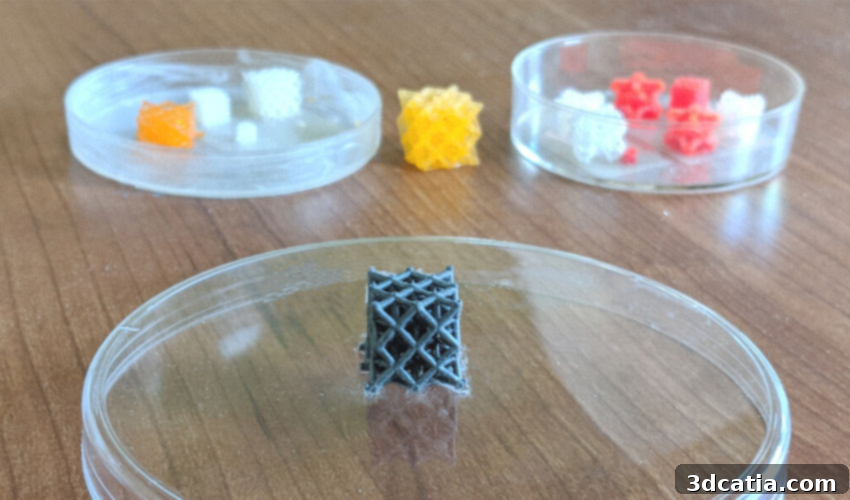
An example of a 3D printed metamaterial structure, engineered for specific acoustic or vibrational responses.
Magnetically Tunable Metamaterials: A Paradigm Shift
At the forefront of this groundbreaking research is Professor Qiming Wang, who leads the pioneering team at USC Viterbi. Professor Wang and his colleagues have developed metamaterials characterized by a unique reticular (net-like) structure, which inherently grants them the remarkable ability to block both sound waves and mechanical vibrations. What truly sets their invention apart, however, is the incorporation of iron particles within this intricate structure. This seemingly simple addition is the key to their dynamic control mechanism: by applying an external magnetic field, the material can be precisely deformed, fundamentally altering its physical architecture and, consequently, its acoustic and vibrational properties.
The mechanism behind this magnetic control is elegant yet powerful. When a magnetic field is applied, it exerts a force on the embedded iron particles, causing the entire metamaterial structure to compress and deform. Crucially, unlike conventional methods where a physical contact force (such as a metal plate or a piston) would restrict the material, the magnetic field allows for deformation without direct physical constraint. This ‘hands-off’ control ensures that the material retains its flexibility and responsiveness. When an acoustic or mechanical wave encounters this magnetically deformed material, the altered geometry and internal stress distribution within the metamaterial disrupt the wave’s propagation in a highly specific manner. This disturbance generates unique properties that effectively block sound waves and mechanical vibrations, but only within certain, tunable frequencies. This unprecedented level of dynamic control opens doors to a vast array of applications, including advanced noise suppression systems, highly efficient vibration control mechanisms, and even novel camouflage devices or more secure and efficient communication systems.
The Science of Tunability: Reversible and Rapid Control
Professor Qiming Wang, Assistant Professor of Civil and Environmental Engineering at USC Viterbi, eloquently articulated the core philosophy behind their innovation: “When you fabricate a structure, the geometry cannot be changed, which means the property is fixed. The idea here is, we can design something very flexible so that you can change it using external controls. You can apply an external magnetic force to deform the structure and change the architecture and the geometry inside it. Once you change the architecture, you change the property. We wanted to achieve this kind of freedom to switch between states. Using magnetic fields, the switch is reversible and very rapid.” This statement underscores the fundamental departure from traditional metamaterial design. Instead of static properties, their invention introduces dynamic adaptability.
The ability to dynamically reconfigure the material’s internal architecture on demand is what grants these metamaterials their extraordinary capabilities. By altering the structure, the material’s interaction with incoming waves—be they acoustic or mechanical—is fundamentally changed. This allows for precise control over which frequencies are blocked and to what extent. The “reversible and very rapid” nature of this magnetic switching mechanism is crucial for real-world applications where instantaneous adaptation to changing environmental conditions might be required. Imagine an industrial machine that needs different vibration isolation properties depending on its operating speed, or a sound barrier that adapts to varying noise pollution levels throughout the day. This level of responsiveness was previously unattainable with fixed-geometry metamaterials, making Professor Wang’s team’s work a true game-changer in the field of acoustic and mechanical engineering.
A detailed view of the 3D printed metamaterial, showcasing the complex geometries achievable through additive manufacturing (photo credit: Qiming Wang).
Broadening the Horizon: Applications of Tunable Metamaterials
The potential applications for these magnetically tunable 3D printed metamaterials are vast and transformative, spanning numerous sectors from industrial design to consumer products and defense. One of the most immediate and impactful uses lies in **noise suppression**. Think of bustling urban environments, loud industrial machinery, or noisy aircraft cabins. Current noise reduction solutions are often static, bulky, and effective only within a narrow frequency range. These new metamaterials could lead to adaptive noise barriers that dynamically adjust to block specific frequencies of sound in real-time, providing quieter spaces without the need for massive, rigid structures. This could revolutionize interior acoustics for buildings, automotive noise reduction, and even personal noise-cancelling devices that adapt to surrounding sounds.
Similarly, **vibration control** stands to benefit immensely. Vibrations can cause fatigue in materials, lead to mechanical failures, and impair the performance of sensitive equipment. From precision scientific instruments to aerospace components and even bridges, the ability to actively dampen or redirect vibrations at specific frequencies offers unprecedented control. Imagine a car engine mount that stiffens or softens based on engine speed to minimize cabin vibrations, or earthquake-resistant structures that can adaptively absorb seismic energy. The precision offered by these materials allows engineers to design systems that are not just reactive but proactively adaptive to vibrational threats.
Beyond these primary applications, Professor Wang’s team also highlighted the potential for **camouflage devices** and **more efficient communication systems**. In the realm of camouflage, these materials could potentially alter their interaction with sound waves to make objects acoustically invisible or to mimic other sound signatures, crucial for stealth technologies. For communication, the ability to dynamically control wave propagation could lead to advanced antennas that can steer signals more efficiently, or even manipulate acoustic signals in underwater communication or medical imaging (e.g., ultrasound) for greater clarity and precision.
The Indispensable Role of 3D Printing in Metamaterial Innovation
While the specific additive manufacturing process employed by Professor Wang’s team remains largely proprietary or undetailed in public releases, it is clear that 3D printing is an absolutely critical enabler for this breakthrough. The inherent complexity and precision required to create the intricate reticular structures and embed iron particles at specific locations within the material would be virtually impossible with traditional manufacturing techniques. 3D printing offers unparalleled design freedom, allowing researchers to rapidly iterate and prototype complex geometries with microscopic accuracy. This ability to tailor the internal architecture of the material down to the micron level is what allows for such precise control over its acoustic and vibrational properties.
Professor Wang emphasized the importance of scale in relation to frequency control, noting that they are currently able to print their materials with a diameter ranging from one micron to one millimeter. This range is significant: a smaller diameter structure is typically required to control higher frequency waves, as the wavelength of high-frequency sounds is shorter. Conversely, a larger diameter would be necessary to effectively interact with and block low-frequency waves, which have longer wavelengths. This direct correlation between printed feature size and the target frequency highlights the precision of 3D printing. It empowers engineers to design metamaterials that are tuned to specific acoustic environments or applications, whether it’s dampening high-pitched machinery noise or isolating low-rumbling vibrations. The ongoing advancements in 3D printing technology, particularly in micro- and nano-scale printing, promise to further expand the capabilities and applications of these dynamic metamaterials.
Further detailed insights into this pioneering research can be found on the University’s official website, where Professor Wang and his team regularly share updates on their progress and discoveries.
The Future of Adaptive Materials: Challenges and Opportunities
The development of magnetically tunable 3D printed metamaterials represents a significant milestone, yet, like all nascent technologies, it faces both challenges and immense opportunities. Scaling up production from laboratory prototypes to industrial quantities will require further advancements in additive manufacturing speed, material costs, and quality control. Ensuring the long-term durability and stability of these complex materials, especially under continuous magnetic field exposure and mechanical stress, will also be critical. However, the potential rewards far outweigh these challenges.
The concept of “smart” or “adaptive” materials, capable of altering their physical properties in response to external stimuli, has long been a holy grail for scientists and engineers. This research from USC Viterbi brings us considerably closer to realizing that vision, specifically for acoustic and vibrational control. Imagine buildings that automatically adjust their sound insulation based on external noise, aircraft that dynamically reduce drag through shape-shifting surfaces, or even medical implants that adapt to biological environments. The principles demonstrated by Professor Wang’s team could inspire similar innovations across various physical phenomena, from thermal management to light manipulation.
The interdisciplinary nature of this research, combining mechanical engineering, materials science, and physics with advanced manufacturing techniques, exemplifies the collaborative spirit driving modern scientific discovery. As 3D printing technologies continue to evolve, becoming even more precise and versatile, the possibilities for creating increasingly sophisticated and functional metamaterials will only expand. This breakthrough not only promises to solve immediate engineering problems but also lays the groundwork for an entirely new generation of materials that are intelligent, responsive, and truly adaptive to the demands of our dynamic world.
What are your thoughts on the revolutionary potential of these 3D printed, magnetically tunable metamaterials? Do you envision other transformative applications for this technology? We’d love to hear your insights! Feel free to share your comments below or engage with us on our Facebook and Twitter pages. And for all the latest updates in the exciting world of additive manufacturing and material science, don’t forget to sign up for our free weekly Newsletter, delivering cutting-edge news directly to your inbox!