

Restoring Sight: 3D Bioprinted Corneas from Fish Scales Revolutionize Eye Care
A groundbreaking advancement in medical technology has emerged from Massey University in New Zealand, offering a beacon of hope for millions suffering from corneal blindness worldwide. Researchers have successfully developed a novel 3D printer capable of creating transplantable human corneas, not from synthetic materials or human donors, but ingeniously from fish scales. This pioneering project, led by Johan Potgeiter, utilizes collagen – a fundamental protein integral to human skin and connective tissues – meticulously extracted from the scales of the Hoki fish. The Hoki fish (Macruronus novaezelandiae) was specifically chosen for this revolutionary application due to the exceptional biocompatibility of its collagen, making it readily accepted by the human body and significantly reducing the risk of rejection.
The cornea, the transparent, outermost layer of the eye, plays a critical role in focusing light onto the retina, covering vital structures such as the iris and pupil. Damage or disease affecting the cornea can lead to severe vision impairment or complete blindness. Globally, an estimated 10 million individuals are in urgent need of a corneal transplant, a staggering figure that underscores the severe shortage of suitable donor corneas. Current transplantation methods rely heavily on deceased human donors, a resource that is perpetually scarce and often accompanied by logistical challenges, high costs, and the risk of immune rejection.
Addressing the Global Crisis of Corneal Blindness
Corneal blindness is a leading cause of vision loss worldwide, stemming from various conditions including infections, injuries, genetic disorders, and degenerative diseases. The impact extends beyond mere visual impairment; it profoundly affects quality of life, economic productivity, and social participation for individuals and communities. Traditional corneal transplantation, while effective, is bottlenecked by the limited supply of human donor tissue. This shortage means that many patients endure long waiting lists, with some never receiving the life-changing surgery they desperately need. Furthermore, the procedures themselves are often expensive, requiring specialized surgical expertise and post-operative care, which are not universally accessible, particularly in developing nations.
The Massey University breakthrough directly confronts these challenges by proposing a scalable, cost-effective, and bio-compatible alternative. By leveraging an abundant and renewable natural resource – fish scales – the project bypasses many of the ethical and logistical hurdles associated with traditional donor tissue sourcing. This innovative approach promises to democratize access to corneal transplants, potentially transforming the lives of millions who currently have no viable solution for their vision loss.
The Science Behind Bioprinting Corneas from Fish Scales
The process developed by Potgeiter’s team involves extracting high-quality collagen from Hoki fish scales. Collagen is a fibrous protein that provides structural integrity to various tissues in the body, including the cornea. Its natural properties make it an ideal biomaterial for tissue engineering, as it promotes cellular adhesion, growth, and differentiation. Once extracted and purified, the collagen is formulated into a bio-ink, which the custom-built 3D printer then precisely deposits layer by layer to construct a full-thickness, functional cornea. The accuracy of 3D bioprinting allows for the replication of the intricate cellular architecture and unique curvature of a natural human cornea, crucial for its optical function.
The selection of the Hoki fish is not coincidental. This species is abundant in New Zealand waters, and its scales were previously considered a waste product from the fishing industry. This turns a biological byproduct into a valuable resource, aligning with principles of circular economy and sustainability. Moreover, research has demonstrated the high biocompatibility and low immunogenicity of Hoki collagen, meaning it is less likely to trigger an adverse immune response when transplanted into a human eye. This is a significant advantage over conventional donor corneas, where immune rejection remains a persistent concern requiring lifelong immunosuppressive medications.
A Vision for Affordable and Accessible Healthcare
Johan Potgeiter passionately articulated the team’s overarching ambition: “If we can have a way we can make this for a world market, as cheaply as possible, that’s the dream. It should be extremely cheap, it’s a renewable resource, and the machines should be very affordable.” This vision emphasizes accessibility and affordability, which are crucial for addressing a global health issue of this magnitude. The economic implications are profound. By utilizing a readily available and previously discarded resource, the cost of raw materials can be kept exceptionally low. Furthermore, if the bioprinters themselves are affordable and easy to operate, this technology could be deployed widely, including in regions with limited healthcare infrastructure.
The project has already garnered significant support, receiving a substantial million-dollar grant from New Zealand’s Ministry of Business, Innovation and Employment. This funding is dedicated to transforming the prototype into a system capable of mass production. To secure a consistent and sustainable supply of Hoki fish scales, the Massey University team has initiated collaborations with several New Zealand fisheries, forging partnerships that benefit both the research and the local economy. This strategic approach not only ensures a steady supply chain for the collagen but also champions sustainable practices within the fishing industry by valorizing what was once considered waste.
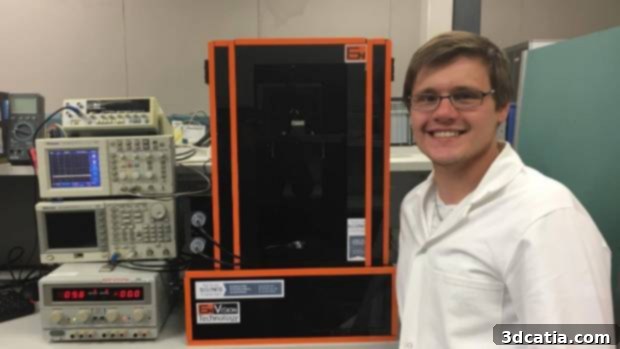
Massey engineer Juan Schutte with the cornea 3D-printer
Scaling Up: From Prototype to Global Solution
One of the most promising aspects of this innovation is its potential for rapid scalability. The 3D bioprinter developed for creating these corneas is built upon principles not dissimilar to existing 3D printing technologies already available in the market. This means that the technological leap from prototype to a mass-production system is not as daunting as it might seem. The team envisions a future where hundreds of corneas could be produced per day, a stark contrast to the current constraints of donor availability. The ambition is high, with hopes that this system could be ready for widespread application as early as next year. However, it’s important to note that rigorous clinical trials, regulatory approvals from health authorities like the FDA or European Medicines Agency, and further safety and efficacy studies will be critical steps before these bioprinted corneas can be routinely transplanted into human patients. These processes, though essential, can take several years, highlighting the complex journey from laboratory breakthrough to mainstream medical practice.
Despite the regulatory pathways, the rapid progress and the inherent advantages of this technology point towards a transformative future for ophthalmology. The ability to manufacture corneas on demand could eliminate waiting lists, reduce the risk of transplant rejection, and significantly lower the cost of treatment, making life-changing surgery accessible to a far greater number of people across the globe. This represents not just an incremental improvement, but a paradigm shift in how corneal blindness can be tackled.
New Zealand’s Strategic Investment in Innovation and 3D Printing
This latest medical breakthrough is yet another testament to New Zealand’s burgeoning reputation as a hub for innovation, particularly in the field of 3D printing and advanced manufacturing. The country is demonstrating a holistic commitment to fostering technological advancement, evidenced by both cutting-edge research and significant investments in education. Education Minister Nikki Kaye recently announced a substantial $40 million investment aimed at integrating 3D printing technology into schools nationwide. This initiative underscores a forward-thinking approach to preparing the next generation for an increasingly digital and technologically driven world.
During a school visit, Ms. Kaye emphasized the importance of this investment: “Teachers will lead the delivery of the new curriculum, but we want to do everything we can to support them to understand new technologies and translate this understanding to effective learning in the classroom. Digital fluency is now an essential life skill for our young people, so we must ensure they have the skills and knowledge they need to engage in an increasingly digital world.” This strategic educational push is designed to cultivate a workforce and an innovative culture that can support and expand on advancements like the bioprinted cornea project. By teaching students about 3D printing and other advanced digital technologies from an early age, New Zealand is nurturing a generation that is not only proficient in using these tools but also capable of pioneering new applications and solutions for complex global challenges.
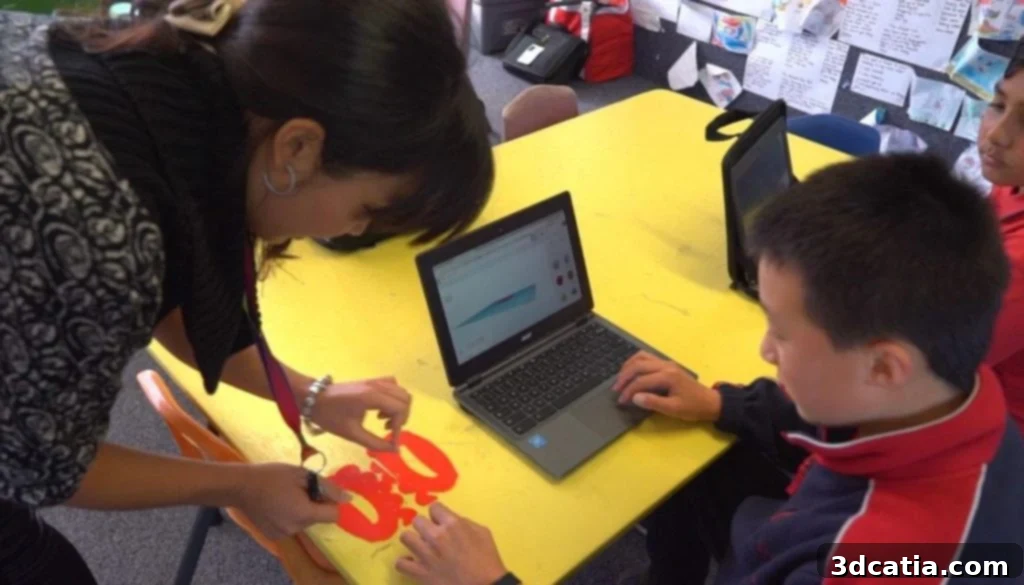
Students learning 3D printing. Source: Newshub
The ripple effect of teaching about this transformative technology in schools is immense. It fosters critical thinking, problem-solving skills, and an understanding of how digital tools can be applied to real-world problems. This early exposure will empower young people to become more educated on 3D printing’s capabilities, encouraging them to take full advantage of the benefits it brings, from medical innovation to sustainable manufacturing and beyond. This integrated approach, combining pioneering university research with national educational investment, positions New Zealand at the forefront of the global 3D printing revolution.
What are your thoughts on this incredible innovation from Massey University? The potential to cure up to 10 million people of blindness with a sustainable and affordable solution is truly astounding. Share your perspectives and join the conversation in the comments below or on our Facebook and Twitter pages! Don’t miss out on the latest advancements in additive manufacturing—sign up for our free weekly Newsletter here and get 3D printing news delivered straight to your inbox!