
Revolutionizing Automotive Manufacturing: The Transformative Impact of Additive Manufacturing and 3D Printing
The automotive industry, a realm traditionally defined by mass production and incremental innovation, is undergoing a profound transformation. Historically, Original Equipment Manufacturers (OEMs) primarily utilized additive manufacturing (AM), commonly known as 3D printing, for rapid prototyping. This allowed for quick design iterations and concept validation. However, recent advancements in AM technologies, materials, and processes have dramatically expanded its potential, fundamentally reshaping how end-use parts are conceived, engineered, manufactured, and even distributed. Deloitte’s seminal study, 3D Opportunity in the Automotive Industry, highlighted that the initial adoption of AM typically involved creating design iterations, enhancing quality through cost-effective prototyping, and producing specialized tooling. These applications represented a “current standard AM path” where companies sought improvements without radical alterations to existing supply chains or products. Yet, a more transformative path is emerging, one that promises to revolutionize product design and supply chain dynamics. Indeed, market analysis reports, such as one from SmarTech Analysis, project that automotive 3D printing will generate an astounding $9 billion in revenue from end-use parts alone by 2029, a substantial leap from $1.39 billion in 2019. This remarkable growth underscores a pivotal question: where exactly is additive manufacturing headed within this dynamic sector?
Accelerating Innovation: Pre-Production Benefits of 3D Printing
In any competitive industry, the ability to accelerate the product design phase during new product development is paramount. The automotive sector, with its rigorous demands for safety, performance, and efficiency, benefits immensely from technologies that streamline this process. 3D printing has emerged as a game-changer, offering a compelling alternative to expensive and time-consuming conventional methods like CNC machining for early-stage development. More precisely, additive manufacturing empowers designers to move through multiple design iterations cost-effectively and rapidly before committing to a final product. The iterative design process typically involves identifying a user need, generating various ideas to address that need, developing a physical prototype, and then testing and refining that prototype. This cycle, often referred to as rapid prototyping, is where 3D printing truly shines. It allows engineers to quickly validate concepts, test form, fit, and even basic functional aspects of a part, drastically cutting down on development cycles and reducing overall project risks.
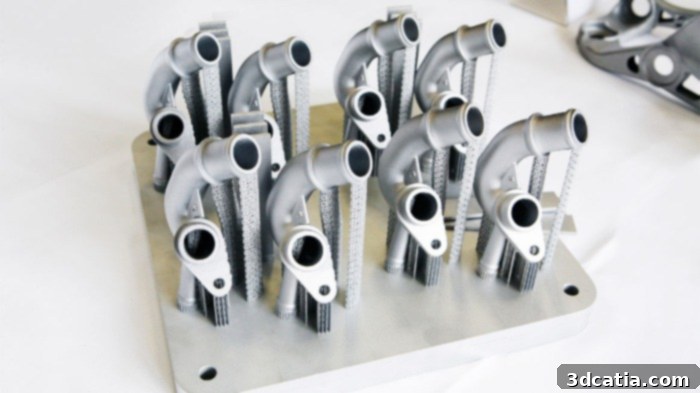
Sample metal 3D printed water connectors for the Audi W12 engine. These complex geometries are challenging with traditional methods. | Photo Credits: Volkswagen AG
Leading automotive giants have long recognized these advantages. Volkswagen, for instance, has been leveraging 3D printing technologies for over two decades. In 2020, the company reinforced its commitment by investing in two additional Stratasys 3D printers. Peter Bartels, head of Volkswagen’s pre-series centre, underscored the significance of these investments, stating that they represent “additional capabilities that strengthen 3D printing operations and allow to further optimize the design process.” This ongoing investment highlights the value of AM not just for initial prototyping, but for continuous optimization throughout the pre-production phase. Beyond prototypes, 3D printing also plays a crucial role in the production of specialized tooling, including grips, jigs, and fixtures. These essential components are vital for ensuring repeatable processes and high-quality assembly on the production line. Traditional tooling manufacturing can be expensive and time-consuming, but AM allows for custom, lightweight, and complex tooling to be produced quickly and affordably, directly on-site. These applications — rapid prototyping and tooling — represent what Deloitte termed the “current standard AM path” in the automotive industry, forming the foundation upon which more radical transformations are being built.
Beyond Prototypes: The Expanding Realm of End-Use Parts
While prototyping remains a core application, a significant shift is occurring as OEMs increasingly explore 3D printing for the production of actual end-use parts. This evolution is driven by a fundamental quest for product innovation and a need to gain a competitive edge in a fiercely competitive automotive market. One of the most impactful ways AM achieves this is by enabling the dramatic improvement of part performance, often through substantial weight reduction. This pursuit of lighter components has far-reaching implications, particularly in the context of increasing fuel efficiency for internal combustion engine vehicles and extending the range of electric vehicles.
A key advantage of AM is its ability to produce components with significantly lower weight. Lighter vehicles translate directly into reduced fuel consumption or greater battery range, both critical factors for consumers and environmental regulations. The role of advanced industrial design software is central to this paradigm shift. Over the years, CAD (Computer-Aided Design) and CAM (Computer-Aided Manufacturing) solutions have seen drastic improvements, especially in their integration with additive fabrication processes. These sophisticated software suites often include features like generative design, topology optimization, and lattice generation tools. Generative design algorithms can automatically create optimized geometries based on specified parameters (e.g., strength, weight, material), often resulting in organic, bionic-like structures that are impossible to produce with conventional manufacturing. Topology optimization removes unnecessary material from a design while maintaining or improving its structural integrity. Lattice structures, characterized by intricate internal networks, provide high strength-to-weight ratios. The result is often lighter, more efficient, and often visually more complex parts. Crucially, unlike conventional manufacturing methods, AM thrives on complexity, viewing it not as a challenge but as an opportunity for enhanced performance. Furthermore, AM also facilitates part simplification through consolidation, where multiple individual components can be redesigned and 3D printed as a single, integrated part. This reduces assembly complexity, minimizes the number of required fasteners, and potentially lowers long-term production costs for high-volume applications.
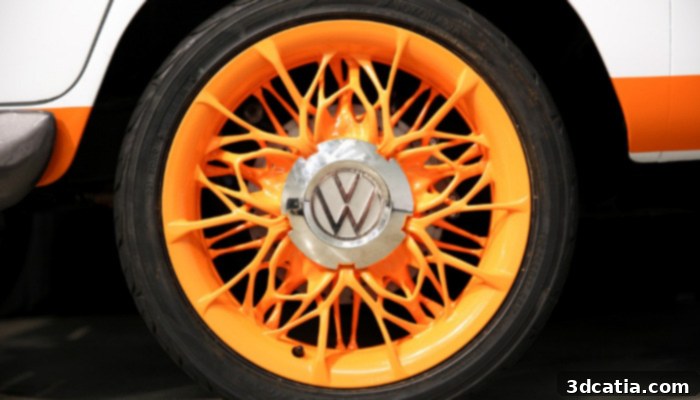
Autodesk’s generative design tools were instrumental in designing lighter, structurally optimized wheels for a classic Volkswagen 1962 Type 2 11-window Microbus concept, showcasing AM’s potential for both modern and heritage vehicles.
Beyond performance, AM unlocks unprecedented possibilities for personalization and customization. This is particularly appealing to luxury car manufacturers and customers seeking unique vehicles. Traditional manufacturing methods, such as CNC machining or injection molding, are inherently designed for mass production and struggle to deliver unique, one-off parts economically and within competitive lead times. The tooling costs alone for a custom injection-molded part would be prohibitive. Additive manufacturing, being tool-less, eliminates this barrier, allowing for bespoke designs tailored to individual customer requirements without significant cost penalties. Moreover, this personalization capability extends to the production of on-demand spare parts. For classic car enthusiasts or owners of older models, finding original replacement parts can be a significant challenge. 3D printing offers a viable solution, enabling the creation of rare or obsolete components precisely when and where they are needed, breathing new life into cherished vehicles and simplifying maintenance logistics.
A compelling example of an end-use application is Ford’s 3D printed aluminum inlet manifold. This complex engine component, responsible for supplying the fuel/air mixture to the cylinders, was installed in a 1977 Hoonitruck, demonstrating AM’s functional capabilities in high-performance environments. According to Ford, this particular part was the largest automotive 3D printed component produced at the time. It took five days to print using GE Additive’s Concept Laser X LINE 2000R, a large-format metal AM system. Ford has historically been a pioneer in industrial additive manufacturing, having invested in an SLA 3 (one of the earliest 3D printers) back in 1986. The company officially stated, “It didn’t take long to see that the invention could be used to create new prototype part designs faster and more efficiently than ever.” Today, Ford has printed over 500,000 parts, resulting in “billions of dollars saved and millions of hours of work.” Its Advanced Manufacturing Centre in Detroit is equipped with a diverse range of 3D printing technologies, including FDM (Fused Deposition Modeling), SLS (Selective Laser Sintering), and sand 3D printers, reflecting its broad application of AM across various stages of product development and production.
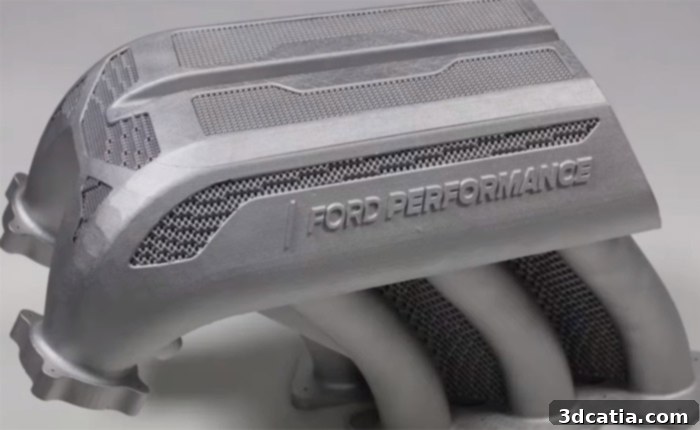
Ford’s impressive 3D printed aluminium inlet manifold, showcasing the potential of metal additive manufacturing for robust, functional automotive components. | Photo Credits: Ford
Another prominent example comes from the BMW Group, which further solidified its commitment to AM by opening its dedicated Additive Manufacturing Campus near Munich in 2020. This state-of-the-art facility, representing an investment of approximately €15 million, houses around 50 industrial systems capable of processing both metals and plastics. The campus serves as a hub for a wide array of activities: from the production of prototypes and small series parts for high-performance vehicles to advanced research and development, and comprehensive training for associates in tool-less manufacturing techniques. This substantial investment underscores BMW Group’s unwavering confidence in the long-term potential of 3D printing technologies. Much like other leading car manufacturers, BMW initially adopted additive manufacturing in 1991 for creating prototypes of concept cars. Over time, its applications expanded to include the production of small series parts for prestigious vehicles such as DTM race cars, the Rolls-Royce Phantom, the BMW i8 Roadster, and MINI models. In a single year, the company successfully 3D printed an impressive 300,000 components. Milan Nedeljković, a member of the BMW Board, emphasized the strategic importance of AM, stating: “Additive manufacturing is already an integral part of our worldwide production system today, and an established part of our digitalization strategy. In the future, new technologies of this kind will make production even faster and allow us to benefit even more fully from the potential of toolless manufacturing.” This vision points towards a future where AM is not just a niche technology, but a fully integrated element of the automotive production ecosystem.
Reshaping the Automotive Supply Chain with Additive Manufacturing
The profound shifts in product design and manufacturing capabilities brought about by additive manufacturing inevitably extend their impact to the global automotive supply chain. Deloitte’s study accurately highlights that as OEMs increasingly adopt the “product evolution route”—moving beyond simple prototyping to integrating AM for end-use parts—the eventual outcome will be transformative. This transformation is expected to manifest in two key ways: significantly smaller and more agile supply chains, and a greater value contribution from OEMs themselves. The automotive industry currently operates with vast, intricate supply chains involving thousands of suppliers for various components. OEMs are perennially seeking ways to streamline these complex networks, reduce dependencies, and mitigate risks. Additive manufacturing offers a powerful mechanism to achieve this by fundamentally altering where and how parts are produced.
One of the most significant effects of AM is its potential to shorten and simplify these enormous automotive supply chains. By enabling on-site production, companies can reduce their reliance on distant suppliers and complex logistics. This localized manufacturing capability translates into quicker response times, reduced shipping costs, and a smaller carbon footprint. Furthermore, AM allows for a drastic reduction in part inventory. Traditionally, maintaining large inventories of spare parts or components for various models is a significant cost and logistical burden. With 3D printing, parts can be produced on-demand, just-in-time, eliminating the need for extensive warehouses and reducing the risk of obsolescence. This “digital inventory” approach offers unprecedented flexibility and efficiency, allowing manufacturers to respond rapidly to market demands or unexpected disruptions. For example, General Motors successfully utilized generative design and additive manufacturing to consolidate eight separate components of a seat bracket into a single, optimized 3D printed part. This not only reduced the part count and assembly complexity but also improved the part’s performance and weight, directly demonstrating the efficiency gains AM brings to the supply chain through consolidation and localized production.
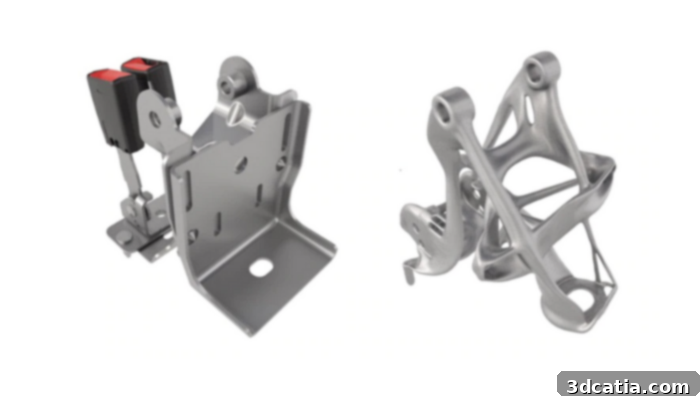
Using generative design and additive manufacturing, General Motors was able to consolidate the eight different components of a traditional seat bracket into a single, lighter, and stronger 3D printed part.
Advancements in Materials for Automotive Additive Manufacturing
The rapid evolution of additive manufacturing in the automotive sector is inextricably linked to continuous improvements in materials technology. Over the years, a growing array of high-performance materials has been qualified and optimized specifically for AM processes, expanding the range of applications from conceptual prototypes to demanding end-use components. Automotive parts require materials that can withstand harsh operating conditions, including extreme temperatures, vibrations, and corrosive environments, while also meeting stringent safety and performance standards. Typically, these parts are manufactured from robust materials such as high-performance polymers, carbon-fiber-reinforced thermoplastics, and advanced metal alloys. OEMs have been particularly keen on incorporating lightweight materials like carbon fiber composites and aluminum into vehicle bodies and components, driven by the imperative to reduce overall vehicle weight and improve efficiency.
Materials tailored for additive manufacturing offer several advantages. They allow for a greater number of specific properties – such as enhanced strength-to-weight ratios, improved thermal resistance, or unique aesthetic qualities – to be embedded directly into the final product’s design. These specialized materials are not only crucial for functional end-use parts but also play a vital role in the development of functional prototypes, enabling engineers to test material behavior under realistic conditions early in the design cycle. A compelling case study comes from BASF Forward AM, a leading material provider. They collaborated with Daimler to develop a new engine mount designed to reduce the transmission of vibrations, thereby maximizing passenger comfort. Engine mounts, traditionally produced via injection molding using fiber-reinforced polymers, presented a challenge due to the need for shorter development cycles and lower costs. BASF Forward AM addressed this by leveraging AM technologies, eliminating the costly requirement for new molds with every design modification. The primary challenge was to meet strict thermal and mechanical performance requirements under rigorous test conditions, necessitating a very rigid and thermally stable material. The ideal solution was Ultrasint PA6 MF, a mineral-filled polyamide 6 that significantly outperforms common materials like PA11 and PA12. This material enabled the production of test-ready prototypes in under 48 hours, a dramatic improvement compared to several weeks with injection molding. While the 3D printed part’s design was distinct from the original, it served as a fully functional prototype during the development stage when no injection molding part was available, validating the design and material choice. This highlights that finding the right material replacement, capable of reproducing or even exceeding the performance of traditionally manufactured parts, is absolutely critical for AM’s success in automotive applications.
The Future Landscape of Automotive AM Applications
In recent years, automakers have been compelled to explore innovative business models and technologies to sustain growth and maintain a competitive edge. Jabil’s Automotive Industry Trends report reveals that a striking 71% of automotive companies operate with a go-to-market timeline of under two years. This intense pressure for rapid development and cost efficiency is driving many towards new technologies, with additive manufacturing at the forefront. One of the most significant shifts in the industry is the rapid electrification of vehicles. Approximately 50% of automotive manufacturers aim to become market leaders in fully electric vehicles (EVs) in the near future. As the industry transitions away from internal combustion engines, 3D printing emerges as a powerful solution that can significantly accelerate the development of lighter, more efficient parts specifically for EVs. Lightweighting is absolutely critical for electric vehicles because every kilogram saved directly translates into improved battery range and overall vehicle performance. AM’s ability to create complex, optimized geometries and utilize advanced lightweight materials is therefore invaluable for the EV revolution.

The Olli, an autonomous electric minibus with 80% 3D printed parts, exemplifies the potential for radical manufacturing efficiency and design freedom in future mobility solutions.
Within the burgeoning EV sector, a notable innovation is Olli, a 3D printed autonomous electric minibus designed by Local Motors in 2016. Local Motors boldly claimed that approximately 80% of Olli’s parts were 3D printed, a feat that reportedly reduced the overall production time by an astounding 90%. With a speed limited to 40 km/h, Olli is designed for specific urban applications, such as city centers, university campuses, and hospital complexes, demonstrating a vision for localized, sustainable transportation. Prior to Olli, Local Motors introduced the Strati roadster, an electric two-seater that featured 75% 3D printed components, showcasing their early commitment to additive manufacturing in vehicle production.
Furthermore, as demand for connected vehicles continues to surge, there is a corresponding increase in the need for sophisticated electronic devices, such as integrated sensors and antennae, within the vehicle architecture. This trend necessitates the design and production of smaller, more complex, and highly integrated electronics. Micro- and nano-scale 3D printing technologies are poised to meet this demand, enabling the in-house design and direct embedding of intricate electronic components directly into vehicle structures. Electronic 3D printing promises to reduce both the costs and development timelines associated with creating these advanced devices, facilitating the seamless integration of smart functionalities into future vehicles.
As previously highlighted, customization capabilities offered by additive manufacturing present immense possibilities, particularly in the premium and luxury segments. For instance, MINI customers currently enjoy the unique opportunity to personalize their vehicles by custom designing elements such as the passenger-side sideband in the cockpit and various side inserts. Across its diverse projects, the BMW Group has successfully 3D printed over 140,000 components, many of which contribute to these personalized offerings. Christian Reinhardt, who joined BASF Forward AM in 2019, reflected on a significant milestone: “In my opinion, one of the most exciting and important applications was the MINI ‘Yours Customised’ project. This project showed that it is possible to have a 3D printed part in a real series car, and that customer-specific individualization could add value which had never been seen before. I am convinced this project will become a pioneer for a lot of applications to come.” This project vividly illustrates that AM can move beyond niche applications into full production, providing tangible value through unprecedented levels of customer-driven personalization.
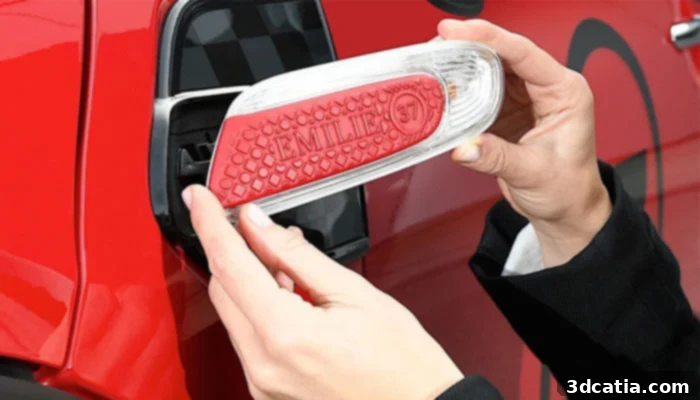
Thanks to the flexibility of 3D printing, MINI vehicles can be personalized by clients, allowing for unique interior and exterior details tailored to individual tastes.
More broadly, virtually every major player in the automotive market is strategically investing in 3D printing technologies to advance into the production of more complex, high-performance parts. Kevin Quinn, Director of Additive Design and Manufacturing at General Motors, offers a pragmatic perspective on this strategic adoption: “On average, there are 30,000 parts in every vehicle. We’re not looking to print all 30,000 pieces. Instead, we’re being very realistic. We’re focused on production opportunities where we can provide a business value for GM and for the customer.” This statement encapsulates the mature approach of the industry: identifying specific applications where AM delivers clear advantages, whether in cost reduction, performance enhancement, supply chain resilience, or unique customization. The focus is on strategic implementation rather than wholesale replacement of traditional manufacturing.
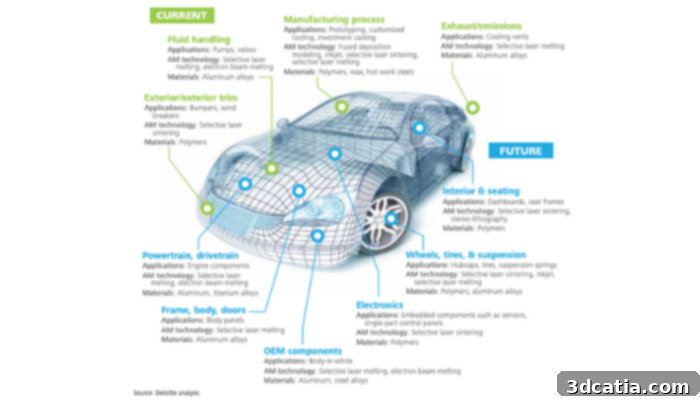
This figure, adapted from Deloitte’s study, illustrates the spectrum of current and future additive manufacturing applications in the automotive industry, from prototyping to full-scale production and personalized components. | Figure via Deloitte Analysis
In conclusion, additive manufacturing has evolved significantly beyond its initial role as a rapid prototyping tool in the automotive sector. While still enhancing overall manufacturing capabilities and contributing to cost reductions, OEMs are increasingly leveraging AM to create entirely new product possibilities and drive profound transformations within their supply chains. The journey from niche prototyping to integrated production of high-performance, lightweight, and customizable end-use parts is well underway, promising a future of more innovative, efficient, and personalized vehicles.
What are your thoughts on the evolving role of additive manufacturing in the automotive sector? We invite you to share your insights in a comment below or connect with us on our LinkedIn, Facebook, and Twitter pages! Don’t forget to sign up for our free weekly Newsletter here to receive the latest 3D printing news straight to your inbox! You can also find all our videos on our YouTube channel.