
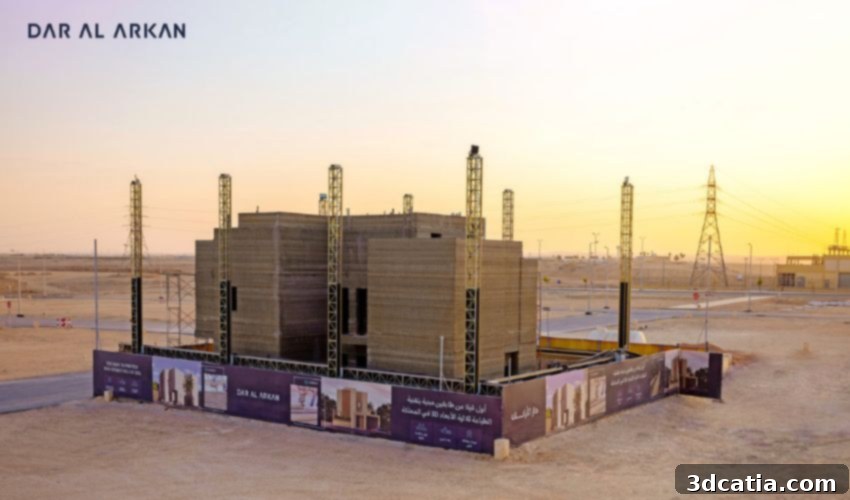
Saudi Arabia Unveils World’s Tallest 3D Printed Building by COBOD and Dar Al Arkan: A Milestone in Construction
The year has proven to be extraordinarily dynamic for the realm of additive manufacturing in the construction sector. From groundbreaking Zero Net Energy buildings to innovative 3D printed schools and even expansive holiday parks, the global building industry is increasingly recognizing the pivotal and transformative role of 3D printing technology. This innovative approach to construction is rapidly gaining traction worldwide, offering unprecedented flexibility, speed, and sustainability. Amidst this surge of innovation, COBOD, a leading name synonymous with its robust BOD2 construction 3D printer, has once again made headlines. Renowned for its involvement in numerous high-profile projects worldwide, COBOD, in collaboration with Dar Al Arkan, a prominent real estate developer based in Riyadh, has officially unveiled what they proudly claim to be the world’s tallest 3D printed building. This monumental three-story structure is strategically located in Saudi Arabia, marking a significant achievement not only for the companies involved but for the entire additive construction industry, setting a new benchmark for what is achievable with digital fabrication.
The escalating popularity of 3D printing in construction is not without strong justification. While acknowledging certain inherent challenges, such as navigating complex building regulations and ensuring widespread accessibility to the technology, 3D printed construction is rapidly emerging as a powerful, viable solution to the pressing global housing crisis. Its core advantages lie in its remarkable speed of execution, significantly reduced construction timelines, and substantial cost-saving potential when compared to traditional building methods. Beyond these tangible benefits, the technology also offers unparalleled design freedom, allowing for complex geometries and customizable structures that would be cost-prohibitive with conventional techniques. In this particular instance, the impressive three-story 3D printed building is situated within Shams Al Riyadh, an ambitious and expansive development project spanning approximately 12 million square meters of prime land. This project is a crucial component of Saudi Vision 2030, a comprehensive strategic framework designed to diversify the Kingdom’s economy and develop key public service sectors, including health, education, infrastructure, recreation, and tourism. The integration of cutting-edge construction technologies like 3D printing is central to achieving the ambitious goals set forth by this national vision, paving the way for a modern, sustainable, and diversified future for Saudi Arabia, emphasizing innovation and efficiency.
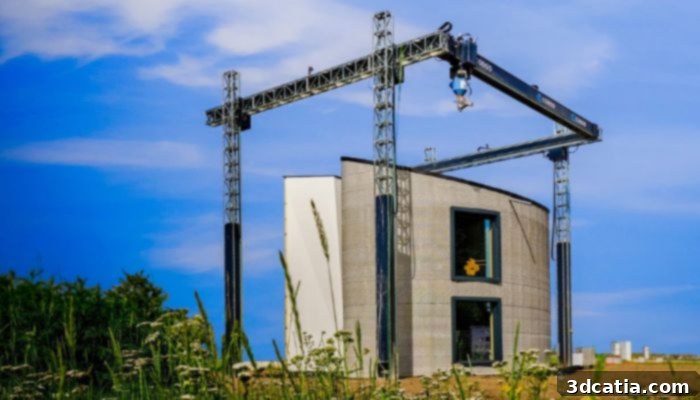
The BOD2 printer from COBOD has already been used in a number of different projects (photo credits: COBOD)
Wael Al Hagen, the astute 3D construction manager from Dar Al Arkan, provided further insight into the strategic rationale behind this pioneering venture. He articulated, “Our efforts are profoundly focused on advancing the Kingdom’s real estate sector by seamlessly integrating the latest trends and state-of-the-art technologies. We draw extensively from global best practices to elevate our industry locally and, crucially, to deliver on the multifaceted objectives of Vision 2030. The strategic introduction of 3D construction printing empowers us to achieve greater flexibility in design, significantly strengthen overall productivity, and realize substantial improvements in cost efficiency across our projects.” This statement underscores Dar Al Arkan’s unwavering commitment to embracing innovation as a cornerstone of its development strategy. It highlights how digital construction technologies are instrumental in shaping the future landscape of urban development in Saudi Arabia, promising not just faster builds but also more sustainable and architecturally diverse structures. The adoption of sustainable building practices through advanced 3D printing is a testament to their forward-thinking approach, aiming to create communities that are both economically viable and environmentally responsible, directly contributing to the Kingdom’s long-term sustainability goals.
Unveiling the World’s Tallest 3D Printed Building: A New Benchmark in On-Site Construction
Standing proudly at three stories tall and reaching an impressive height of 9.9 meters, this structure transcends the mere title of the world’s tallest 3D printed building. What truly sets it apart and solidifies its place in history is its distinction as the tallest on-site 3D printed building globally. This subtle yet significant difference highlights a critical advantage of COBOD’s revolutionary BOD2 printer. Unlike many other projects where building components are individually 3D printed off-site in controlled factory environments and then meticulously transported and assembled, COBOD’s technology facilitates direct, continuous printing right at the construction location. This on-site capability drastically streamlines logistics, virtually eliminates transportation costs and associated carbon footprints, and offers unparalleled design freedom and adaptability during the entire building process. Builders can react to site-specific conditions and even adapt designs in real-time, providing flexibility not possible with prefabrication. This groundbreaking achievement by COBOD and Dar Al Arkan now officially displaces the previous record holder for the tallest on-site 3D printed building: a three-story structure located in Germany, also constructed using COBOD’s advanced technology by Peri. The new record in Saudi Arabia not only showcases the continuous evolution and scaling capabilities of large-scale 3D printing but also firmly cements COBOD’s position at the undisputed forefront of this rapidly advancing field of 3D printed architecture.
Innovative Materials and Cost-Efficiency: The D.fab Solution Driving Sustainable Building
A cornerstone of this project’s success and its remarkable cost-effectiveness lies in the intelligent utilization of low-cost, locally sourced materials to create the specialized concrete mixture. This was made possible through the innovative D.fab solution, a collaborative development between global building materials leader Cemex and COBOD. The D.fab solution is a game-changer for sustainable construction, empowering users to source an astonishing 99% of concrete materials locally. This capability translates into numerous benefits: it dramatically cuts down on material transportation costs, which are a major expense in traditional construction; it robustly supports local economies by utilizing regional suppliers and resources; and it significantly reduces the environmental impact associated with long-distance material logistics, lowering the overall carbon footprint of the project. Furthermore, the economic advantage is stark: less than €10,000 was invested in the building supplies themselves for this expansive 345 m² home. This demonstrates the immense potential of cost-effective construction through advanced sustainable practices, making high-quality, durable housing more accessible and affordable for a wider population. The building’s design thoughtfully maximizes its living space across its three floors. The ground floor warmly welcomes residents and visitors alike with a spacious hall and several versatile living areas, perfect for family gatherings or entertaining guests. The second floor is dedicated to comfort and privacy, featuring three well-appointed bedrooms, two modern bathrooms, an additional living room, and a serene balcony offering views. The uppermost floor, often referred to as a “roof annex” in Saudi Arabia due to its slightly smaller footprint compared to the lower levels, efficiently houses practical amenities like a maid’s room, a flexible multipurpose hall suitable for various uses, and a convenient laundry room, showcasing smart space utilization tailored to local lifestyle needs and cultural requirements.
The Future of 3D Printed Homes: Energy Efficiency, Rapid Deployment, and Scalability
Building on the resounding success of this pioneering project, Dar Al Arkan has ambitious plans for the future. The company is not only looking to replicate this success but also to enhance it further, integrating even more advanced features into their next-generation 3D printed homes. Wael Al Hagen confidently concluded on their next steps, stating:
“We are currently building the second villa, which will typically take a month to complete, but we’ve already finished the first floor of 130 m2 in only eight days. This 3D printed villa has additional insulation layers and features that ensure energy conservation, saving up to 30% in energy consumption. We urge all industry experts to visit us and view the first completed villa and the second under construction for themselves.”
This next project highlights Dar Al Arkan’s unwavering commitment to continuous improvement and innovation within residential 3D printing. The emphasis on advanced insulation layers and energy conservation features addresses a critical aspect of modern, sustainable living, promising significant reductions in energy consumption – up to 30% – for future residents. Such features are not merely about comfort but also about long-term financial savings and greater environmental stewardship, aligning perfectly with global sustainability targets. The rapid construction timeline, with the first floor of the second villa completed in an astonishing eight days, further exemplifies the profound efficiency gains offered by COBOD’s BOD2 printer technology. This pace is unparalleled in traditional construction and positions 3D printing as a scalable, vital solution for addressing high-demand housing needs and rapid urban development. The open invitation to industry experts underscores the transparency and confidence in the technology’s capabilities, actively fostering collaboration and further innovation in the broader construction innovation landscape. The vision for future developments clearly points towards more energy-efficient, rapidly deployable, customizable, and ultimately affordable homes, fundamentally redefining what is possible in the real estate sector and contributing to a more sustainable built environment for everyone.
For more in-depth information and technical details, you can access COBOD’s official press release HERE. What are your thoughts on this groundbreaking achievement in 3D printed architecture and its implications for global construction? We invite you to share your valuable insights and comments below, or engage with us on our vibrant social media platforms: LinkedIn,Facebook, andTwitter pages! Don’t miss out on the latest advancements, innovations, and breaking news in the world of 3D printing – sign up for our free weeklyNewsletter here to receive comprehensive updates directly to your inbox! Additionally, explore our extensive library of insightful videos on ourYouTube channel for visual demonstrations and further compelling content on additive manufacturing.