
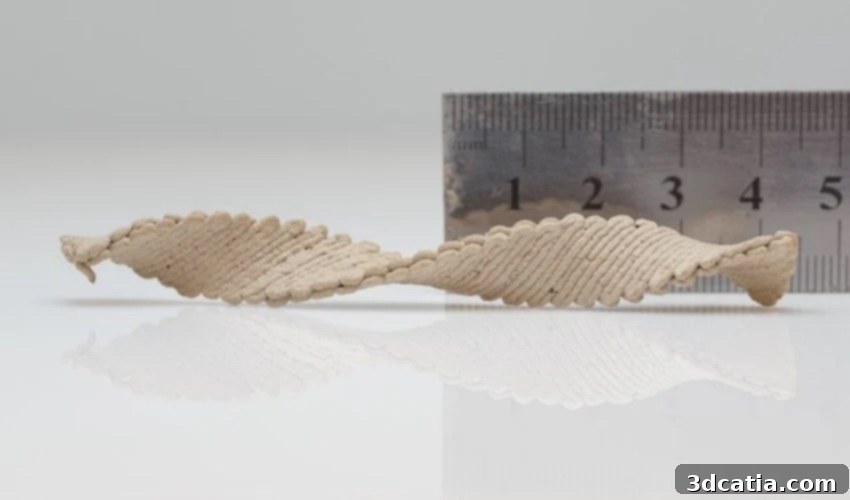
Revolutionizing Manufacturing: The Transformative Power of Self-Shaping 3D Printed Wood
The landscape of manufacturing is undergoing a profound transformation, with 3D printing emerging as a pivotal technology for producing everything from intricate furniture designs to complex structural components for buildings. This additive manufacturing method continues to evolve at an astonishing pace, driven by relentless innovation in materials science and engineering. Among the most exciting recent breakthroughs is the development of a novel 3D printing technique that harnesses the natural properties of wood, allowing printed objects to transform their shape autonomously after production. This groundbreaking research, pioneered by scientists at The Hebrew University of Jerusalem in Israel, introduces a unique “wood ink” that enables parts to undergo self-shaping processes once their moisture content is fully removed. Unveiled at the American Chemical Society Fall event, held from August 21st to 25th, this ingenious wood-based ink holds immense potential to redefine product design, manufacturing processes, and our interaction with materials, promising to usher in an era of truly dynamic and sustainable creations.
At the heart of this innovation lies a deep understanding of wood’s inherent characteristics. Wood, a marvel of natural engineering, is composed of a complex arrangement of cells and fibers. This intricate internal structure grants it a remarkable property: hygroscopy. Simply put, wood naturally changes its shape and volume in response to fluctuations in moisture content. When wood dries, it contracts, and this contraction is not uniform across all directions due to the anisotropic arrangement of its cellulose fibers. Leveraging this fundamental characteristic, the researchers embarked on a mission to control this natural phenomenon to achieve predetermined shapes. Their success is vividly demonstrated by the creation of a bowl, approximately one meter in diameter, which self-assembled from a flat, 3D printed sheet. The ingenious design involved printing the wood ink in a specific circular pattern, meticulously orchestrating the orientation of the wood particles. As the printed piece dried, the carefully aligned fibers contracted differentially, causing the ends of the circular print to rise and spontaneously form the desired three-dimensional bowl shape. Eran Sharon, a leading member of the research team, articulated the philosophical underpinning of their work, stating, “We wanted to go back to the origin of this concept, to nature, and do it with wood.” This statement encapsulates their commitment to biomimicry and sustainable innovation, using nature’s own mechanisms as a blueprint for advanced manufacturing.
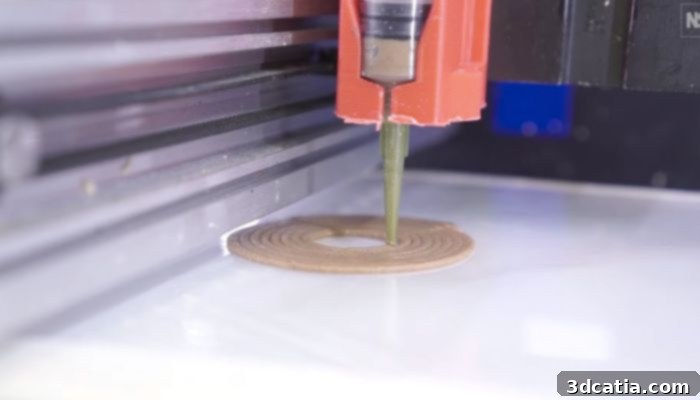
The printing process of the bowl (photo credits: New Scientist)
Why Combine 3D Printing and Wood? Answering the Call for Sustainability
The decision to integrate 3D printing with wood was driven by a powerful confluence of innovation and sustainability. Traditional woodworking often generates significant waste, and the production of many synthetic 3D printing materials raises environmental concerns. The Hebrew University team sought to address these issues head-on. To formulate their revolutionary wood ink, they adopted an environmentally conscious approach by utilizing wood waste, specifically microparticles referred to as “wood flour,” salvaged from other projects. This commitment to recycling and resource efficiency is a cornerstone of their research. Beyond wood flour, the ink composition includes cellulose nanocrystals and xyloglucan, which are naturally occurring binders derived from plants. This carefully selected combination results in an entirely eco-friendly, water-based ink, free from harsh chemicals often found in industrial resins. Once the optimal composition was achieved, the next critical step involved determining the precise printing parameters necessary for this unique application. Through extensive experimentation and iterative testing, the researchers discovered that both the printing speed and the orientation of the 3D printed strips were paramount. These parameters directly influenced how the anisotropic wood particles would align within the printed structure, and consequently, how the entire piece would behave and transform when subjected to drying. The ability to precisely control these factors is what allows for the predictable and desired self-shaping outcomes, opening up unprecedented design possibilities.
The immediate applications of this self-shaping wood technology are already becoming apparent. Several functional pieces, including various kitchen utensils and innovative furniture prototypes, have been successfully designed and fabricated using this method. These early creations serve as compelling proof-of-concept, demonstrating the viability and versatility of the process. However, the ambitions of the scientists extend far beyond these initial successes. Their ongoing research delves into the fascinating realm of responsive materials. The team is actively working to prove that by manipulating specific printing parameters and environmental conditions, it is possible to not only induce an initial shape change but also to re-shape the wood multiple times. This capability would elevate the material from a passive, self-forming object to an active, “smart” material. Eran Sharon envisions a future where objects could dynamically adapt to their environment, concluding: “We hope to show that under some conditions we can make these elements responsive — to humidity, for example — when we want to change the shape of an object again.” This vision hints at a new generation of products that can alter their form in response to environmental cues, offering unparalleled flexibility and functionality. The potential implications for adaptive furniture, smart packaging, and even self-deploying structures are immense, promising a future where materials are not static but fluid and intelligent. For those interested in delving deeper into the specifics of this groundbreaking research, additional information can be found in the official press release HERE.
The Science Behind Self-Shaping: How Wood’s Anisotropy is Harnessed
To fully appreciate the ingenuity of this 3D printing method, it’s essential to understand the underlying science of wood’s behavior. Wood is an anisotropic material, meaning its properties vary depending on the direction. This is primarily due to the parallel alignment of cellulose fibers within the wood structure. When wood absorbs or loses moisture, it swells or shrinks, respectively. Crucially, this dimensional change is not uniform; it’s much more pronounced across the grain (tangential and radial directions) than along the grain (longitudinal direction). The Hebrew University researchers have masterfully exploited this natural tendency. By precisely controlling the orientation of the wood microparticles during the 3D printing process, they can essentially “program” how the material will contract when dried. Imagine laying down strips of wood paste, each with its microscopic fibers aligned in a specific direction. As the solvent (water) evaporates, these fibers pull in different directions with varying strengths, creating internal stresses that force the material into a predetermined, complex 3D shape. This is a form of self-assembly, where the material itself does the work of shaping, guided by the initial digital design and printing parameters. This concept is revolutionary for additive manufacturing, moving beyond simply building layer by layer to creating materials that perform a transformative action post-production.
Sustainability and the Circular Economy in Focus
The environmental advantages of this 3D printed wood extend beyond just utilizing waste materials. By employing a water-based ink and natural binders like cellulose nanocrystals and xyloglucan, the entire process is inherently less toxic and more biodegradable than many conventional 3D printing methods that rely on petroleum-based polymers or synthetic resins. The reduction of wood waste by transforming it into a valuable raw material for additive manufacturing contributes significantly to the circular economy. Instead of being discarded, sawdust and wood scraps are given a new life, diverting them from landfills and reducing the demand for virgin timber. Furthermore, the ability to print objects that can self-shape or even re-shape offers potential benefits in logistics and packaging. Imagine furniture components or architectural elements that can be printed flat, shipped compactly, and then allowed to self-assemble or transform on-site simply by drying or exposure to humidity. This could drastically reduce shipping volumes and associated carbon emissions, making the entire product lifecycle more sustainable. This blend of cutting-edge technology with traditional, renewable resources positions this innovation at the forefront of sustainable manufacturing, offering a blueprint for future eco-friendly industrial practices.
Future Horizons: Adaptive Architecture and Smart Materials
The potential applications for self-shaping and responsive 3D printed wood are vast and truly exciting. Beyond customizable furniture and kitchenware, this technology could pave the way for adaptive architecture. Imagine building components that can subtly change their form in response to environmental conditions, such as humidity or temperature, to optimize insulation or ventilation. This could lead to more energy-efficient and comfortable living spaces. In the realm of smart materials, the researchers’ goal of creating “responsive” elements opens up possibilities for bio-inspired robotics, soft robotics, and advanced sensors. Objects could be programmed to perform specific tasks or movements based on environmental stimuli, blurring the lines between passive materials and active systems. The ability to induce shape changes on demand through humidity could lead to novel humidity sensors, self-adjusting fixtures, or even smart textiles incorporating wood fibers. This research bridges traditional material science with advanced digital fabrication, pushing the boundaries of what is possible with natural, renewable resources. It signifies a shift towards materials that are not merely fabricated but are imbued with a form of intelligence, capable of interacting and adapting to their surroundings. The elegance of utilizing wood’s inherent properties, coupled with the precision of 3D printing, positions this innovation as a critical step toward a future where our manufactured world is more sustainable, adaptable, and integrated with natural processes.
In conclusion, the work by The Hebrew University of Jerusalem represents a monumental leap forward in the field of additive manufacturing and sustainable material science. By cleverly harnessing the natural hygroscopic and anisotropic properties of wood, they have developed a method to 3D print objects that self-shape upon drying, offering unprecedented design freedom and functional capabilities. This innovative approach, utilizing wood waste and natural binders, underscores a strong commitment to environmental responsibility and the principles of a circular economy. From customizable home goods to the ambitious vision of adaptive architectural elements and responsive smart materials, the transformative power of self-shaping 3D printed wood promises to revolutionize how we conceive, design, and interact with the physical world. It is a testament to the fact that sometimes, the most advanced solutions can be found by looking back to nature, empowered by cutting-edge technology.
What do you think of the self-shaping 3D printed wood from The Hebrew University of Jerusalem? We’d love to hear your thoughts and predictions for its impact! Let us know in a comment below or join the conversation on ourLinkedIn,Facebook, andTwitter pages! Don’t forget to sign up for our free weeklyNewsletter here, to receive the latest 3D printing news straight to your inbox! You can also find all our videos and more fascinating insights on ourYouTube channel.
*Cover Photo Credits: The Hebrew University of Jerusalem