
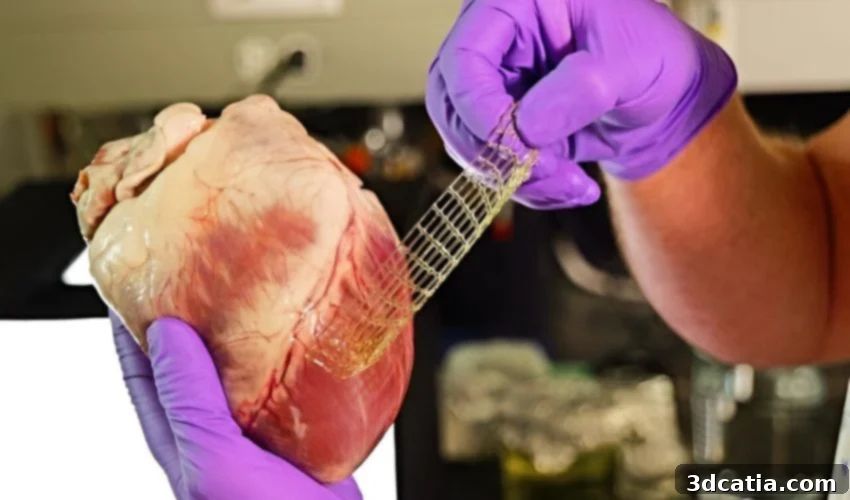
Revolutionizing Cardiac Care: How a New 3D Printed ‘Band-Aid’ Offers Hope for Heart Repair
The human heart, a marvel of biological engineering, is also remarkably vulnerable. Whether succumbing to the ravages of a heart attack, the chronic complications of diseases like diabetes, the destructive effects of smoking or drug abuse, or the immediate trauma of an accident, damage to this vital organ rarely heals effectively on its own. Such injuries often necessitate complex surgical interventions, invasive procedures designed to prolong life, but which come with their own set of risks and recovery challenges. But what if the future of cardiac repair lay not in traditional surgery, but in the ingenious application of artificial tissues? A groundbreaking collaboration between a team from the University of Colorado Boulder (CU Boulder) and the University of Pennsylvania has unveiled a revolutionary approach: a new method to 3D print a material that possesses both exceptional elasticity and robust toughness. This unique combination makes it perfectly suited to withstand the constant, dynamic beating of the heart, leading to the development of what researchers are calling a 3D printed ‘band-aid’ for the heart. This innovation has the potential to fundamentally transform how medical professionals approach the replacement and repair of human body parts, especially within the delicate realm of cardiology.
One of the most formidable challenges in developing biomaterials for cardiac applications is the paradoxical requirement for a material that is simultaneously strong and highly stretchy, all while being infinitely customizable in shape and size to suit the unique anatomy of each patient. This particular demand stems directly from the very nature of the heart itself: an organ in perpetual motion, contracting and expanding approximately 100,000 times a day. Such constant, vigorous movement renders traditional, rigid plastic implants utterly impractical and even dangerous. A stiff material, unable to flex and adapt with the rhythmic pulsations of the heart, would inevitably lead to fracturing, tearing, or even detachment, causing further damage to an already compromised organ. This inherent biological constraint means that many conventional biomedical devices and implants, typically fabricated using methods like injection molding or casting, are simply not viable for direct integration with cardiac tissue. When considering that heart damage is not only profoundly life-threatening but also largely beyond the body’s natural regenerative capabilities, the emergence of this innovative material – envisioned as a 3D printed ‘band-aid’ for the heart – heralds a truly transformative era for cardiac patient care. It represents a potential paradigm shift, moving beyond mere damage control to offering genuine restoration.
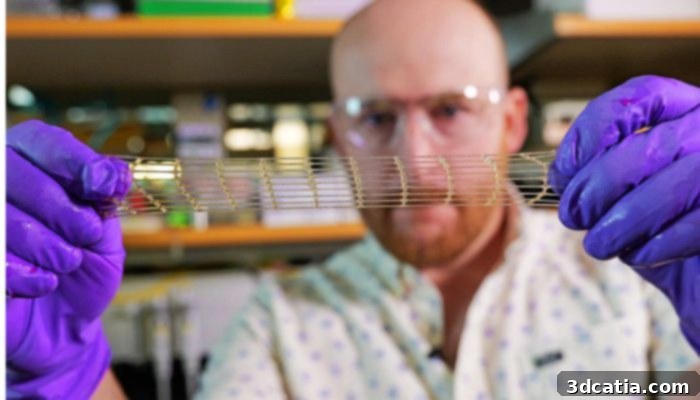
The stretchy material can be used as a 3D printed ‘band-aid’ for a heart
Dr. Jason Burdick, a senior author of the research and a distinguished professor of chemical and biological engineering at CU Boulder’s BioFrontiers Institute, succinctly articulates the critical need for such advancements. He emphasizes the inherent limitations of certain tissues: “Cardiac and cartilage tissues are similar in that they have very limited capacity to repair themselves. When they’re damaged, there is no turning back.” This stark reality underscores the urgency of finding external solutions. Dr. Burdick continues, highlighting the immense potential of their work: “By developing new, more resilient materials to enhance that repair process, we can have a big impact on patients.” His words resonate deeply, pointing towards a future where irreversible tissue damage might no longer signify an end to hope, but rather a new beginning made possible by cutting-edge material science and additive manufacturing.
Pioneering the Future: Crafting a 3D Printed ‘Band-Aid’ for the Heart
The creation of this revolutionary 3D printed heart ‘band-aid’ required the development of an entirely novel 3D printing methodology. The researchers ingeniously devised a process they named CLEAR, an acronym standing for Continuous-curing after Light Exposure Aided by Redox initiation. This innovative approach draws its fundamental inspiration from a surprisingly simple yet profound biological phenomenon: the intricate way worms tangle and untangle themselves to form ‘worm blobs.’ These peculiar formations exhibit fascinating properties, oscillating between solid-like and liquid-like states due to the dynamic interplay of individual worms. The researchers observed that by incorporating similarly intertwined chains of molecules within their hydrogel materials, they could significantly enhance their toughness and resilience. This biomimetic strategy proved crucial in overcoming the inherent weaknesses of traditional hydrogels.
The Science Behind CLEAR: Hydrogels Reimagined for Biomedical Use
At the core of this innovation are hydrogels, materials that have long been favored in the development of artificial tissues, organs, and implants due to their high water content and biocompatibility, mimicking natural biological environments. However, traditional hydrogels, particularly when processed through conventional 3D printing techniques, have presented significant limitations. They often suffer from brittleness, tending to break easily when subjected to mechanical stress, or crack under pressure, rendering them too stiff and fragile for dynamic applications like integration with a beating heart. The CLEAR method fundamentally transforms these limitations. By employing their proprietary 3D printing process, the researchers were able to fabricate hydrogel-based materials that exhibited exponentially greater toughness compared to those printed with conventional techniques such as DLP (Digital Light Processing). This leap in mechanical strength was rigorously validated through extensive testing, where the materials were subjected to significant stretching and weight loading. The results were conclusive: the CLEAR-printed materials demonstrated unparalleled durability while maintaining their essential flexibility.
Beyond sheer toughness, another critical breakthrough achieved with this material is its remarkable ability to conform and adhere seamlessly to animal tissues and organs. This characteristic signifies a world first: the successful development of 3D printed adhesive materials that are sufficiently strong to mechanically support living tissue. This is a monumental achievement in biomedical engineering, as it opens up unprecedented avenues for direct, durable repair and integration of artificial structures within the body without compromising natural physiological functions. The capacity for both robust mechanical support and biocompatible adhesion makes these materials uniquely suitable for a wide array of demanding clinical applications.
Transformative Applications Across Medicine and Beyond
The versatility of these advanced 3D printed materials, developed using the CLEAR method, extends far beyond their initial conception as a cardiac ‘band-aid.’ The potential applications span a broad spectrum of medical fields, promising to address numerous critical unmet needs. For instance, in cardiology, these materials could be precisely tailored to repair specific defects in hearts, offering a less invasive and potentially more effective alternative to complex open-heart surgeries. Furthermore, their unique properties make them ideal candidates for delivering tissue-regenerating drugs directly to damaged organs or cartilage, facilitating localized treatment and promoting natural healing processes with greater efficiency and fewer systemic side effects. The materials also hold promise for orthopedics, particularly in restraining bulging or herniated discs, providing mechanical support without the rigidity that can exacerbate spinal issues. In the operating room, this innovative material could even revolutionize surgical stitching, allowing surgeons to close wounds with greater precision and minimal tissue damage, potentially leading to faster healing times and reduced scarring for patients. Beyond the immediate medical realm, the potential impact of this technology is equally compelling. Although further research and development are naturally required, the new CLEAR method, which notably does not necessitate curing – a common and often energy-intensive post-processing step in many 3D printing techniques – offers significant environmental advantages. This makes it a more sustainable and appealing option for a diverse range of industrial applications, paving the way for innovations in fields yet to be fully explored.
Abhishek Dhand, a pivotal first author and researcher within the Burdick Lab, encapsulates the profound significance and accessibility of this new technology: “This is a simple 3D processing method that people could ultimately use in their own academic labs as well as in industry to improve the mechanical properties of materials for a wide variety of applications. It solves a big problem for 3D printing.” His statement underscores not only the impactful nature of the breakthrough but also its potential for widespread adoption, democratizing advanced material fabrication for both research and commercial endeavors. This innovation addresses a long-standing challenge in additive manufacturing, pushing the boundaries of what is possible with 3D printed materials. For those eager to delve deeper into this exciting development, comprehensive details are available in the official press release from the University of Colorado Boulder, which can be accessed HERE. Additionally, the full scientific paper, offering an in-depth exploration of the research, methodologies, and findings, is published and can be found HERE.
What are your thoughts on this innovative 3D printed ‘band-aid’ for the heart and its broader implications for medical science? We invite you to share your perspectives and comments below, or engage with us on our vibrant social media platforms. Connect with us on LinkedIn, Facebook, and Twitter to join the conversation! Don’t miss out on the latest advancements and breaking news in the world of 3D printing; make sure to sign up for our free weekly newsletter here, delivered directly to your inbox. For a visual dive into the most recent innovations, you can also explore all our insightful videos on our dedicated YouTube channel.
*All Photo Credits: Casey Cass/CU Boulder