
Relativity Space Secures $140M Funding to Accelerate 3D Printed Rocket Development and Commercial Space Launch
In a significant boost to its ambitious mission, Relativity Space, an innovative American startup at the forefront of aerospace manufacturing, has successfully closed a Series C funding round, securing an impressive $140 million. This substantial investment elevates the company’s total capital raised to $185 million since its inception in 2015, marking a pivotal moment in its journey. The fresh influx of capital is strategically earmarked to finalize the development of its groundbreaking Terran 1 rocket, an orbital-class launch vehicle primarily constructed through advanced 3D printing technologies. With this funding, Relativity Space is set to push towards the commercialization of its launch services, with initial operational flights projected for 2021. The latest funding round attracted a diverse group of high-profile investors, including renowned individuals such as Michael Ovitz, former president of Disney, and multifaceted artist and entrepreneur Jared Leto, underscoring the broad confidence in Relativity’s disruptive potential.
The Dawn of 3D Printed Rockets: Relativity Space’s Vision for Space
The potential of 3D printing, or additive manufacturing, extends far beyond conventional terrestrial applications, reaching into the vast expanse of space. Relativity Space was founded on this very premise, carving out a unique niche within the highly competitive aerospace industry. Their bold vision centers on radically transforming the manufacturing process for rockets by leveraging the power of advanced additive manufacturing. Traditional rocket production is notoriously complex, capital-intensive, and time-consuming, often involving thousands of individual parts, extensive tooling, and lengthy supply chains. Relativity Space aims to dismantle these barriers by pioneering a new paradigm: autonomous, software-driven rocket factories that can rapidly produce launch vehicles.
This innovative approach recognizes that 3D printing offers unparalleled advantages for aerospace applications, including the ability to create highly complex geometries in a single piece, significantly reducing part counts and potential failure points. Furthermore, it enables rapid design iteration and customization, allowing engineers to quickly test and refine rocket components. By embracing additive manufacturing, Relativity Space seeks to not only accelerate the production timeline but also dramatically lower the cost and increase the reliability of access to space. Their commitment to building rockets for an interplanetary future stems from the belief that manufacturing capabilities in space will be crucial for sustainable human expansion, beginning with the foundations laid on Earth.
Revolutionizing Manufacturing with Stargate
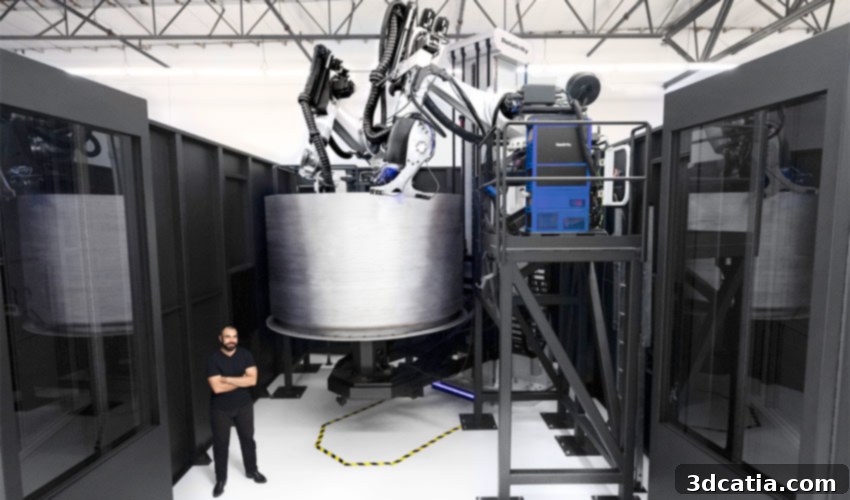
At the heart of this manufacturing revolution is Stargate, Relativity Space’s proprietary large-format metal 3D printer. This innovative system is designed to produce an unprecedented 95% of a rocket’s mass, including its Aeon 1 engines and major structural components, through additive processes. This extraordinarily high percentage of 3D-printed parts dramatically simplifies the supply chain, reduces labor, and significantly cuts down on the number of individual components typically required for rocket assembly. By integrating cutting-edge robotics, sophisticated software, and artificial intelligence, Stargate enables Relativity Space to print an entire rocket from raw materials to flight readiness in as little as 60 days. This accelerated production timeline represents a seismic shift from the months or even years typically required for traditional rocket manufacturing, promising greater agility and responsiveness to the burgeoning demand for space launch services for small satellites.
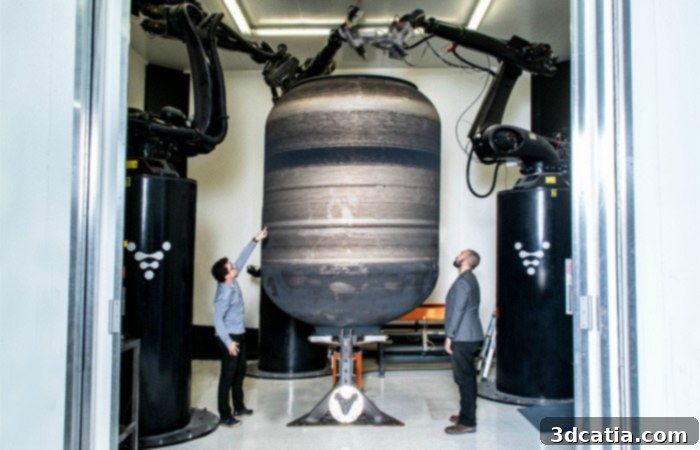
This investment should accelerate the development of the Terran 1 rocket | Credits: Relativity Space
Relativity Space Secures $140 Million in Landmark Series C Funding
The recently concluded Series C funding round, which brought in $140 million, is a critical enabler for Relativity Space to achieve its ambitious milestones. This capital infusion is precisely what the company needed to bring its flagship Terran 1 rocket to its inaugural flight. Jordan Noone, co-founder and Chief Technology Officer of Relativity Space, articulated the profound significance of this investment, stating that it provides “all the capital needed to achieve this ambitious goal” of a first orbital flight. Beyond funding the flight itself, the investment will support several key strategic initiatives designed to scale the company’s operations and infrastructure, laying the groundwork for sustained commercial success.
Part of the strategic allocation of this new funding includes the significant development of the company’s test facilities and production capabilities. Specifically, Relativity Space plans to expand its engine test site at the Stennis Space Center in Mississippi, which is crucial for the rigorous testing and qualification of its 3D-printed Aeon 1 engines. Furthermore, the company will develop Complex 16, a launch site located at Cape Canaveral Space Force Station in Florida, positioning it to conduct orbital launches from a historically significant aerospace location. Concurrently, the company’s headquarters and primary production facility in Los Angeles are slated for expansion, increasing their capacity to iterate on design, manufacture components, and assemble rockets at an accelerated pace. These expansions are vital to supporting the planned increase in production as commercial operations ramp up and demand for flexible launch options grows.
Terran 1: A New Era for Small Satellite Launches
At the core of Relativity Space’s offerings is the Terran 1 rocket, poised to disrupt the small satellite launch market. Designed to deliver payloads of up to 1,250 kg to low Earth orbit, Terran 1 stands out not just for its payload capacity but for its unique genesis. It is the world’s first entirely 3D printed orbital-class rocket, showcasing the profound capabilities of the Stargate system. This rapid prototyping and manufacturing capability means that design improvements can be implemented swiftly and efficiently. Indeed, customer feedback has already played a crucial role in enhancing the Terran 1’s capabilities and market appeal. Notably, the rocket has seen an upgrade to a 3-meter fairing, effectively doubling the volume of its payload capacity compared to the initial design. This enhancement directly addresses the evolving needs of satellite operators, allowing for larger, more complex constellations to be deployed, thereby expanding Terran 1’s market appeal and competitive edge.
Strategic Expansion and Growing Customer Base
Relativity Space has already garnered significant interest and secured contracts with a notable roster of early customers, signaling strong market validation for its innovative approach. These include established satellite operator Telesat, the small satellite aggregator Spacesight, and promising startups such as Momentus and mu Space. These partnerships are not merely transactional; they represent a collaborative effort to define the future of space launch, with customers directly influencing Terran 1’s design enhancements, as seen with the fairing upgrade. Following the successful closure of the Series C funding round, Jordan Noone expressed the company’s aggressive growth targets, stating their intent to significantly expand their customer base, aiming to double the current number of clients in the near term. This ambitious goal reflects confidence in their ability to deliver reliable, cost-effective, and rapidly deployable launch solutions.
Noone further emphasized the profound significance of the $140 million investment, particularly within the context of the highly capital-intensive space launcher industry. He noted, “This announcement really puts us in a good position for our first flight. The size of this investment is quite rare in the launcher industry, with the exception of SpaceX. We really take this as a strong validation of our investors’ confidence in the team and the rocket.” This comparison to SpaceX highlights the magnitude of trust and belief that investors have placed in Relativity Space’s vision, technology, and execution capabilities. It positions the company as a formidable challenger in the evolving commercial space sector, ready to capitalize on the increasing demand for flexible and rapid launch services, thereby opening up new possibilities for satellite deployment and space exploration.
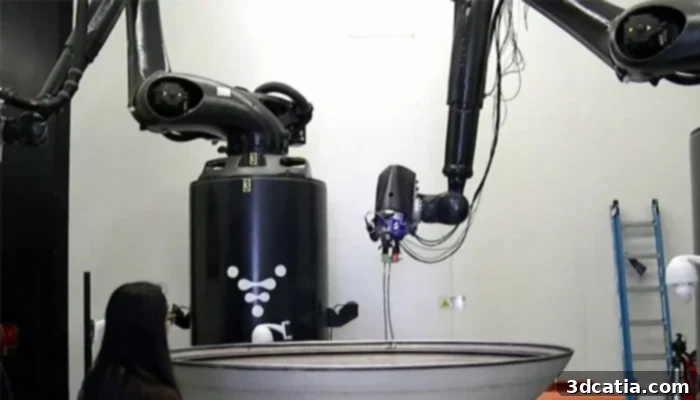
Credits: Relativity Space
The Future: From Earth to Mars with Additive Manufacturing
Beyond the immediate goal of commercializing Terran 1 and securing initial orbital flights, Relativity Space harbors an even grander vision: to 3D print humanity’s future on Mars. The technologies and processes being refined for Earth-based rocket production are conceived with extraterrestrial manufacturing in mind. Imagine autonomous factories on Mars, printing structures, tools, and even new rockets directly from local resources, dramatically reducing the logistics and cost of deep-space missions. This long-term aspiration drives the company’s innovation, pushing the boundaries of what’s possible with additive manufacturing and autonomous production. The journey of Terran 1 is not just about launching satellites from Earth; it’s a foundational step towards enabling multi-planetary life through revolutionary manufacturing capabilities that will one day extend across the solar system.
The aerospace world eagerly anticipates February 2021, when Relativity Space plans its inaugural orbital flight of the Terran 1 rocket. This event will not only be a test of engineering prowess but a profound testament to the transformative power of 3D printing in the space industry. As we await this historic launch, the ongoing developments at Relativity Space continue to demonstrate how innovation can accelerate access to space and unlock unprecedented opportunities for exploration and commercial ventures. For those keen to delve deeper into the pioneering work of this ambitious company, comprehensive information and further insights are available on the official Relativity Space website.
This monumental investment and the rapid advancements at Relativity Space undoubtedly mark a new chapter in commercial space exploration. What are your thoughts on the implications of 3D printed rockets for the future of space travel and industry? Share your perspectives in the comments section below, or join the conversation on our Facebook and Twitter pages. To stay informed about all the latest breakthroughs and news in the dynamic world of 3D printing and aerospace, be sure to sign up for our free weekly Newsletter, delivered directly to your inbox!